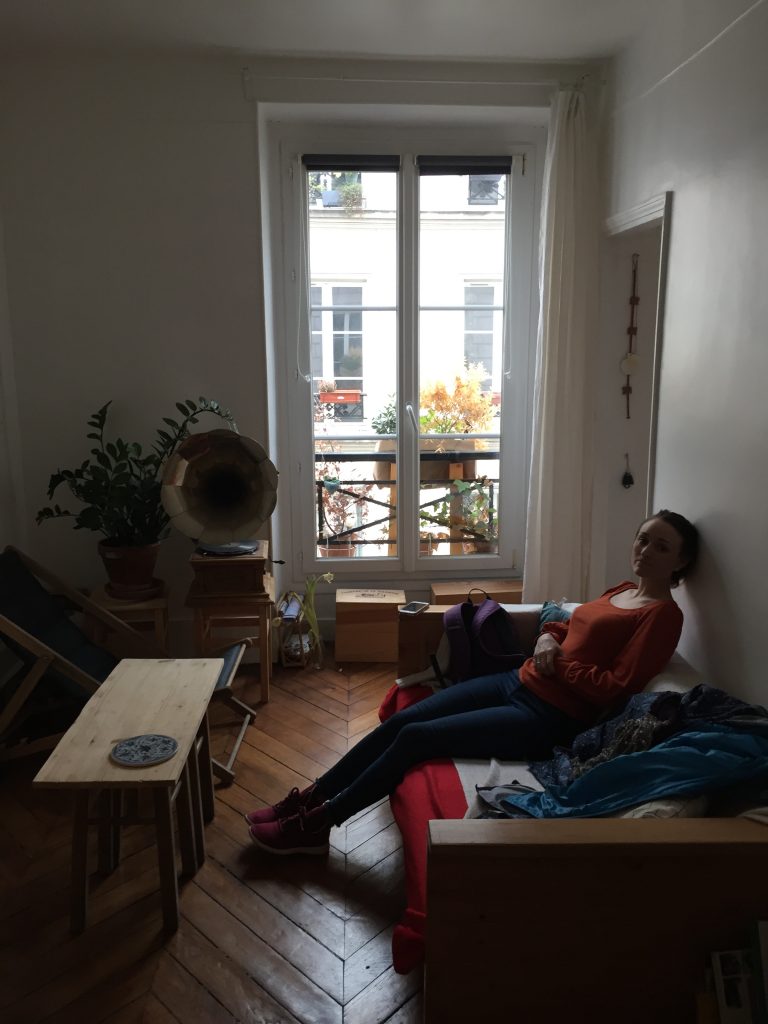
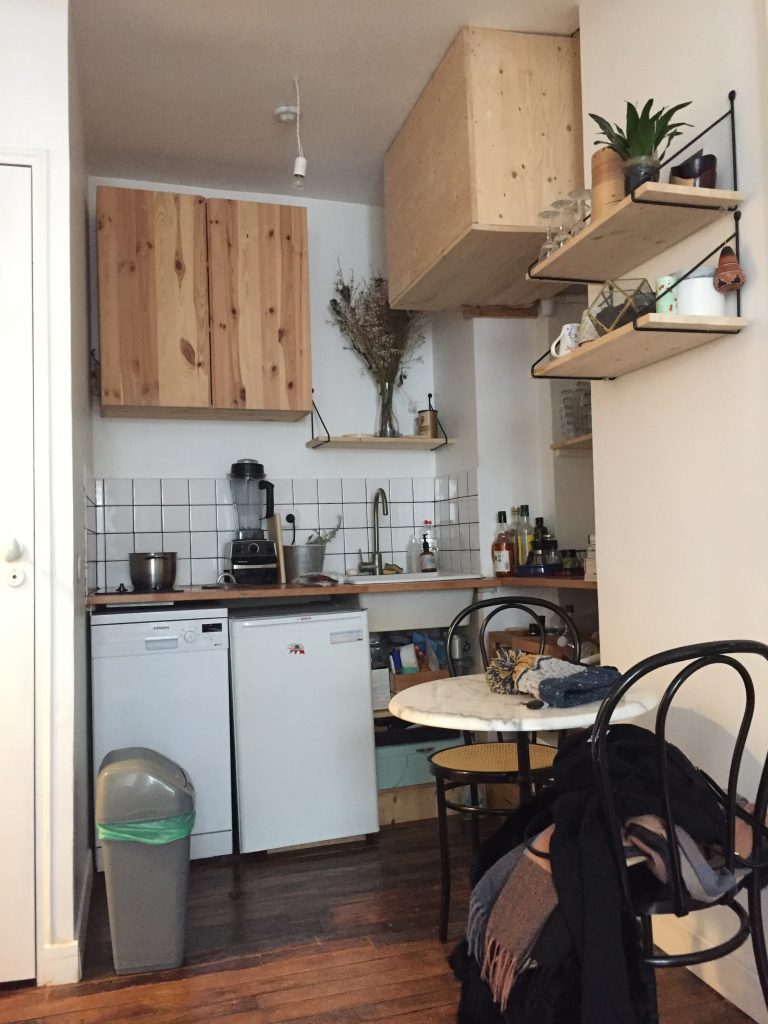
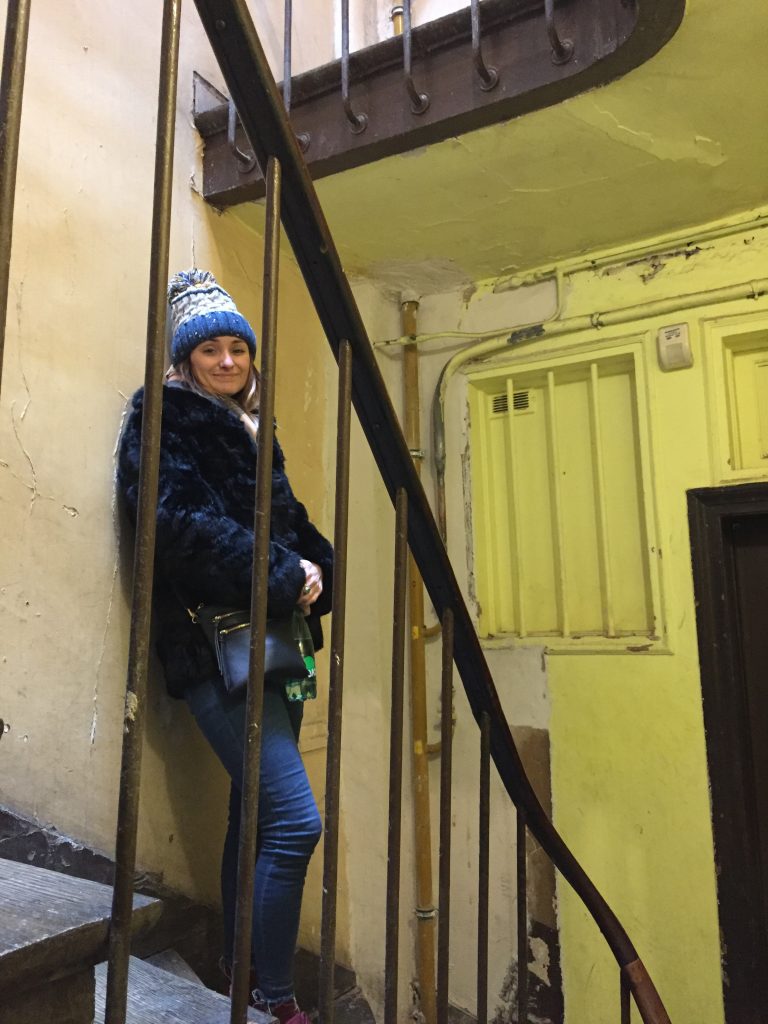
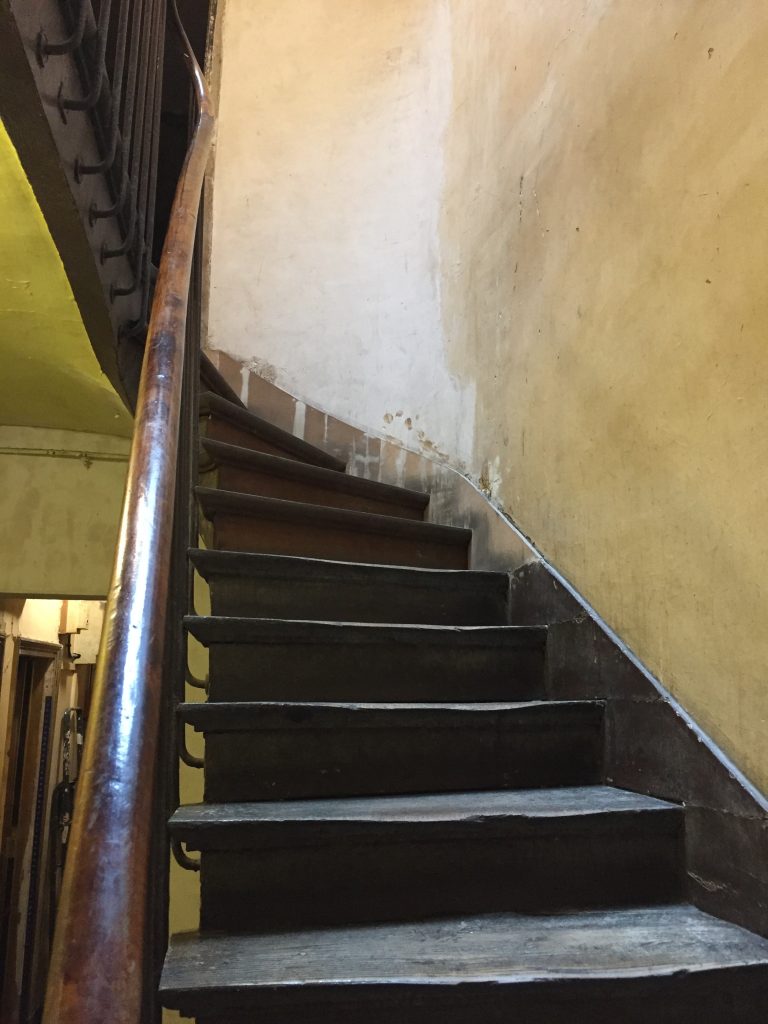
First order of the day was to take my bags over to my Airbnb and check out my new digs. It was only a 6 minute walk over there. My apartment was on the third floor and the well-worn wooden staircase inside the block reminded me of the place I stayed in Sicily. It was quite creepy, but the apartment was fine and gave me a good view of the igoings on in the apartments on the other side of the narrow street.
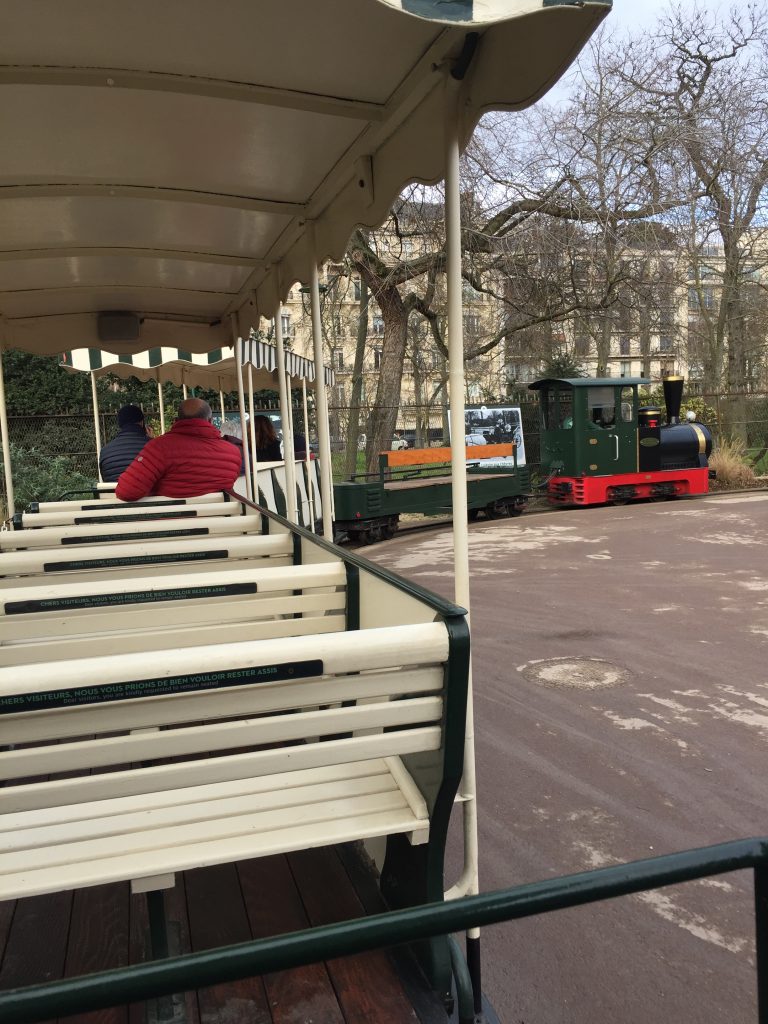
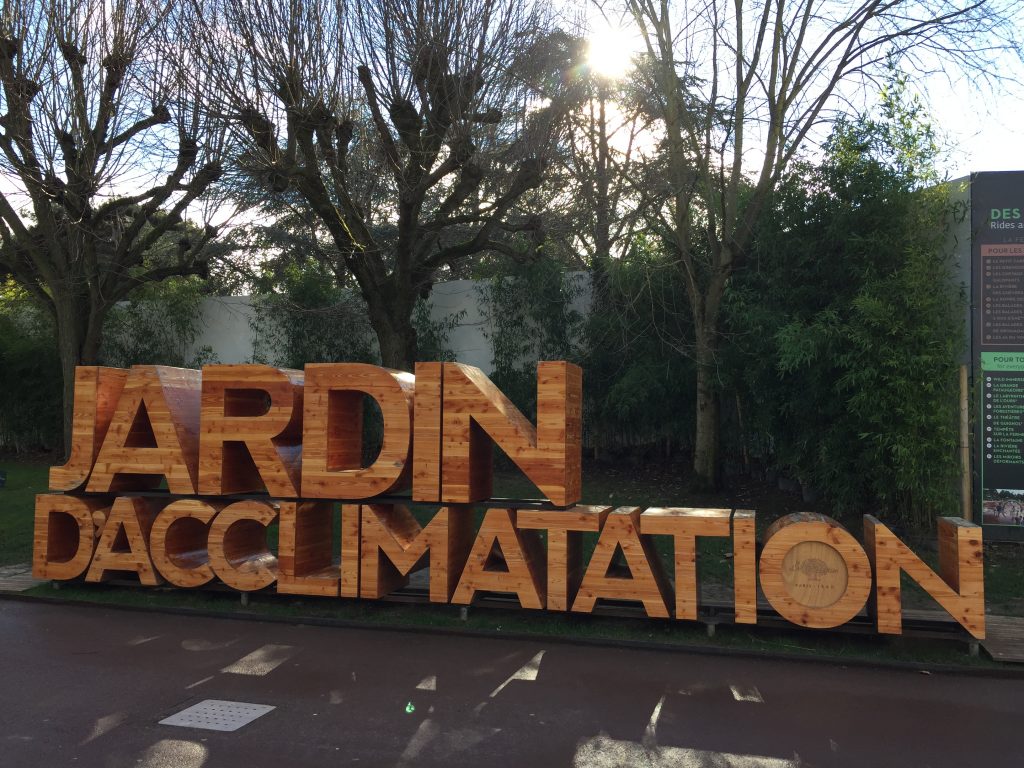
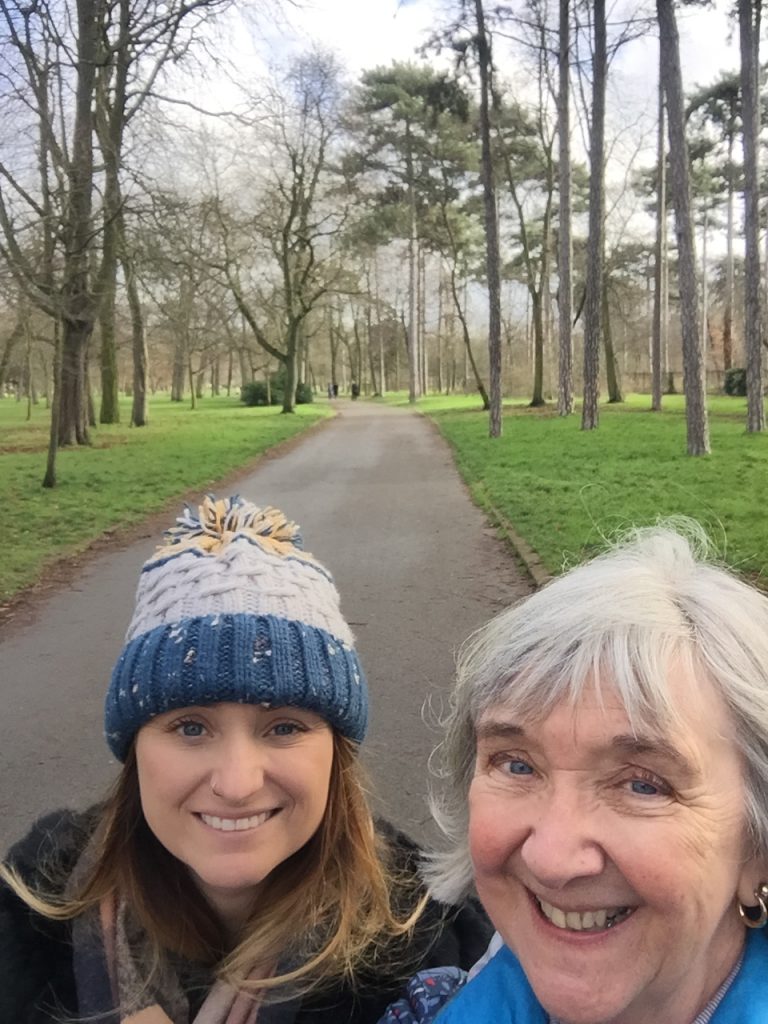
Anna put on a pile of laundry and we head out to the Bois de Boulogne. From the Metro station the park appeared to me basically an avenue of trees with pleasant footpaths. We were fortunate with the weather and though a bit wet underfoot we had bright sunshine. Eventually we came to an area of activities including a little railway.
My immediate idea was to take the train through the park so that we would know what there was to see.
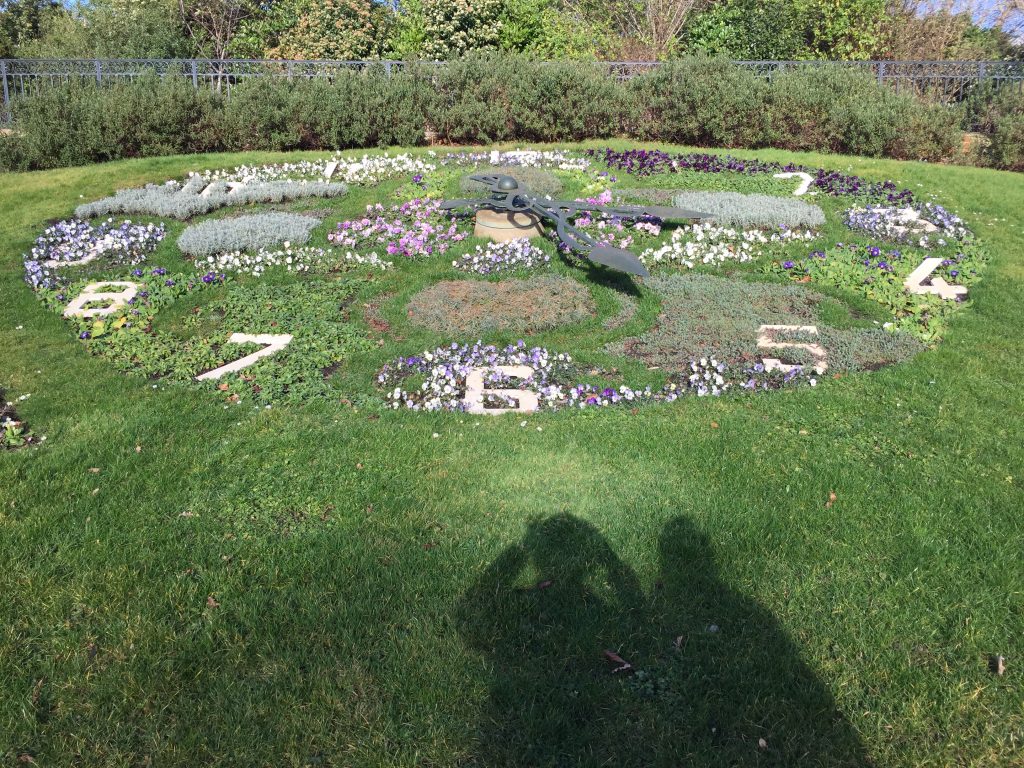
I hadn’t done my homework! But we discovered that the train doesn’t go through the park, it just connects the activity centre in the park to the Metro station. We had lunch at a lovely cafe full of photos of inventors and a lot of their inventions were on display in glass cabinets. It was delightful. Outside a floral clock was full of purple winter pansies.
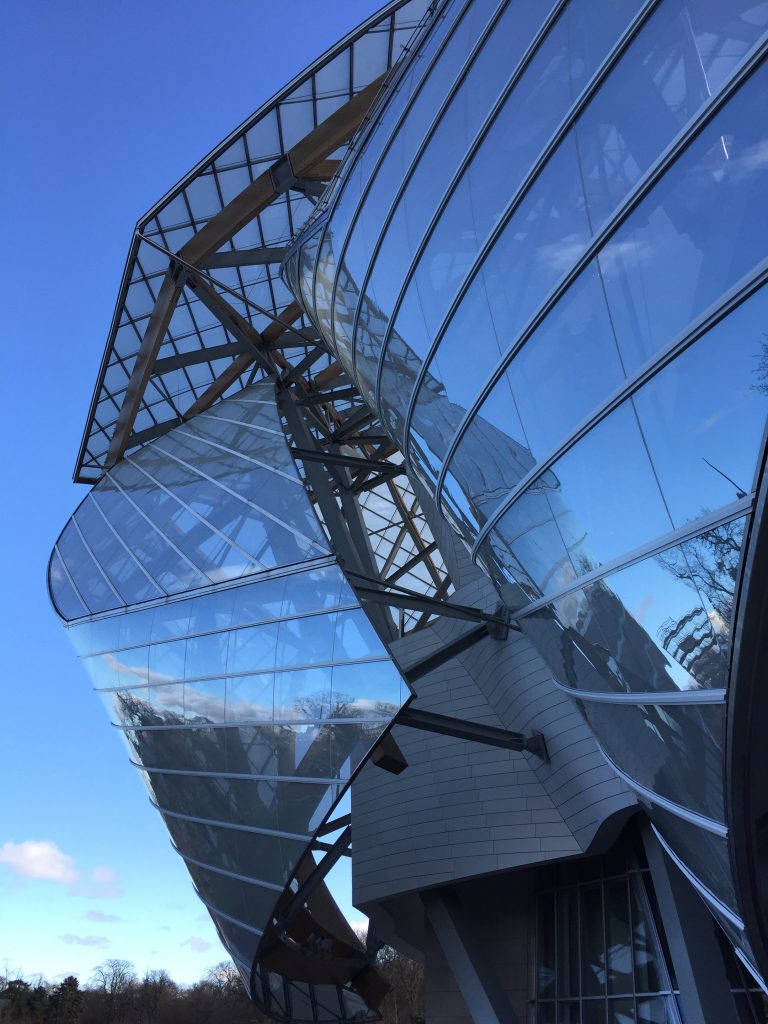
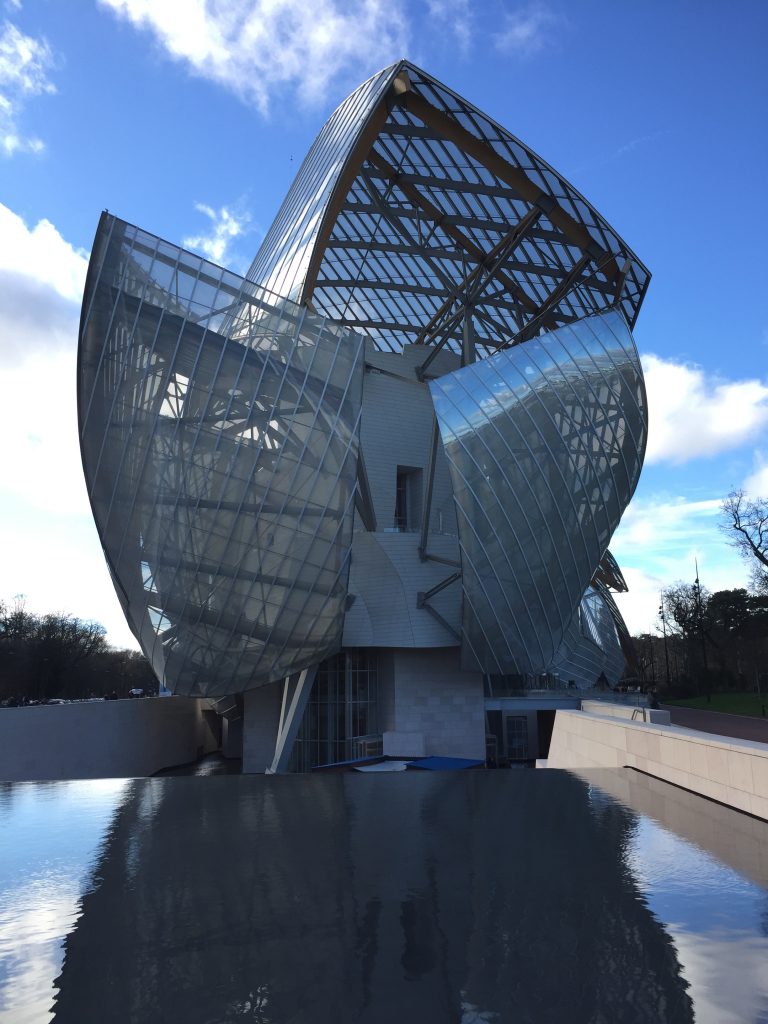
We headed over to an enormous glass and steel building. It reminded me of the Lowry centre in Salford and the museum of Rock and Pop in Seattle. The other place it reminded me of was the amazing concert hall in Los Angeles that I’d been to at a MTAC conference and with a bit of digging around we found out that it was the same architect, Frank Gehry.
The art museum opened in October 2014. More than 1million 400,000 people visited the Louis Vuitton Foundation in 2017. We didn’t go in because we wanted to see the other attractions in the park but it’s definitely on my ‘must see’ list next time I go to Paris. It’s designed like an enormous ship with billowing sails.
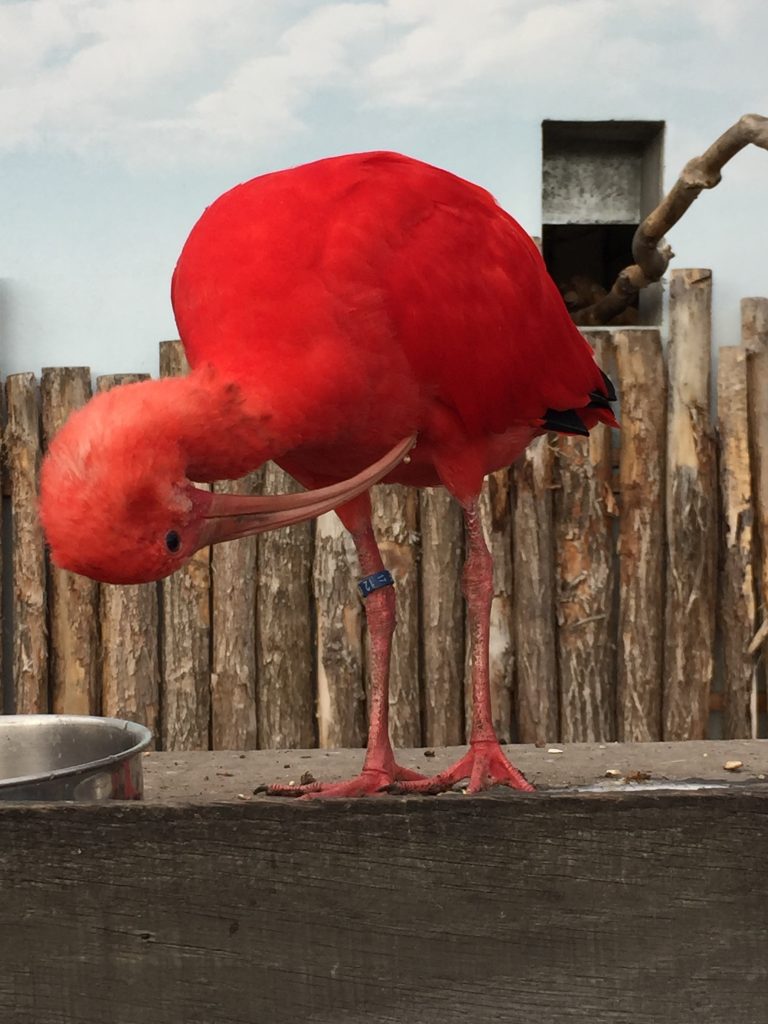
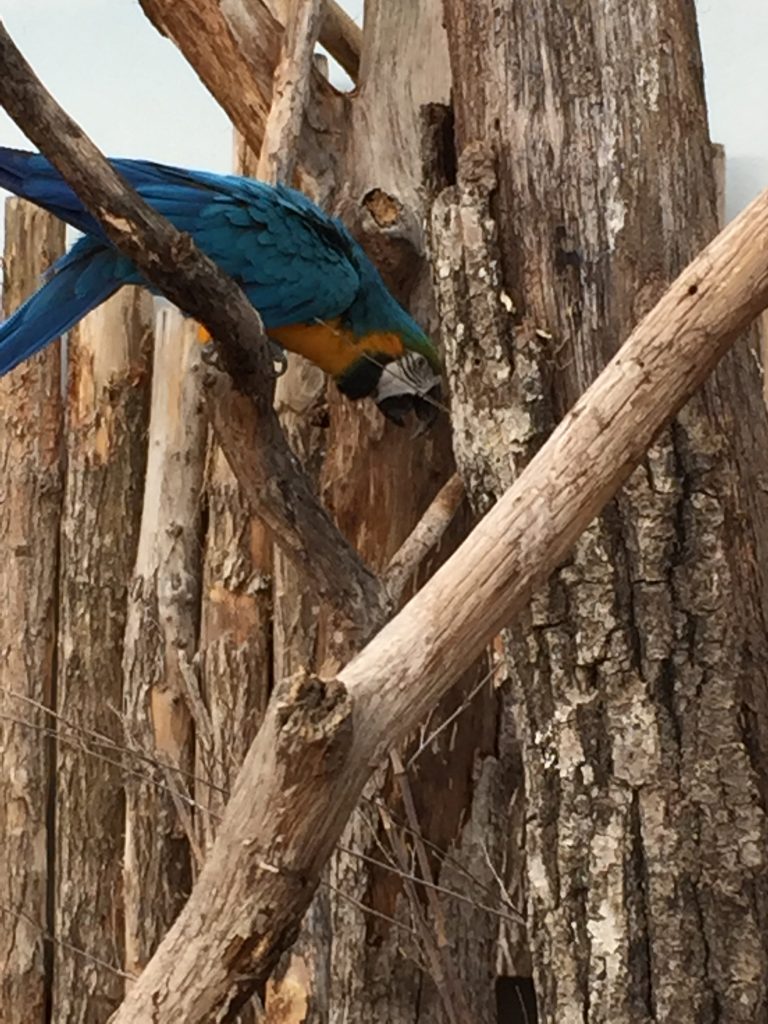
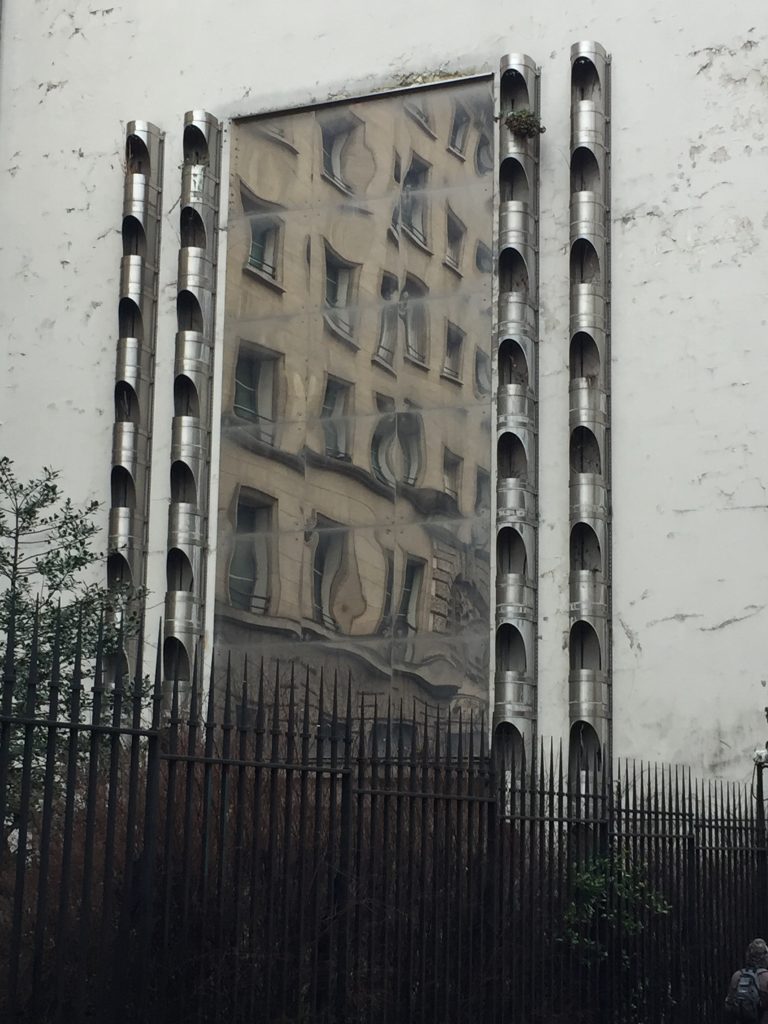
Moving on we found ourselves in a farm with sheep and goats, old looking farm buildings, including an apple press. All rather incongruous with the ritzy apartments lining the edges of the park. There was a bird house, too, with some spectacularly colored birds including a scarlet ibis. A nice feature of the birdhouse was the back wall which looked like the apartment buildings lining the park but were, in fact, cut tree trunks.
We left the park aboard the train. It was great fun doing this with Anna: something that we had done with our children when they were just little kiddie winkers. Next stop for us was the Pompidou Centre. I had it in my memory that just outside the centre was the glass pyramid but no, that’s outside the Louvre. The fountain with the treble clef that I photographed with icicles in 1984 is no longer there.
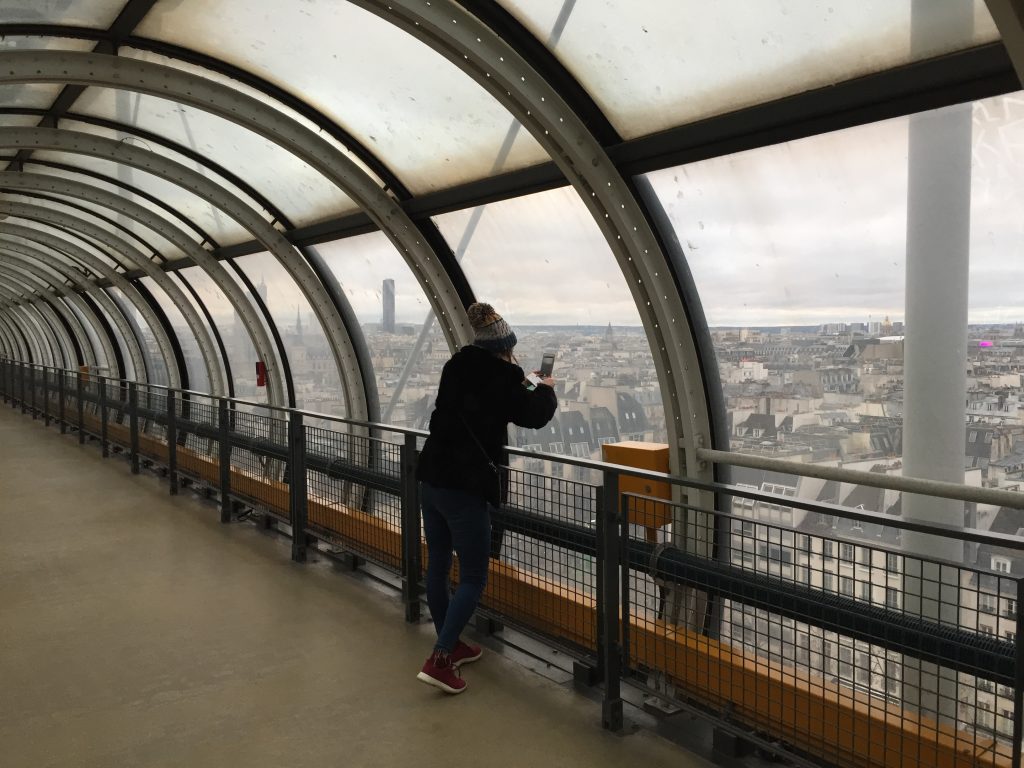
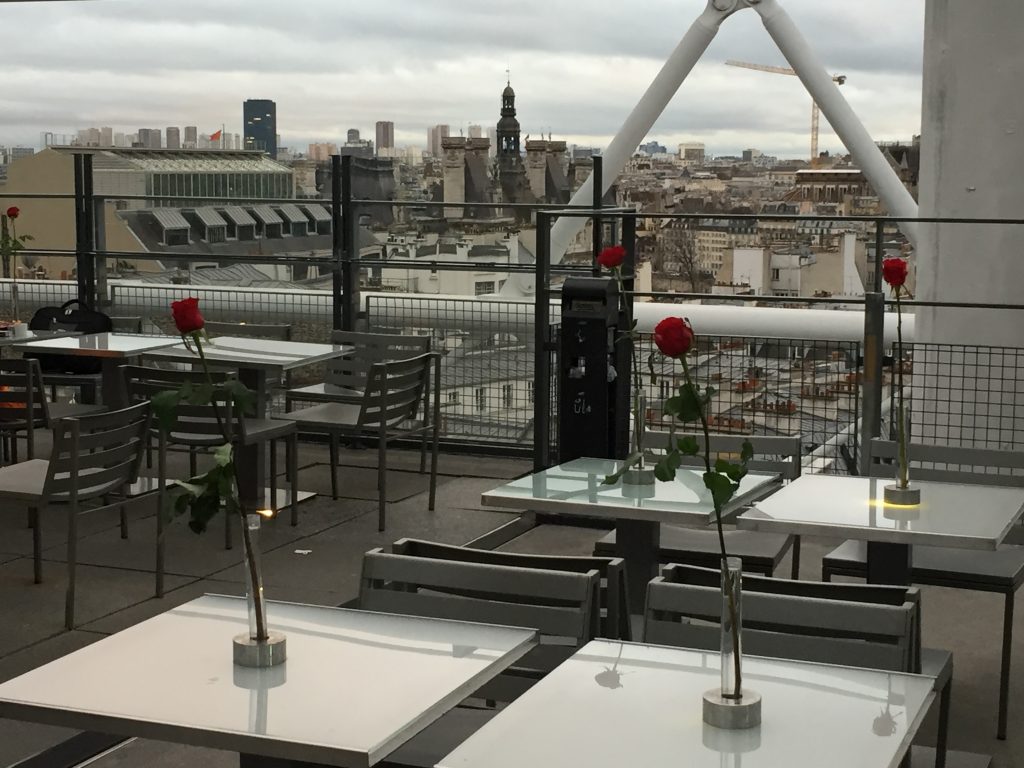
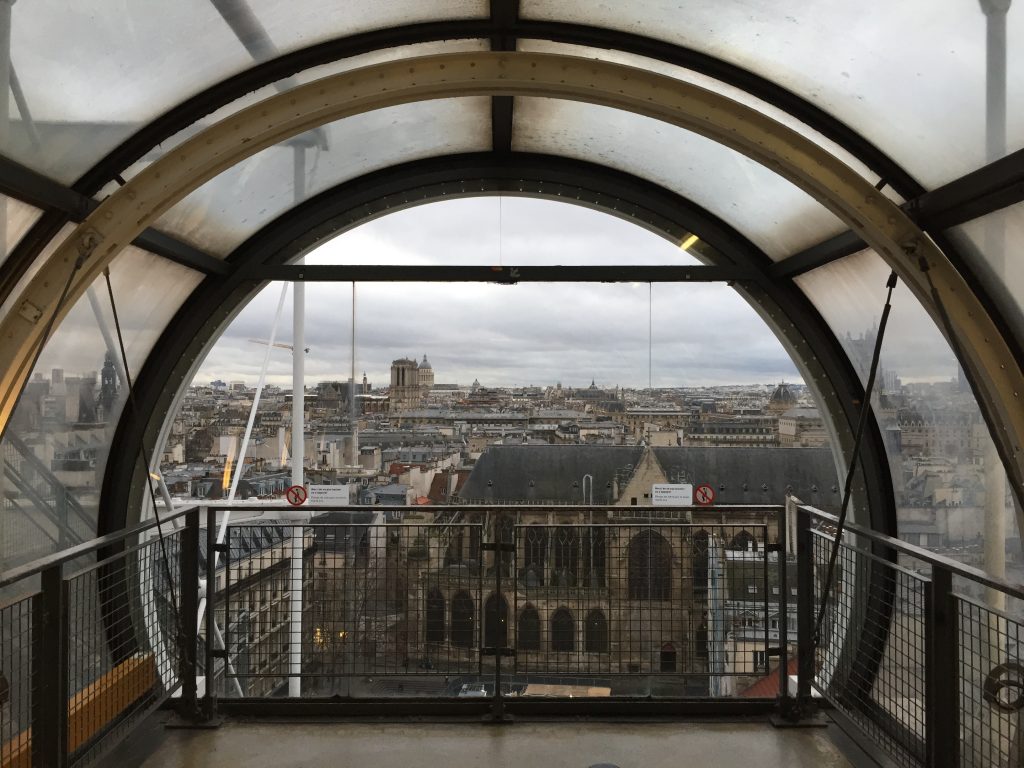
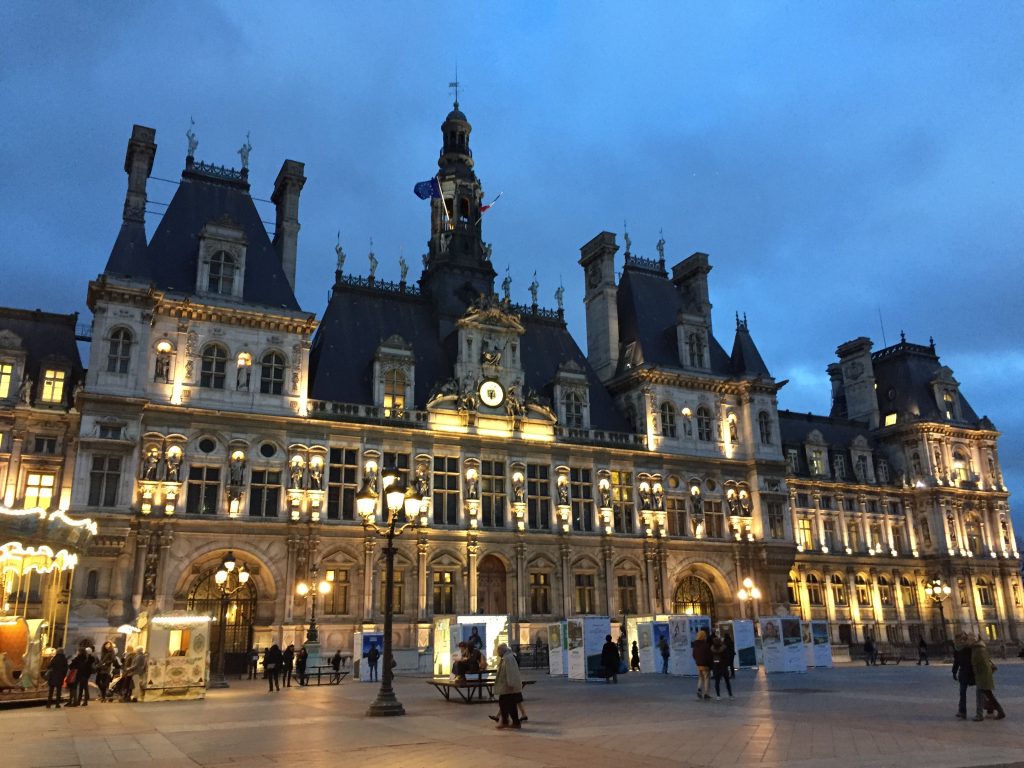
It looks as if the square in front of the centre is under construction. At the top of the Pompidou centre the walkways are covered in perspex making photography difficult. Although we’d timed our arrival to coincide with sunset the sky was too cloudy. We did peak into the very upmarket restaurant on the top floor and surreptitiously took a few quick photos of the table with their single roses, not encased in perspex. All very romantic.By the time it went dark we found ourselves outside the Hotel de Ville, Paris’s city hall, and we had a lovely dinner outside, again, right opposite the ornate floodlit building close to the Seine. Then it was time for me to return to my Airbnb and Anna went to meet Cez, arriving from Liverpool at the Gare du Nord.
There was no TV in my new place so I spent the evening watching various documentaries about Paris on my phone! One done by Griff Rhys Jones was full of interesting facts that I’ve incorporated to this blog. Here are just a few:
Hitler thought Paris was too beautiful to bomb
There are 40,000 public monuments
70% of bread is made by hand compared to 3% in England
On average there’s a bread shop every 100 metres
Lack of bread was a major cause of the French Revolution
The street and gutters are cleaned by swilling them out each morning at the touch of a switch
There’s a graffiti eradication squad for racial and sexist messages
Paris is the richest city in Europe
The indoor shopping passages which we’d admired were built to allow rich people to shop during the rain
Most office workers are given luncheon vouchers to make sure they eat properly
Paris has the highest proportion of singles in Europe.
Anna’s friend Cez was arriving tomorrow evening so I had booked myself an Airbnb close to the hotel. Its owner Gaeille came and brought me the keys to the place at 10 and as we followed her out it was already raining. We were to take the Metro to visit the Bastille Market.
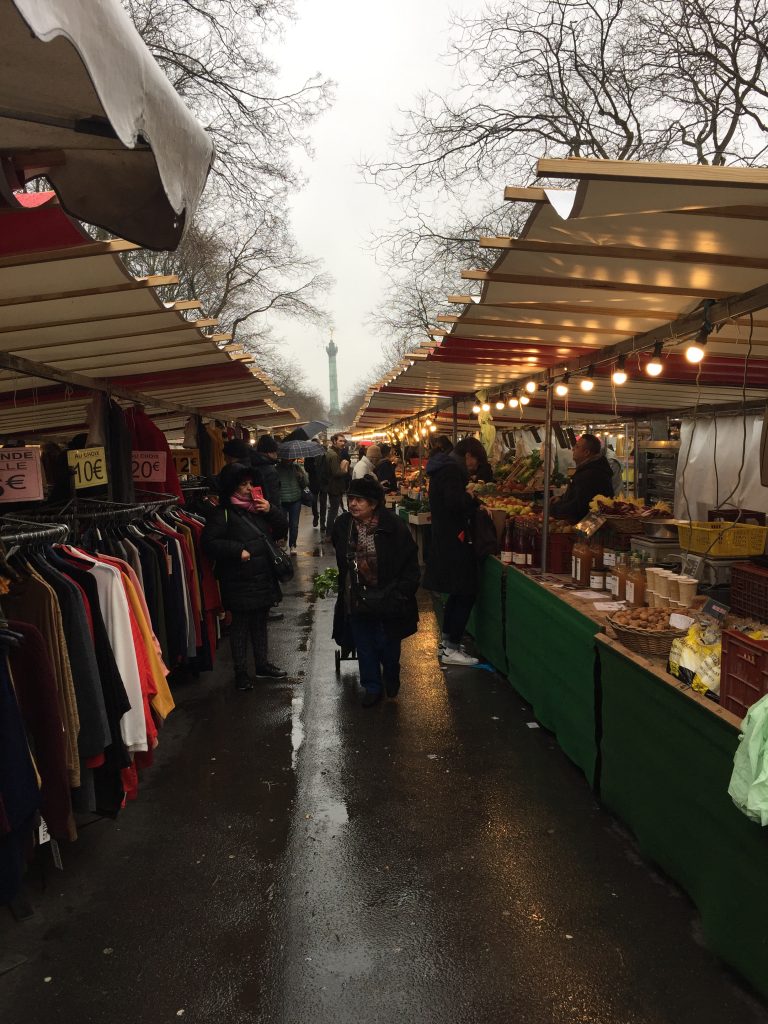
Bastille market
Anemones
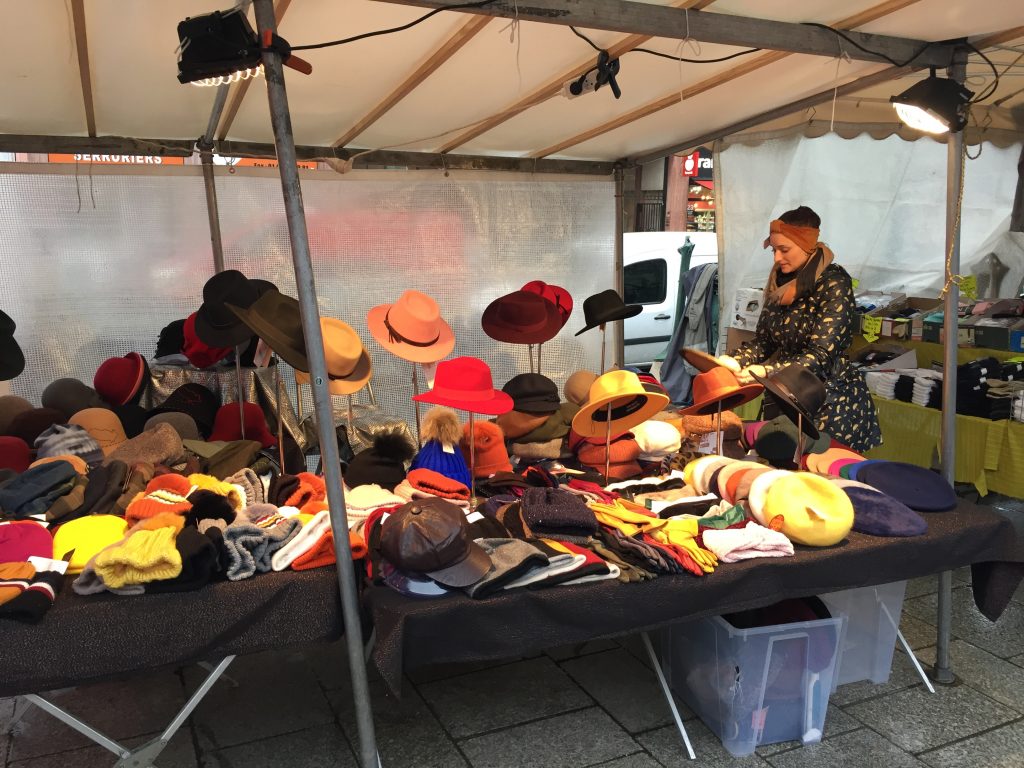
Which hat?
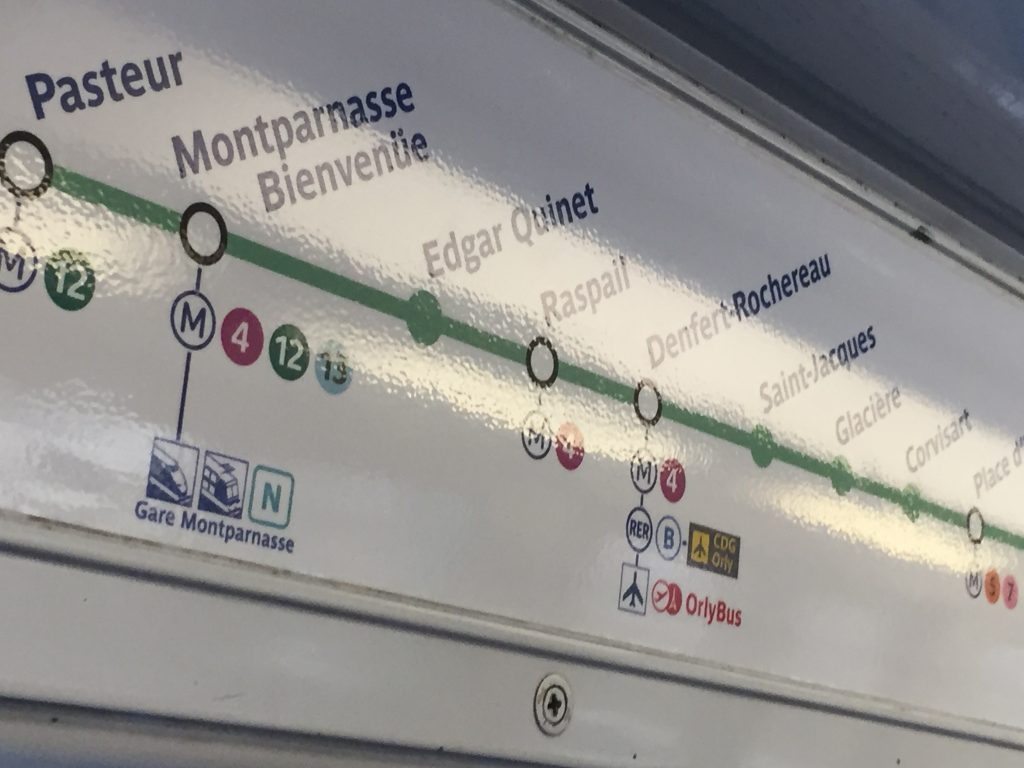
The cleanliness of the Metro stations is beyond belief. The white tiled walls are glossy and look as if they were built yesterday. We speculated as to whether they hose down each station during the night. The floor of the stations show no dust, dirt, spills, gum or anything else. The most rubbish I saw on a station platform was one ring pull from a can – in a whole week of using the Metro. The route indicators within the trains light up so so know exactly where you are in your journey. I was greatly amused that I read the station ‘Edgar Quinet’ as ‘Elgar Quintet.’ (!).
The outdoor market was vast but on this rainy morning customers were pretty scarce. Within minutes my feet were soaking wet, which was strange, since my shoes didn’t let in the water on our rainy walk last night. Anyway this prompted me to buy two pairs of socks for Euros each. It wasn’t until later that I realized one was Angora and one was Cashmere, both retaining their original price labels of 20 Euros. We chatted to a stall holder selling a new line in umbrellas, which can turn inside out. They come with lovely scarves to match. Other scarves featured hand embroidery using toro technique that I a recently learned in my textile class at home. During out morning coffee stop I donned my new socks and my feet dried out perfectly.
In the Catacombs
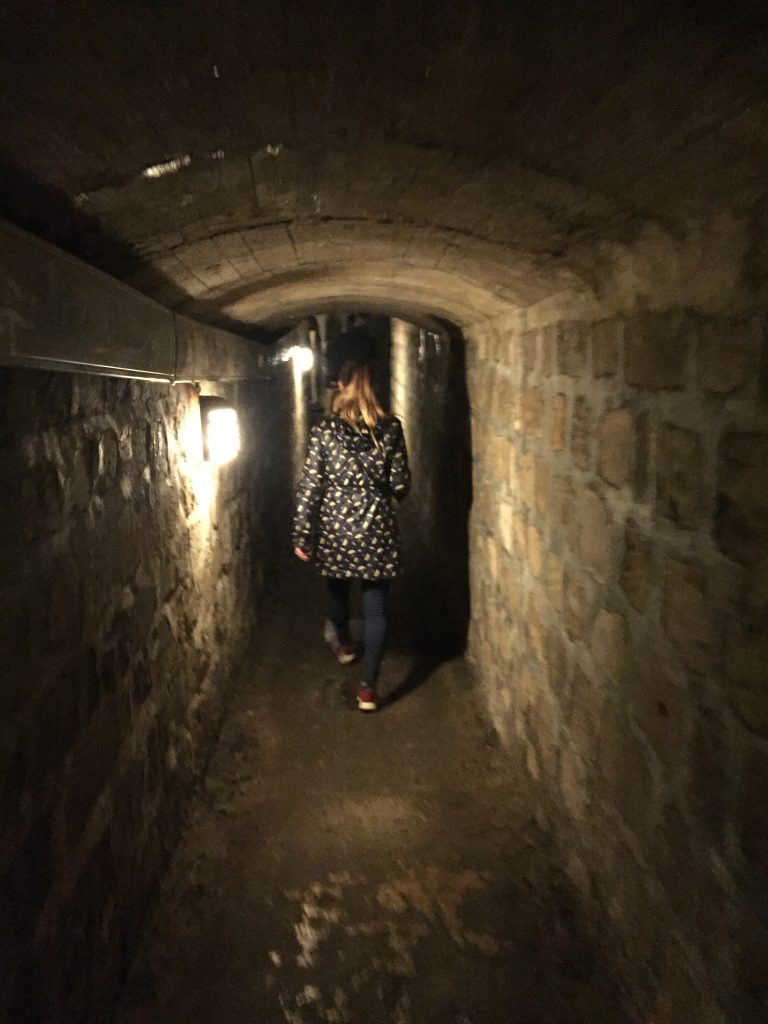
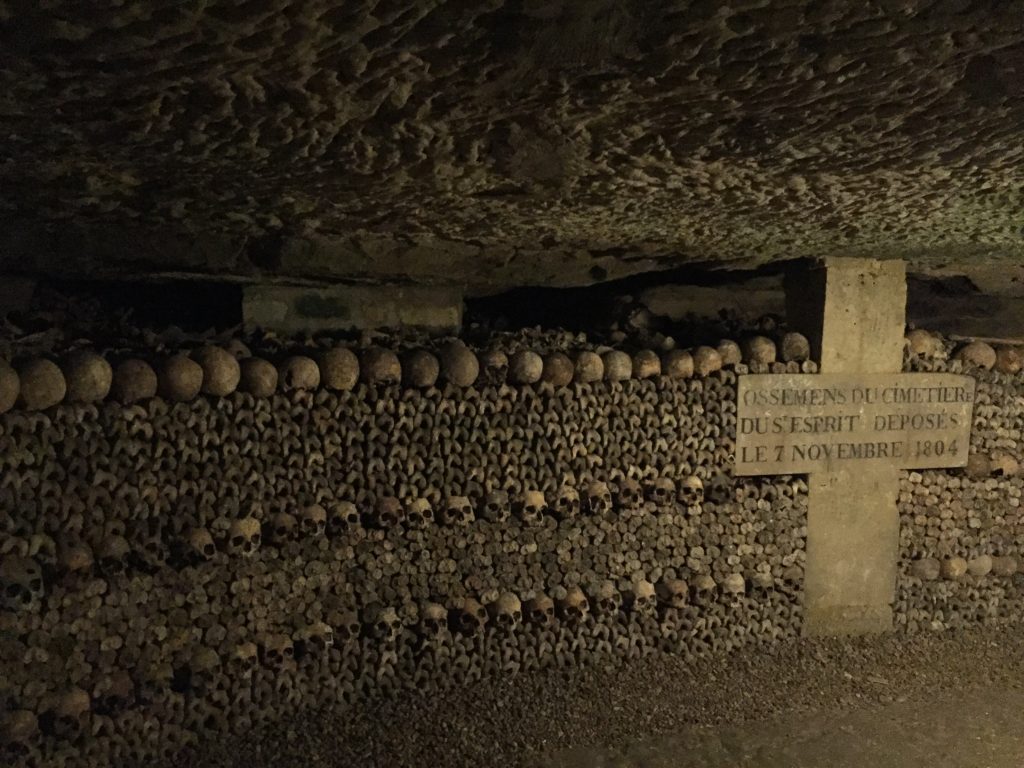
The afternoon was spent at the Catacombs which necessitated changing Metro trains at Chatelet which turned out to be an enormous station more like an airport. And SO many people. Directly across the street from where we exited the metro was a regular building which was the entrance to this vast underground system of tunnels filled with skeletons. You would never have suspected it. “Stop. This is death’s empire.’ Thus begins the path that leads through the remains of several million Parisians. The first bones were thrown here haphazardly into an abandoned quarry shaft.
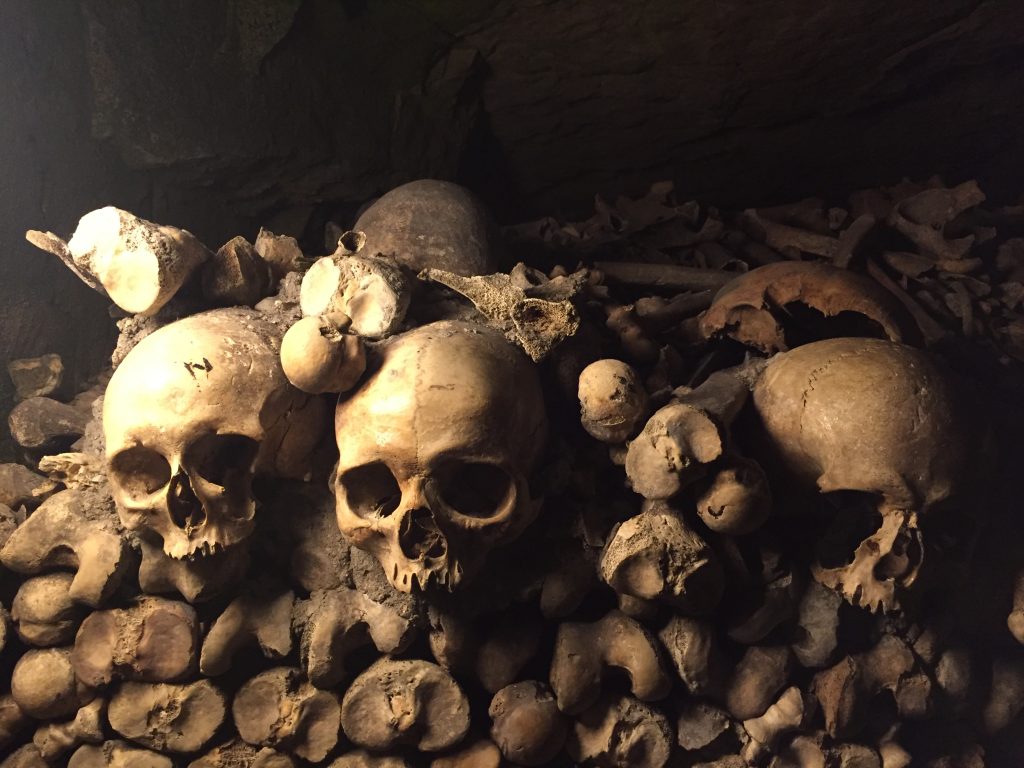
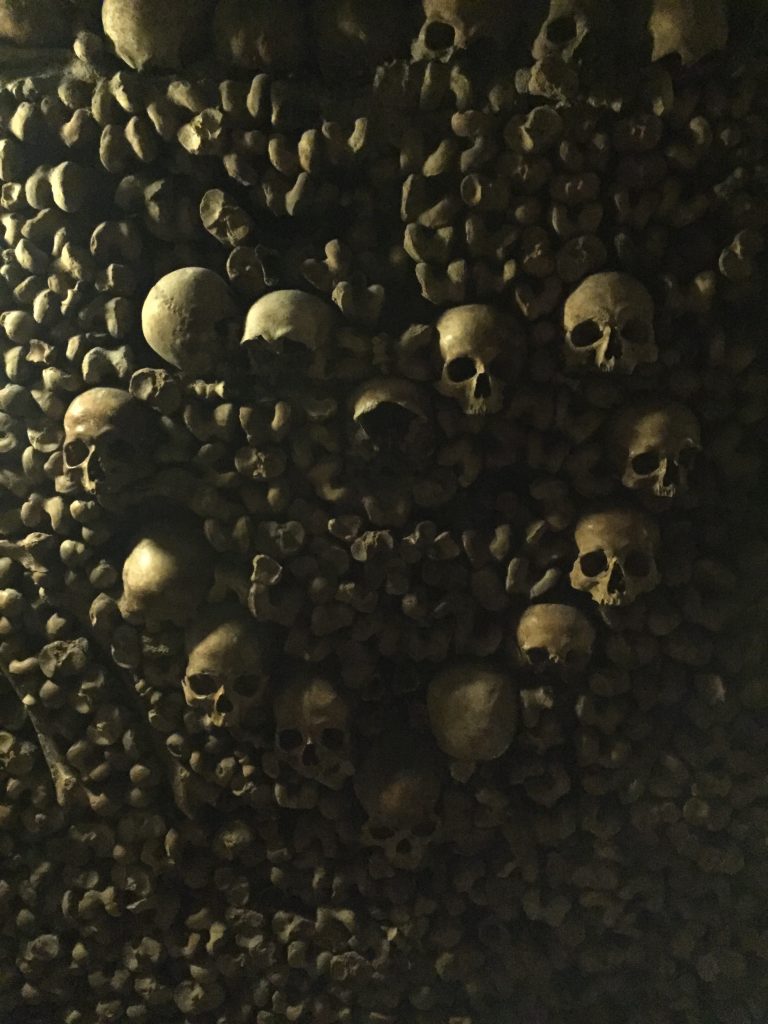
The first bones came from the largest cemetery in the city at the time located in Les Halles district. The cemetery was closed in 1780 amidst concerns for public safety and little.by little the remains of people from various city cemeteries were deposited in the old quarries. There are signs in the passageways indicating which cemeteries the bones came from. Around 1810 the inspector general of the quarries decided to develop the area and the long bones and skulls were arranged decoratively to form a back wall behind which the other bones are piled.
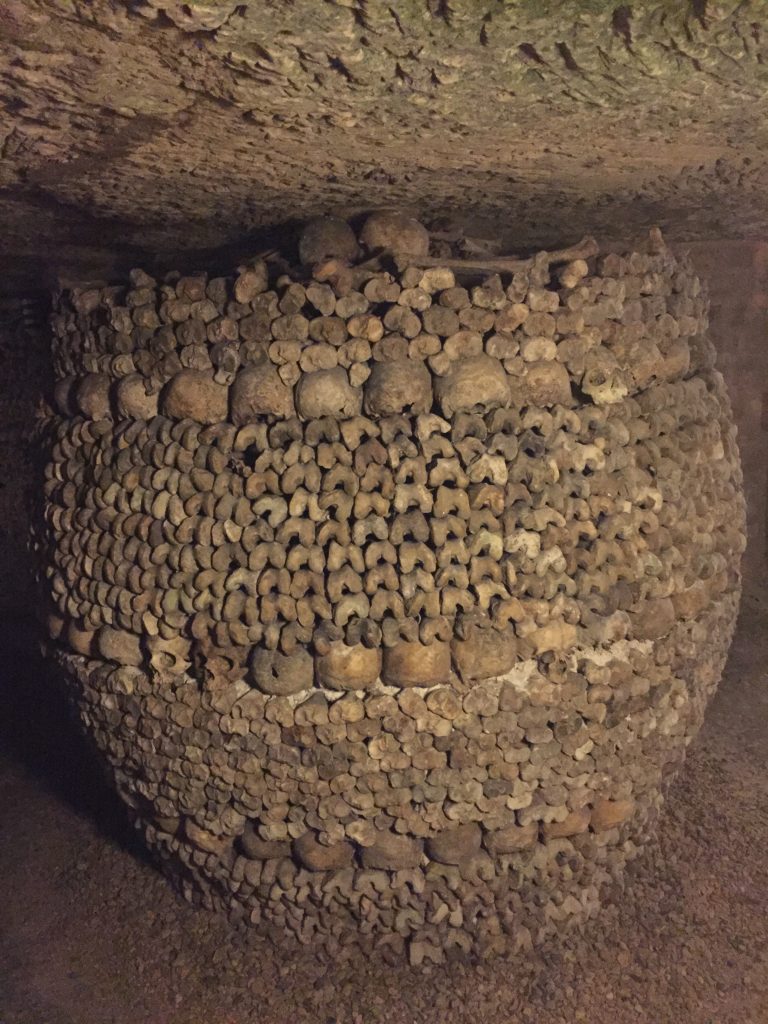
These bone walls are called agues and there are corridors of them. Pillars of rock, left by the quarry men to support the ceilings are hidden by skulls and tibias. One of these in particular had became quite famous as the ‘tibia rotunda.’ One of these supporting pillars is surrounded by bones in the form of a barrel shape. On 2 April 1897 a night concert was organized there between midnight and 2 a.m.
Tibia rotunda
The information was circulated in the newspaper and the concert drew over 100 people to hear Chopin’s Funeral March and Danse Macabre by Saint-Saens among other piece. There are hate remains of about 6 million people in these corridors and the bones of Charles Peroult who created Little Red Riding Hood and Cinderella are somewhere in this labyrinth. We visited the souvenir shop with its macabre trinkets before heading up onto street level. Anna bought a book about cats. She asked the lady at the checkout if this book was here because of the word ‘cat’acombs? No, it turns out it’s because Paris was known at one time to have a lot of cats, especially in the Montmartre district – hence Le Chat Noir, supposedly the first modern cabaret but now simply a hotel. Famous patrons included Debussy, Satie, Toulouse Lautrec and Verlaine.
Lunch was next and we stopped in a cafe where the service was very slow, even for European standards. A party of student aged people to our right were from Michigan and the couple to our left were from Redwood City. The group from Michigan complained to the waitress about the slow service – typical Americans!
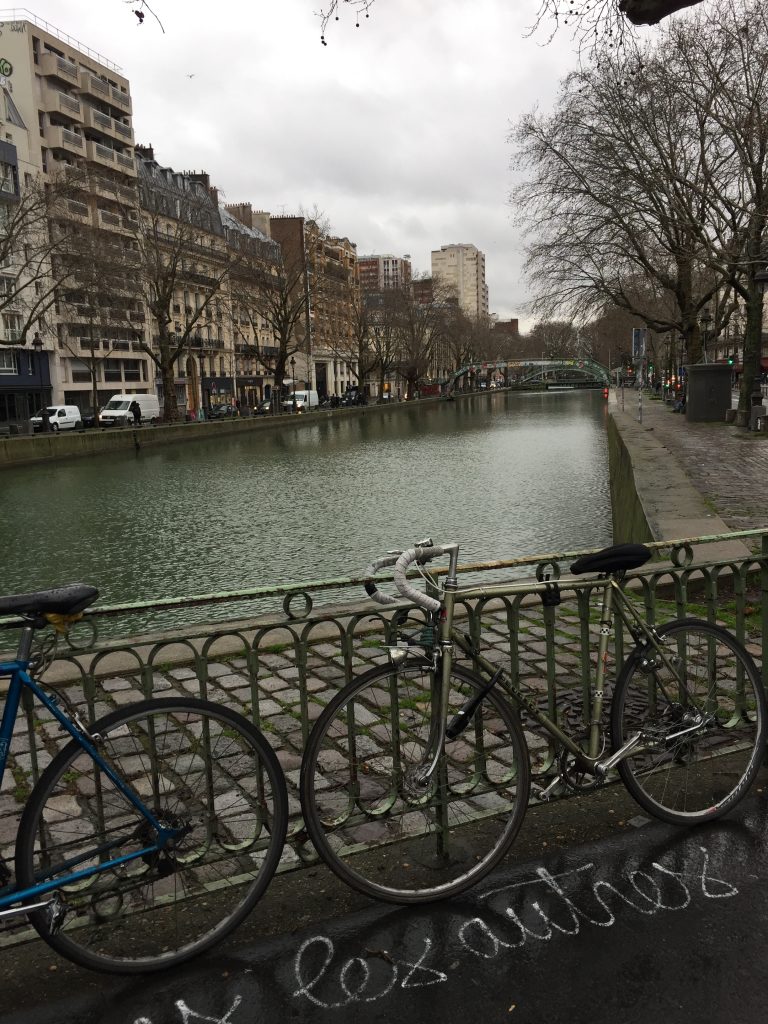
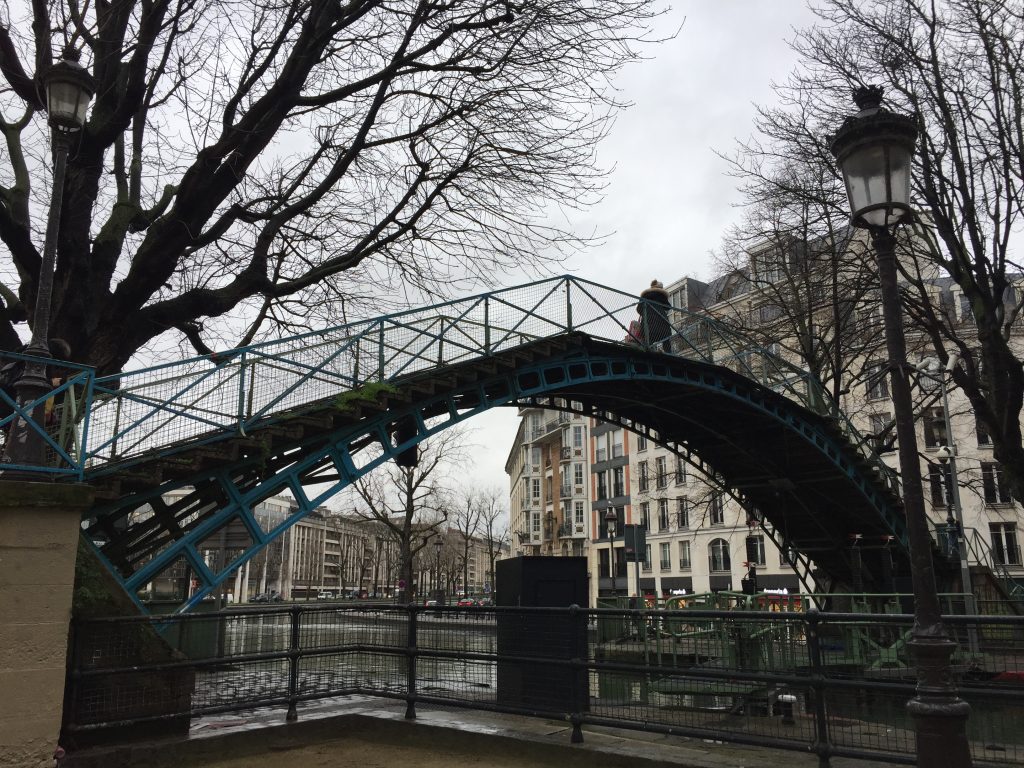
We were bound for the canal district with its wrought iron bridges. There was a playground that was teaming with children and their carers. This was truly a multicultural district of Paris. The area reminded me of Amsterdam with bikes leaning on bridges.
The canal district
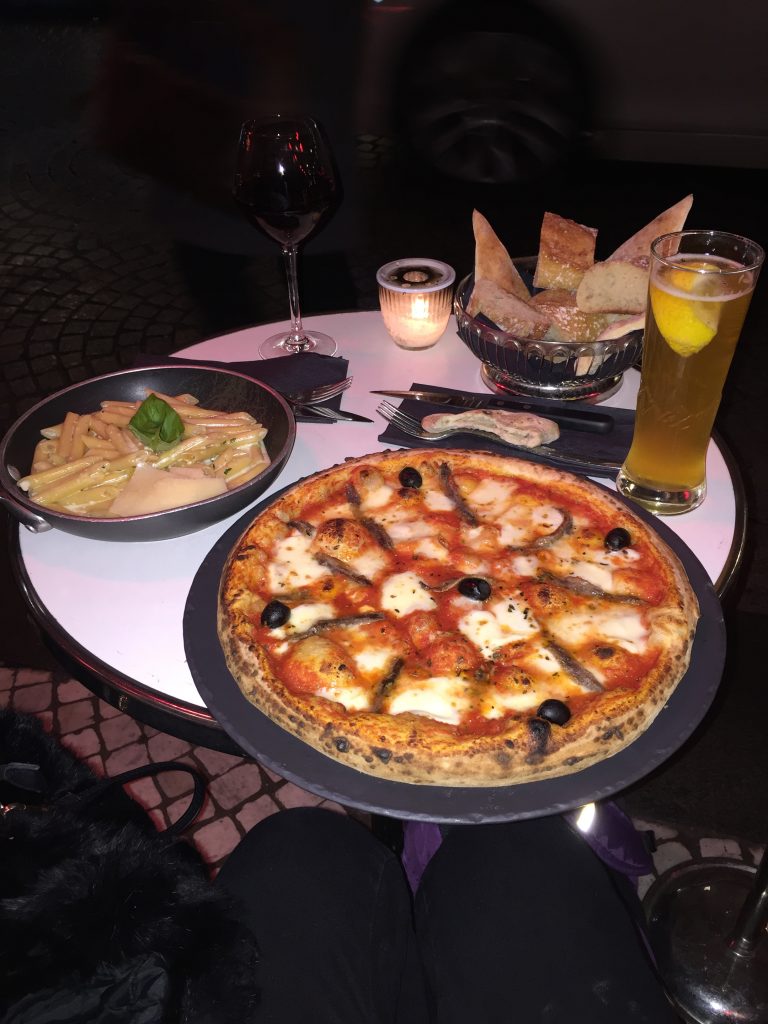
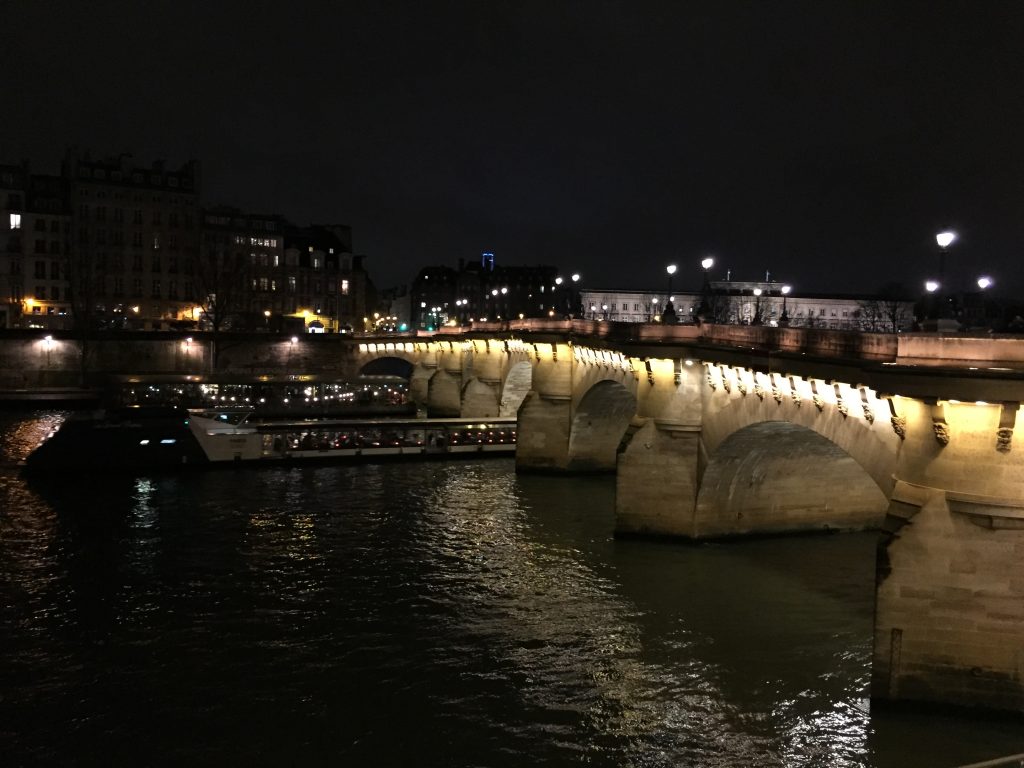
Later, at dinner in an outdoor bistro I discovered a new beer Eidelweiss, which I enjoyed with my pizza while Anna tucked into a 1664 with her pasta. We walked down to the Seine after dark and watched the flashing lights of the Eiffel Tower.
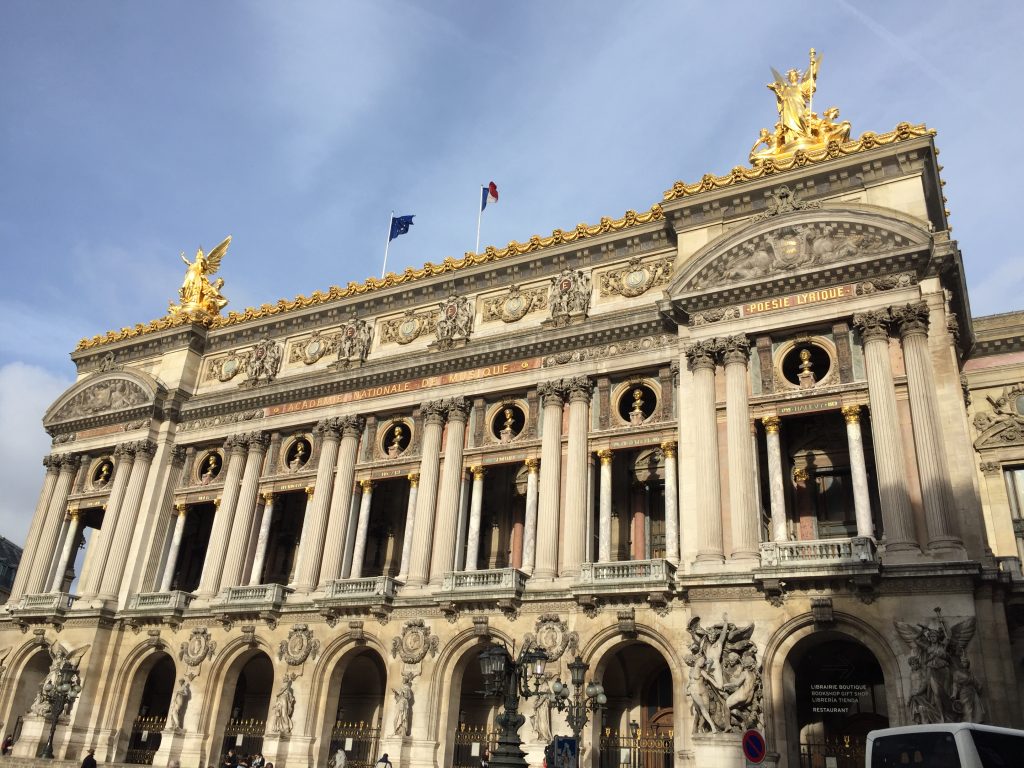
A day filled with blue sky and we were on our way to find the Hop On/ Hop Off bus before 10:30. We saw from the website that there was a stop at the Opera House but having walked to this wonderful building but we couldn’t find a bus stop with our bus’s logo. Many streets converge at The Opera House and we were stuck. At that moment, while admiring the imposing facade of this famous music building with its larger than life sculptures of composers I glimpsed a security guard in the foyer.
This is the Paris Opera House, but where is the bus stop?
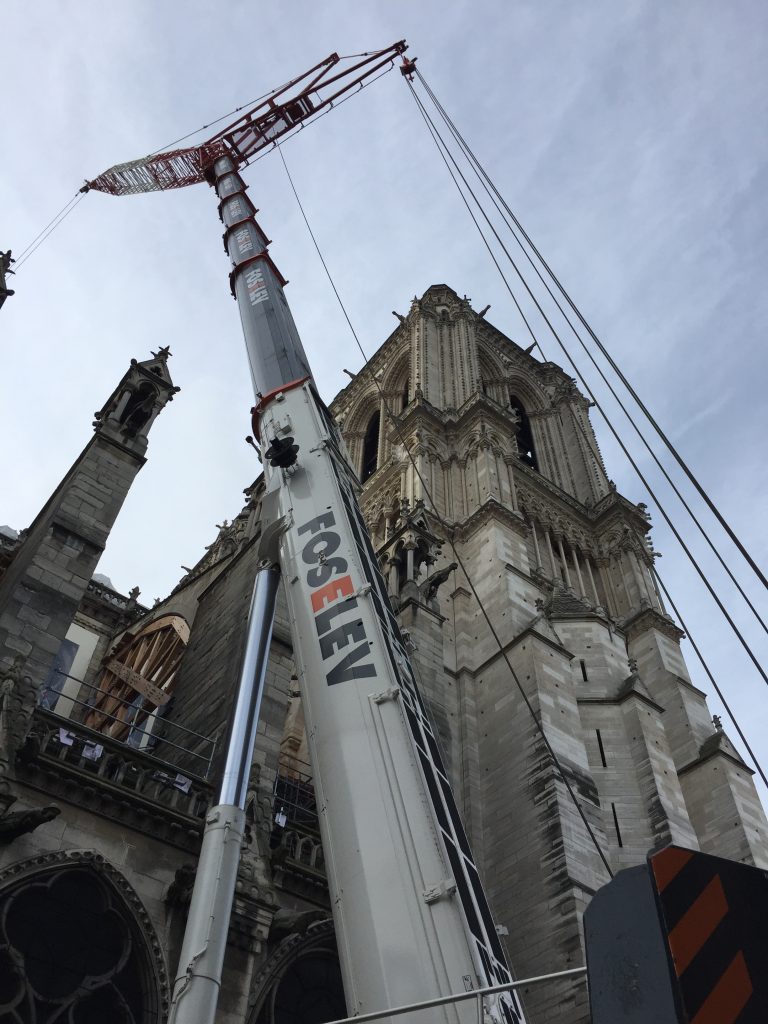
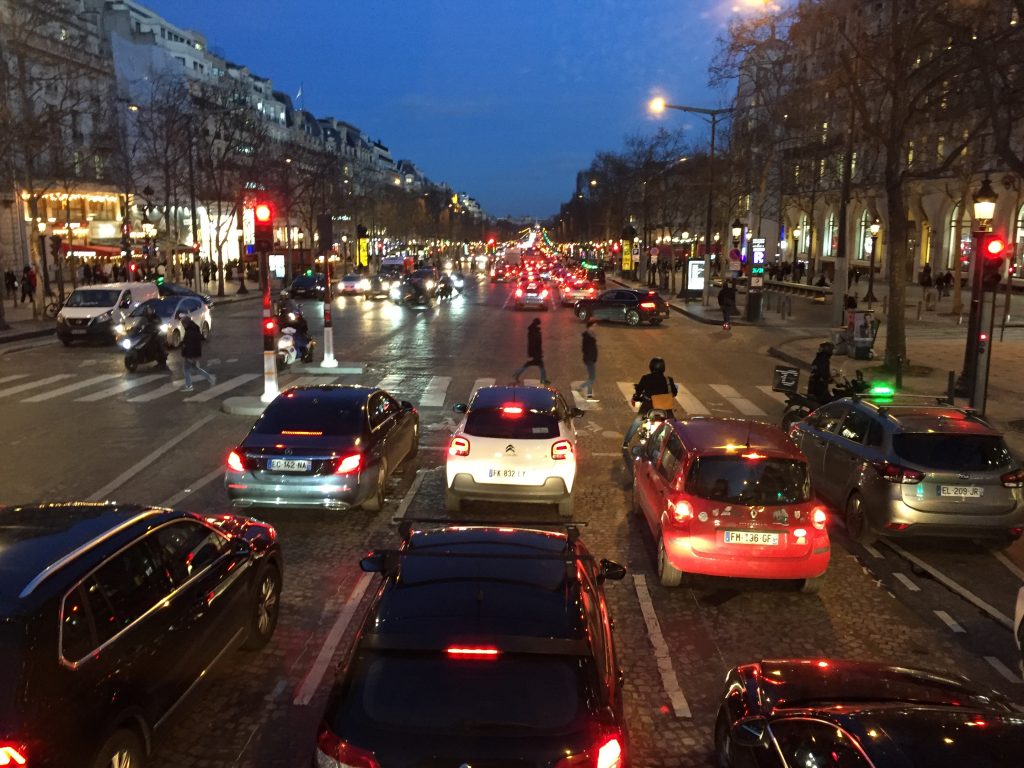
So, we went into the Paris Opera house to inquire about a bus stop! That takes some beating. The subterranean “lake” below the Paris opera house inspired the Phantom of the Opera’s lair. Beneath the opera house, Palais Garnier, there sits a water tank, and some folk say that once a man lived there who had no face. “The Phantom of the Opera” was based upon this place. We didn’t see the phantom but we did get the information we needed from the security guard and we boarded our bus. We were paying the driver by credit card but his credit card machine wasn’t responding. Daunted not in the least, he pulled out into the crazy, heavy traffic and continued to simultaneously drive and fiddle about with the machine while we stood by the driver’s seat hanging onto the rails for dear life – quite unnerving. Eventually he gave up and told us to take a seat and he’d pick up a new machine at a stop later in our ride. We headed upstairs and in spite of being a little disappointed that this bus still had its awning in place , so it wasn’t quite ‘open top,’ we got great views of Notre Dame under cover, all wrapped up after last year’s devastating fire, with mighty cranes looming overhead.
Notre dame
Scaffolding covered some walls and it did give a sense of what it must have looked like during its original construction. The flying buttresses are supported by wooden frames and all the cranes were active. We decided to get off the bus and have a closer look and we browsed the outdoor photo exhibition of the fire.
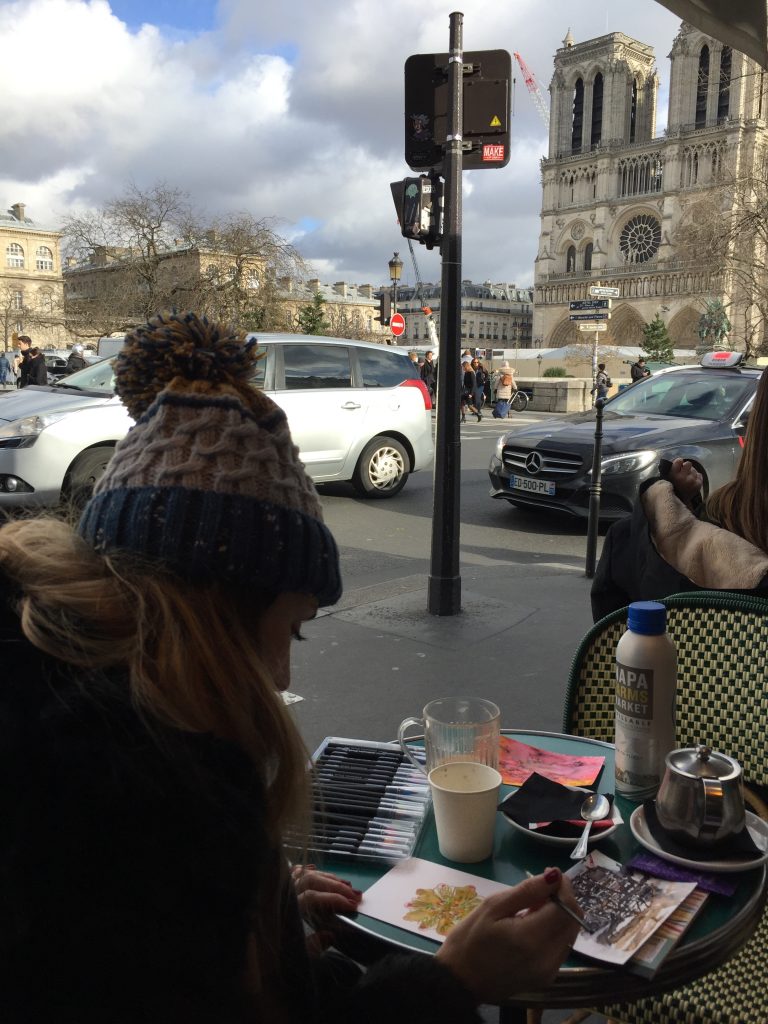
We stopped at an outdoor bistro directly across from the cathedral and had the most expensive cappuccinos of the trip – 6 Euros – but that’s rather cheaper than in St Mark’s square in Venice.
My view
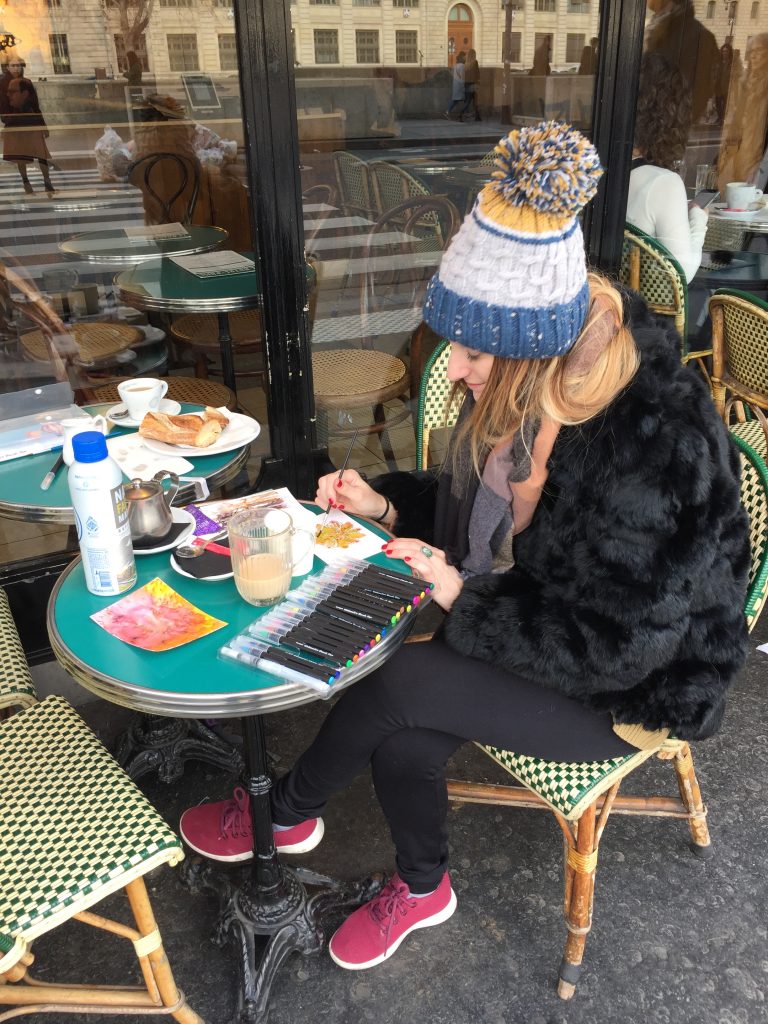
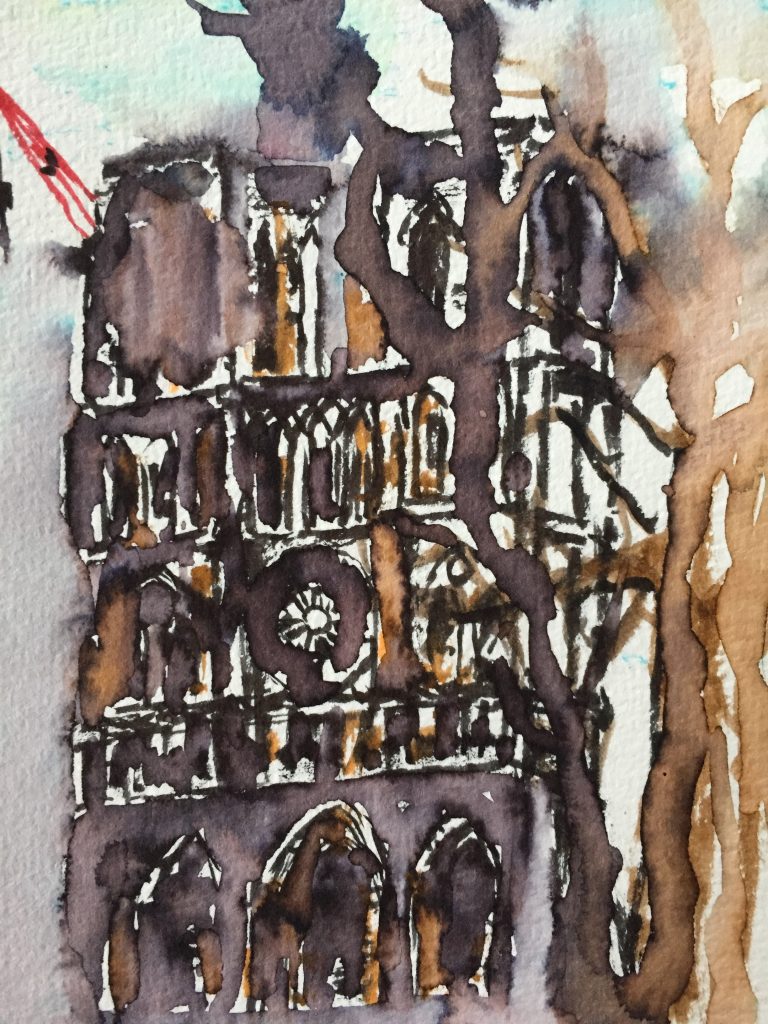
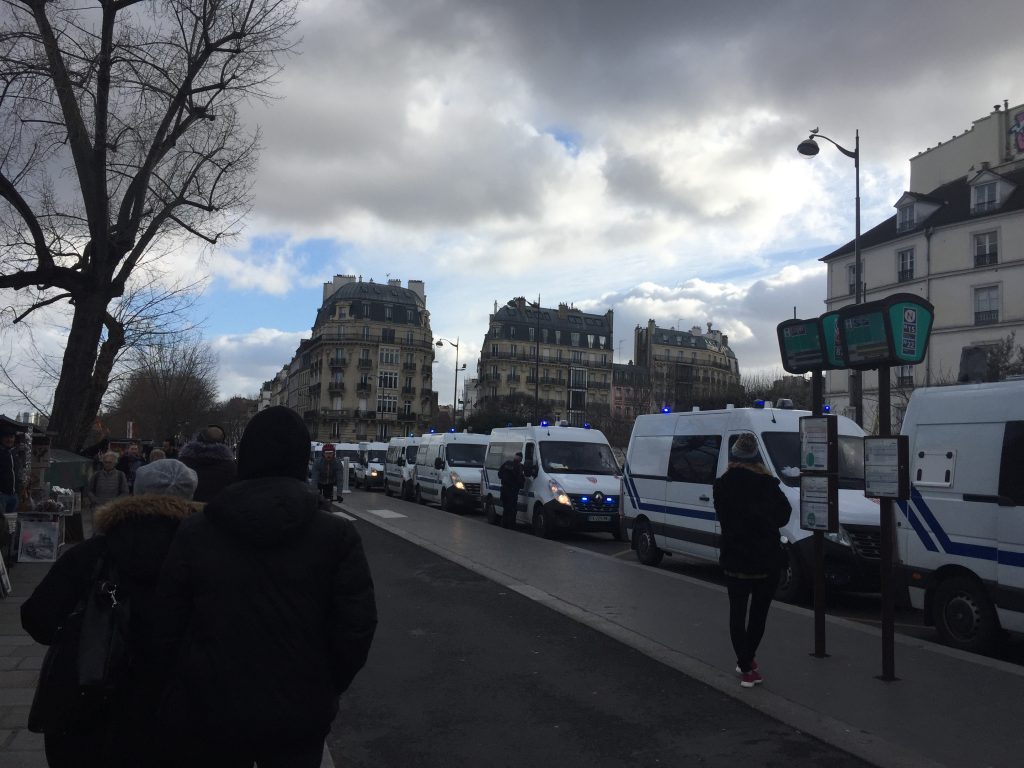
We took out our watercolors and painted for an hour – what a view of the cathedral we had from our table! Several times police sirens broke the quiet as a dozen or so police vans filled with policemen in what looked like full combat gear whizzed past at high speed. When we came to re-board the bus the whole bus lane was taken up by a parked convoy of police vans.
Anna hob-nobbing with the Gendarmes who were parked in our bus stop!
Several tourist stalls were set up along the river bank and Anna bought a new bobble hat.
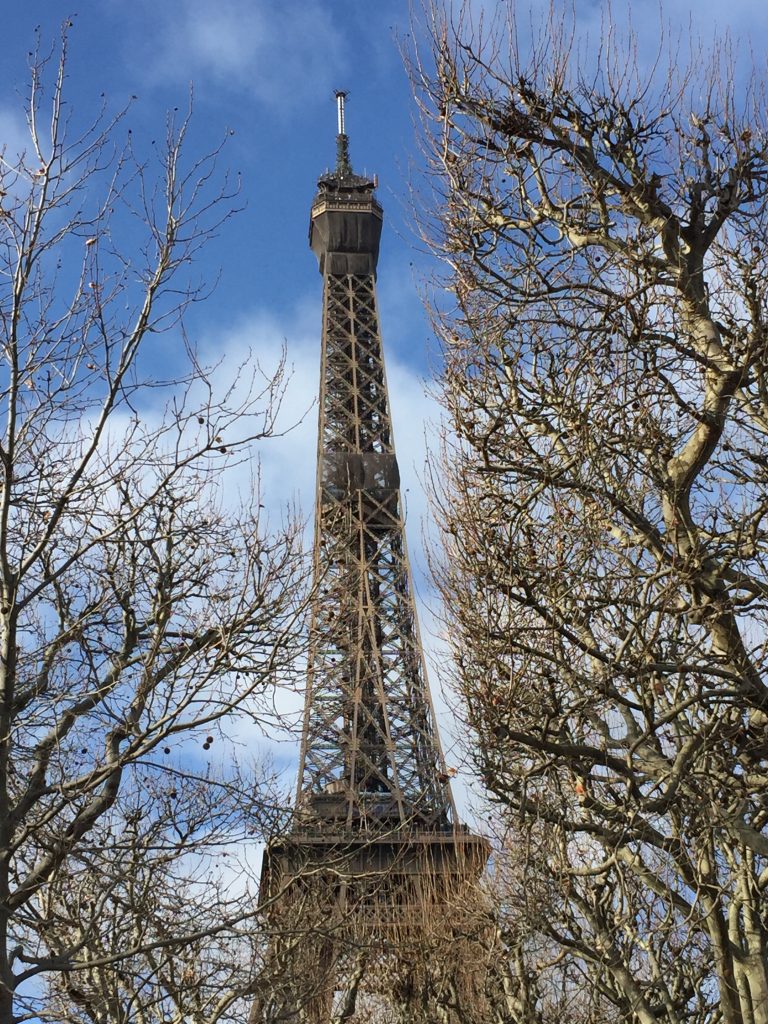
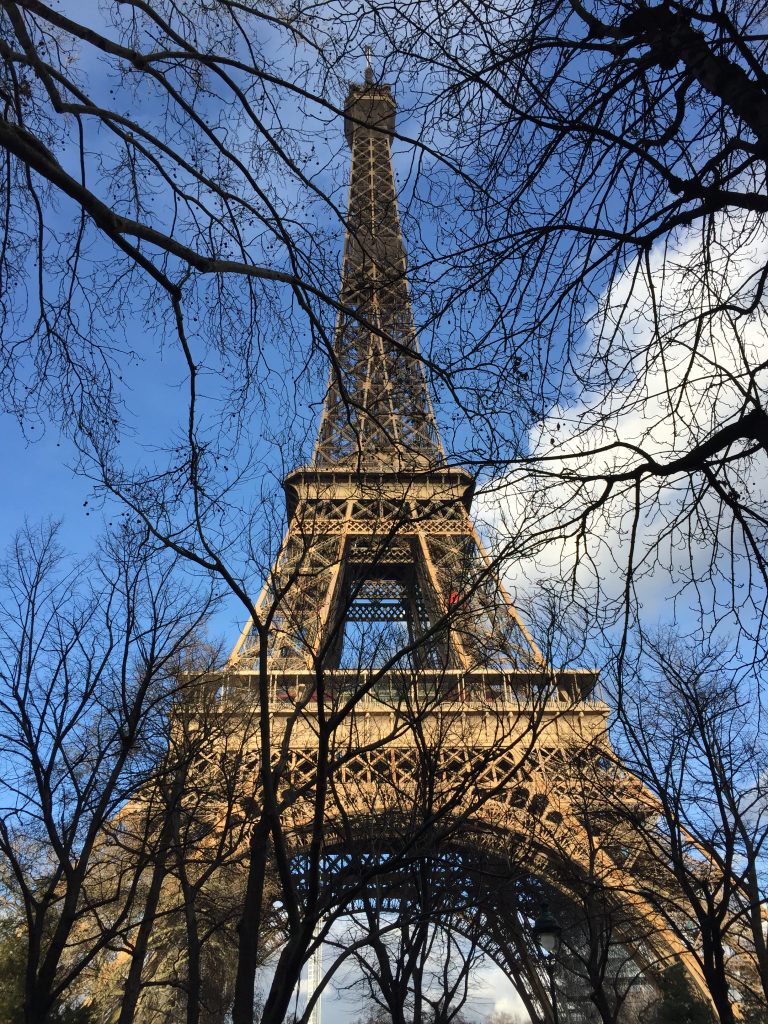
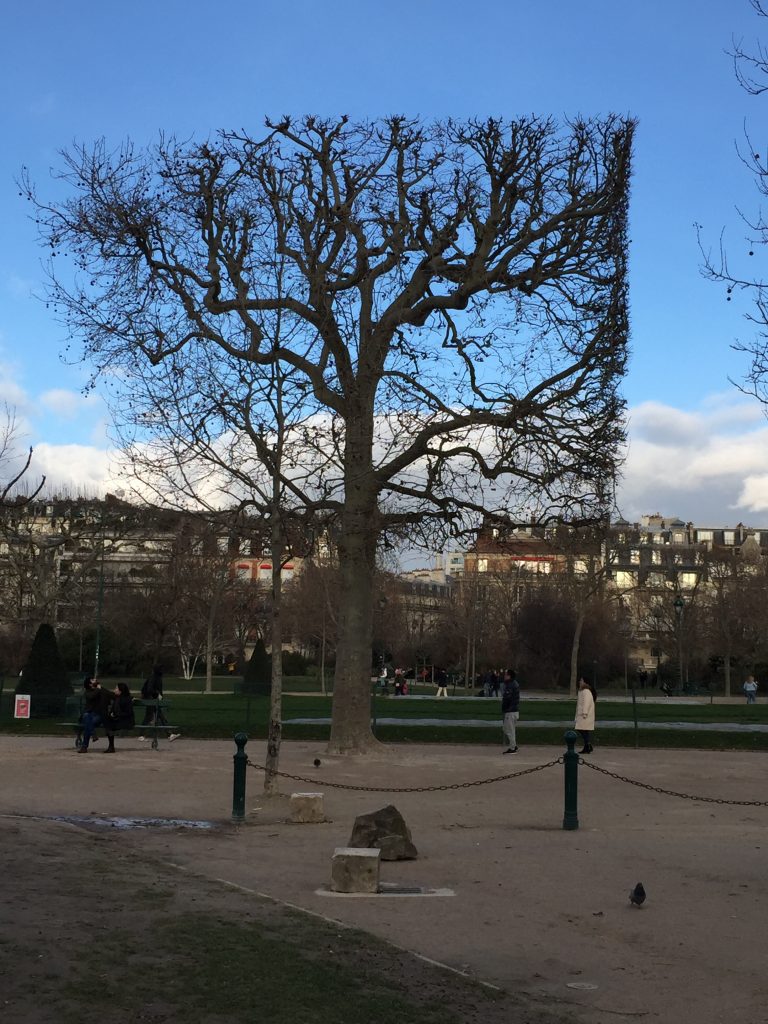
Our next stop was the Eiffel Tower, constructed in 1889, and we approached it through a park with rows of strangely pollarded trees.
Trees with right angles!
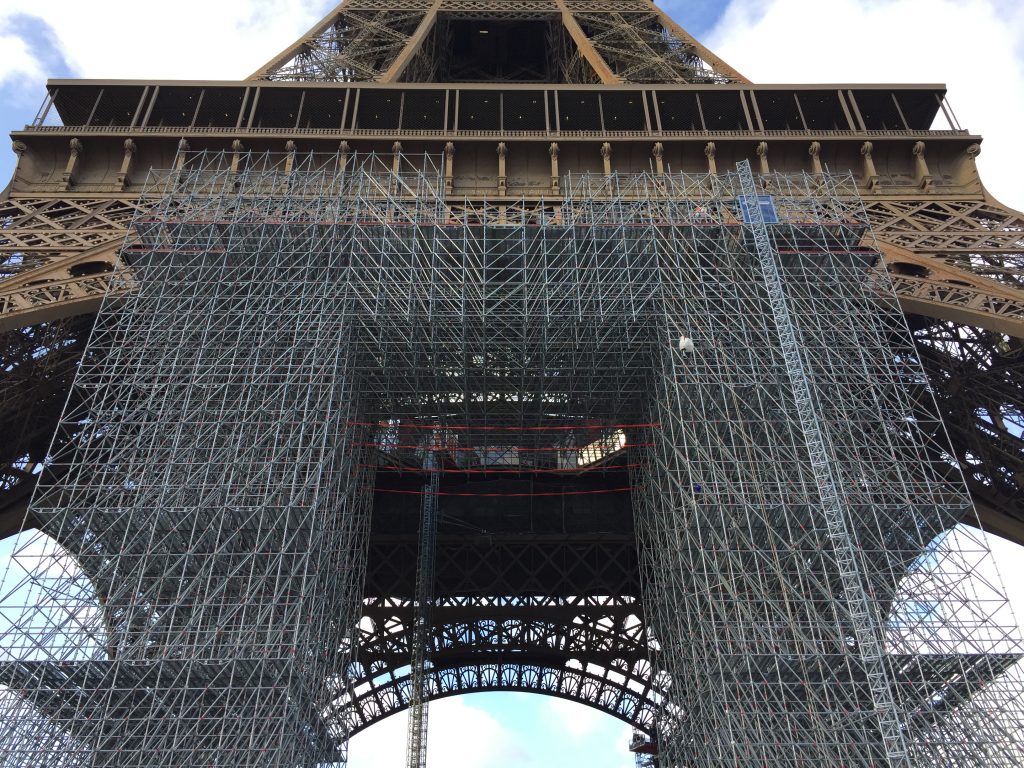
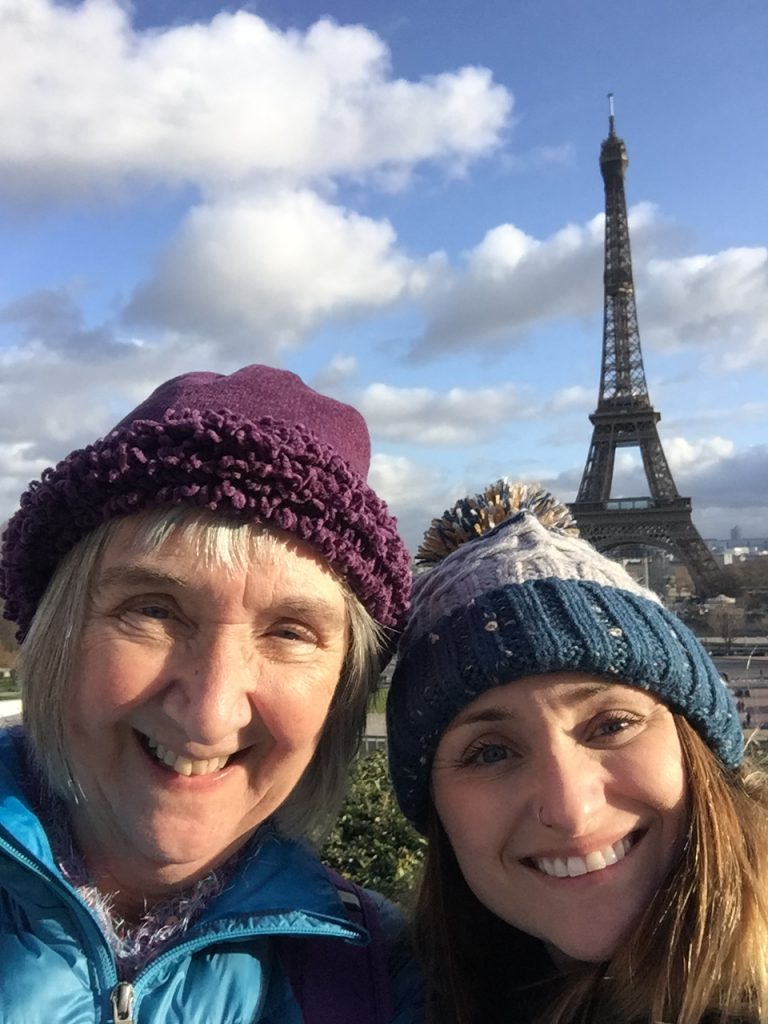
We weren’t going to go up the tower but the line to go up didn’t look too long. Up this close the engineering feat just blew my mind – how could anyone could design something that had so many separate pieces all riveted together? Apparently there are 2.5 million rivets. (Thanks to Griff again for that piece of trivia.) It’s also the world’s most visited tourist attraction. We walked towards the steps at the end of the boulevard. Anna wanted to get her profile photo taken there a while ago updated.
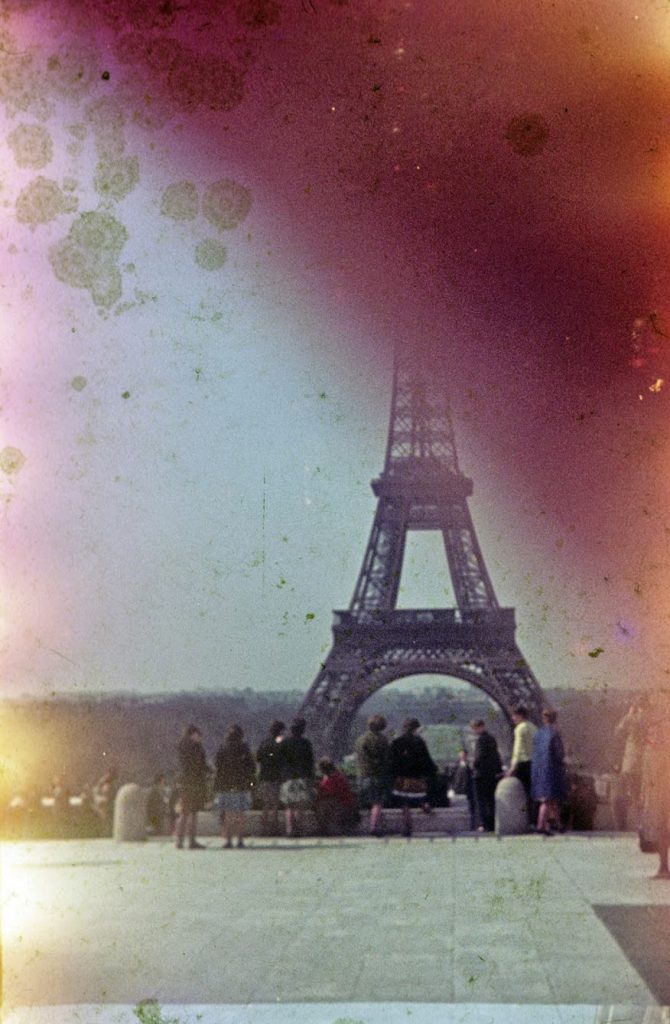
We were now deep inside tourist territory with people glued to their phones posting their photos to social media , admiring the street artists and browsing the souvenir stands. However, in all this I simply could not find a bathroom. We wandered around for what seemed like an hour, someone eventually directing us to a street toilet, but the door wouldn’t open. Finally I entered the Museum of Man (!) and used their facilities. As we came out I took a photo of some gold colored statues on the side of the square. It wasn’t until I arrived home that I found that my dad had taken a photo from exactly the same spot. When I was quite young, maybe about 8 years old he had organized 2 trips to Paris for his high school art class in the Easter holidays.
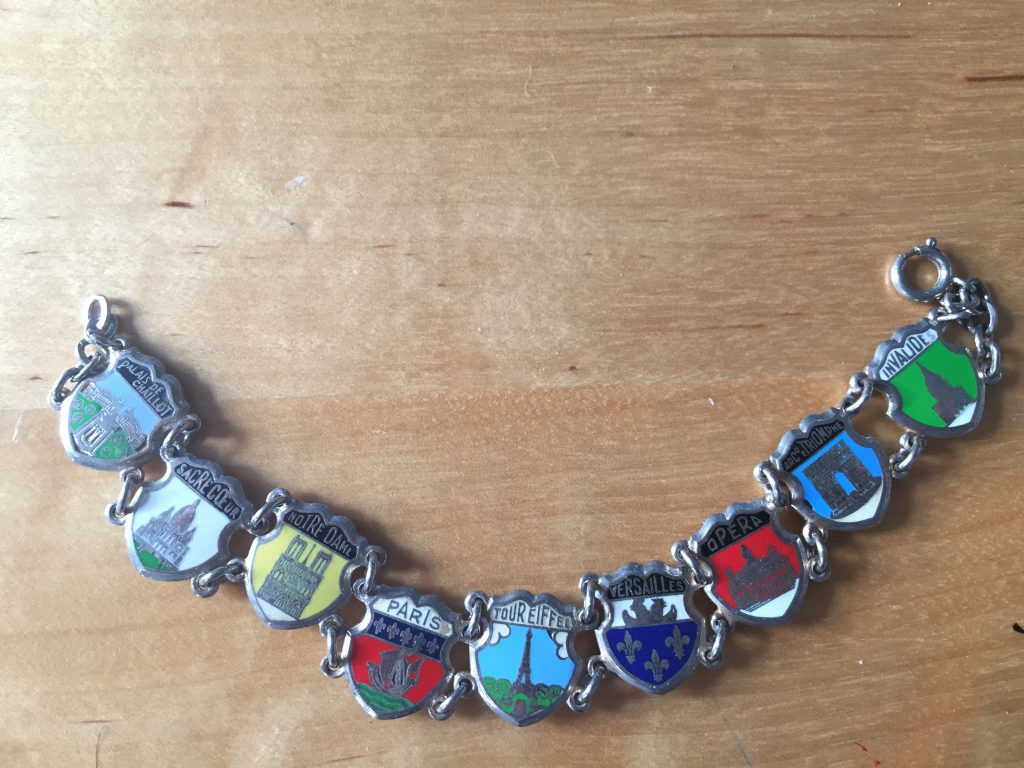
The bracelet my dad brought me home from Paris in 1963. Yes, I still have it!
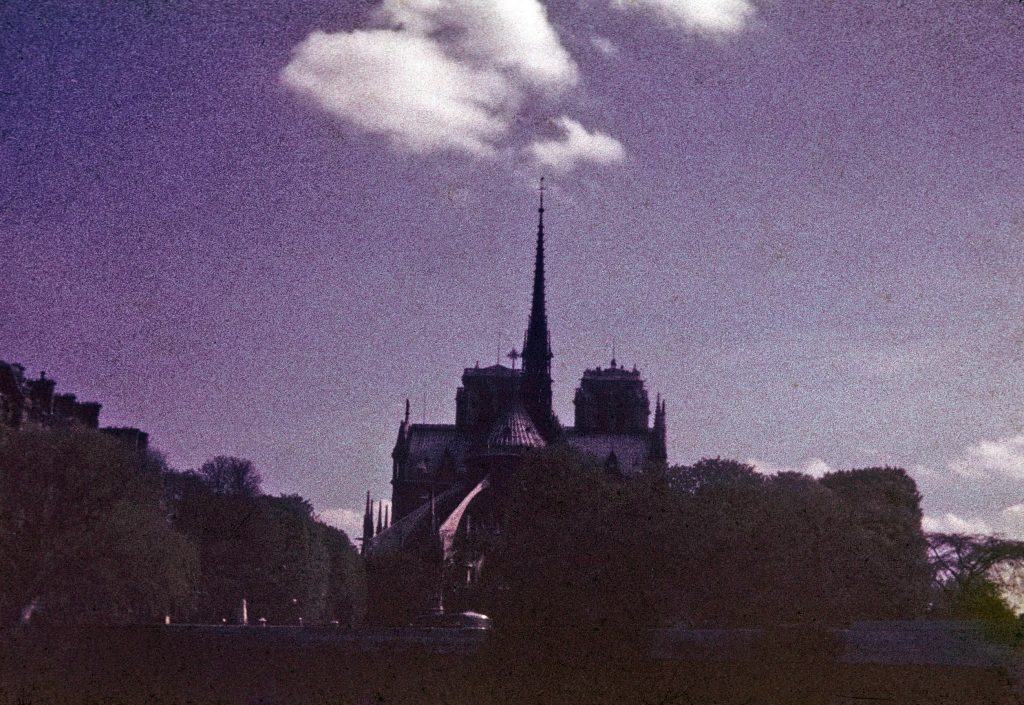
My dad’s slides of Notre Dame
He took a few slides that have deteriorated badly but I had them digitized a few years ago and so now, with this trip, I was able to identify the exact places that several of them were taken from. It wasn’t until that moment that I connected these trips taken in the early 1960’s with Anna’s love of Paris, the only place ‘abroad’ that my dad ever visited.
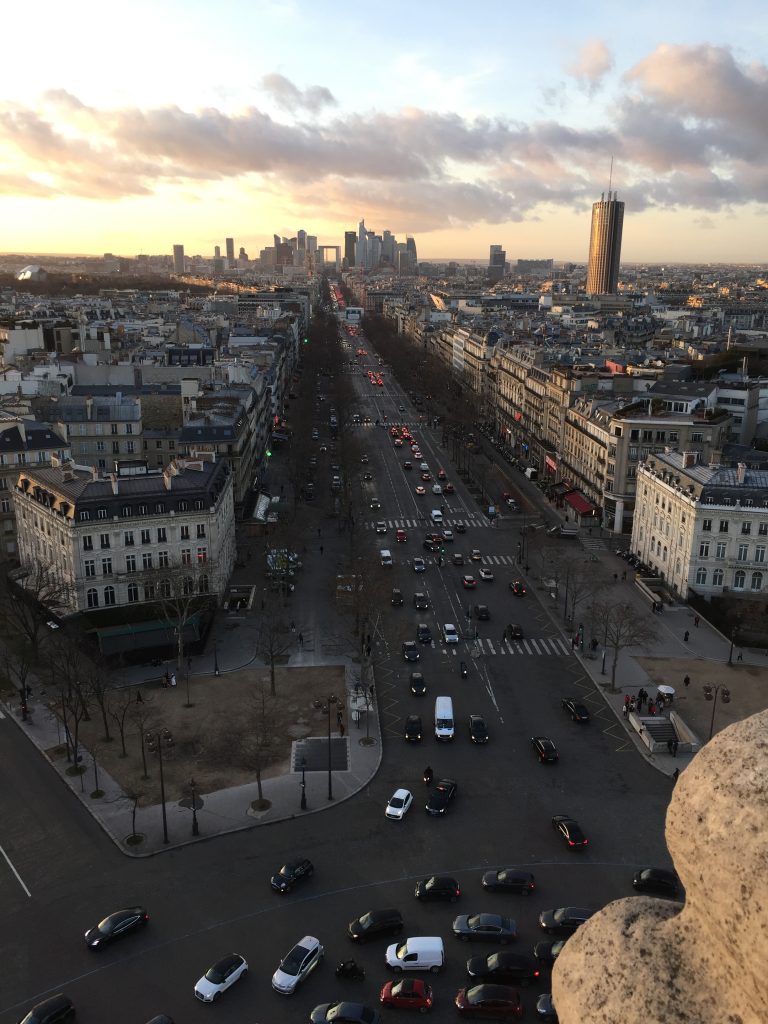
View from the Arc de Triomphe
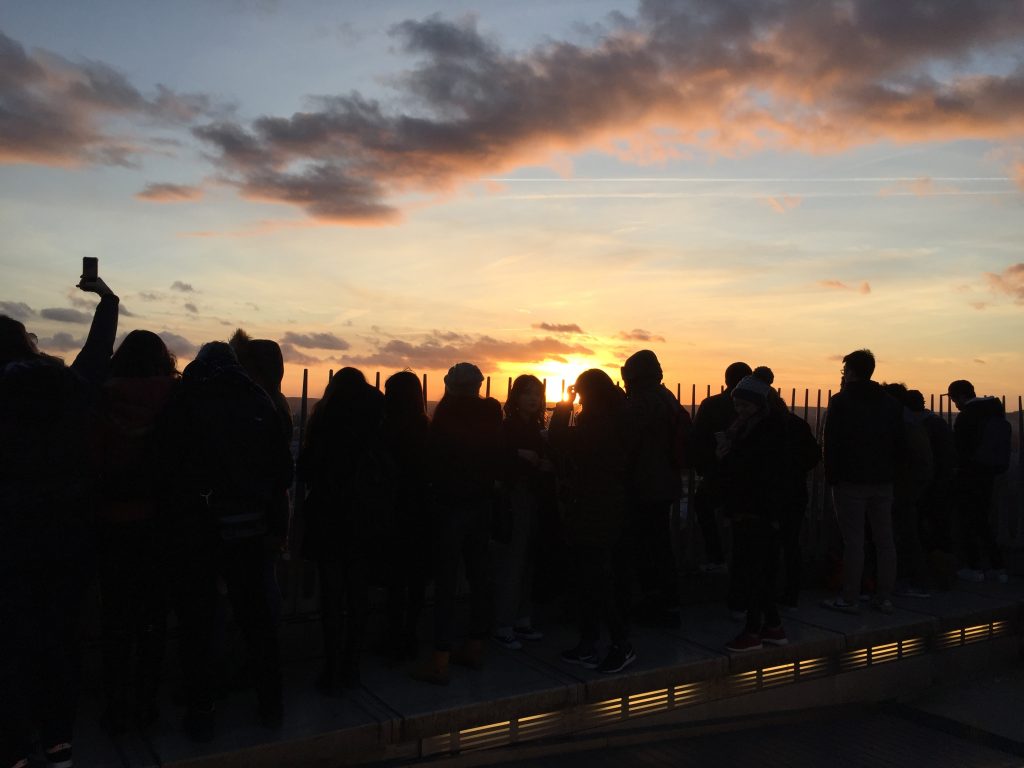
We watched the sunset from the top
Back to the bus and our next stop was the Arc de Triomphe. Known as ‘the greatest obstacle to road safety in Paris’ twelve major roadways converge at this famous landmark. There are no road markings of any kind and we were relieved to find a subway. When someone at choir the following week asked me about my trip she related the story of how her and husband had walked across!! When I’d gone to Paris in 1984 I’d stayed at the bottom of the monument while Colin had gone up to the lookout point so this time I was eager to get to the top.
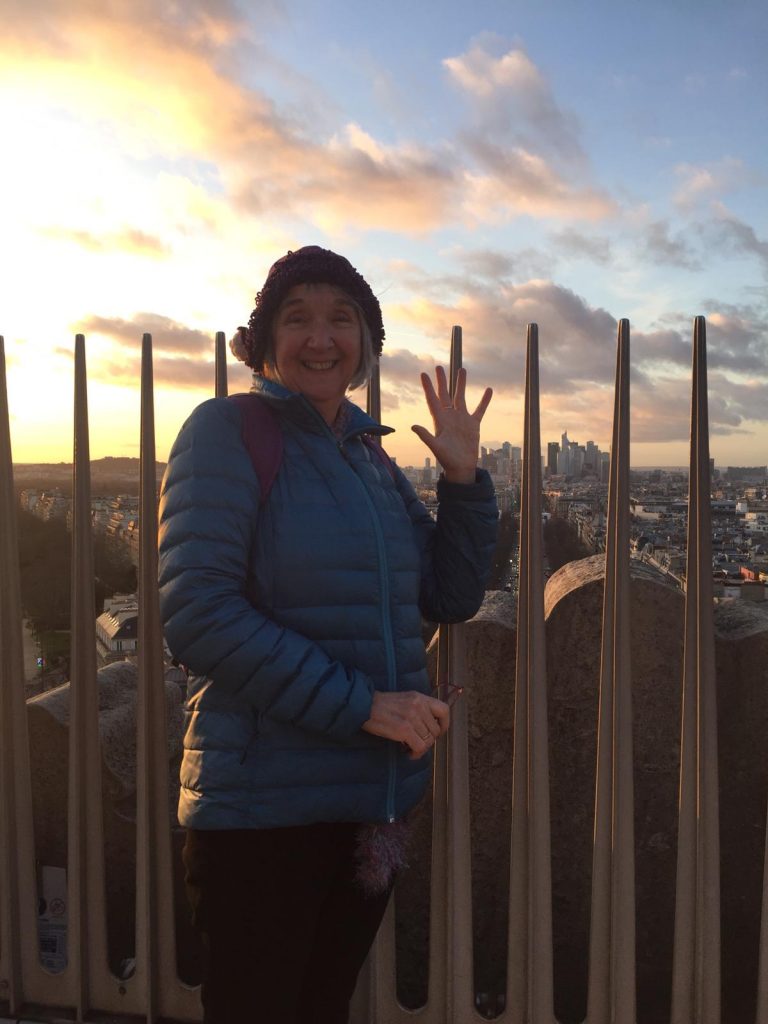
Top of the Arc
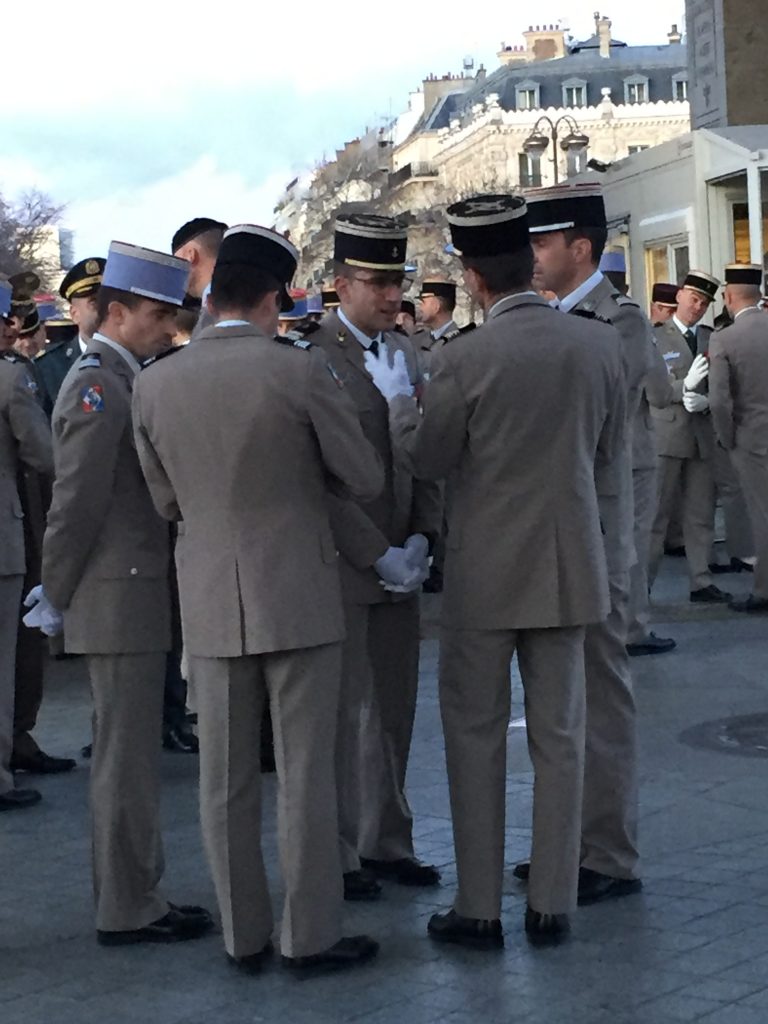
A staircase leads to the top but several displays about the building on various levels break up the climb. We had timed it just right and we were able to watch the sun set, along with many others vying for the best position to take their photos. After the battle of Austerlitz Napoleon promised his victorious troops that they would enter Paris through a triumphal arch. However, it wasn’t completed until 50 years after his death. Beneath the arch is the tomb of the unknown soldier which is relit in a military ceremony every evening at 6:30 and we watched the uniformed men preparing, though we didn’t stop to see the event because, with the setting sun, it had suddenly got much colder.
Prepartions for the relighting of the eternal flame
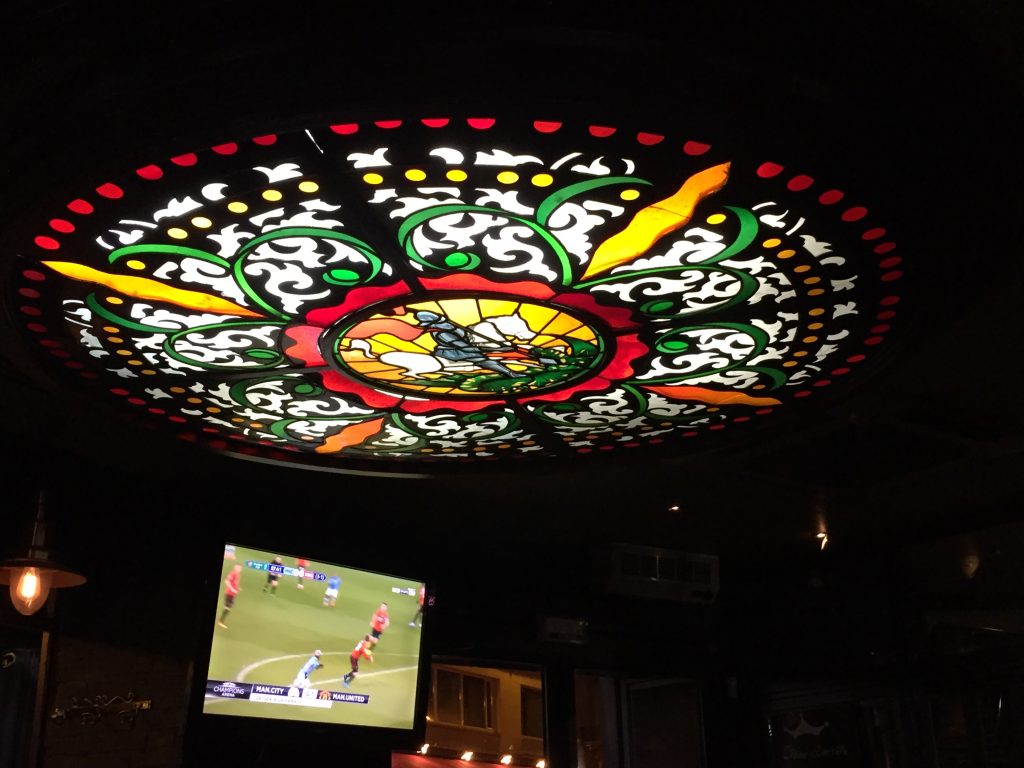
We ran to catch the bus back to our hotel, Anna fortunately retrieving her new bobble hat that she’d left on the bus. After freshening up for half an hour we were back out, this time heading for a bar to watch Manchester United v Manchester City in the Carabao Cup. We’d inquired earlier if this bar would be showing the game and the barmaid had even checked to see if it would. When we walked in she recognized us and immediately turned the two screens onto the correct channel.
During the game we were able to observe locals at play. It was strange to us how all the men gathering in groups kissed each other as a regular form of greeting. There were several groups of men, chatting, checking their phones, but there were also many tables with a couple of guys enjoying an evening together. This felt quite different from both England and the U. S. There were no loud cheers or moans during the game and it was obviously that only a few people were watching it. The backdrop to all this activity was loud music, very loud hip hop with some African style too. It was a good job we hadn’t come in for a quiet chat! Nemanja Matic put United ahead with their first effort at goal though he was later sent off but it’s City who will go through to the next round at the beginning of March. As the match came to a close a few people got up to dance and the curtains onto the street were closed. The bar had turned into a club which would be open til 2 a.m.
We were out of the hotel before 10 after a breakfast of yogurt for me and protein powder for Anna. We passed a small embroidery shop where I couldn’t resist buying a few items for future projects.
Admiring the local attractions
We were bound for Pere Lachaise cemetery and we were going on the Metro. Anna negotiated the ticket machine. You can travel anywhere on the Metro for 1.80 Euros. No wonder every train is packed – it’s so cheap. Not only is every train packed but we never had to wait more than 3 minutes for a train during the entire week. We travelled 9 stops and exited a spotless station into the bright sunlight and found ourselves right at the entrance to Paris’s most famous resting place. We took a photo of the large map on the entrance gate but when we tried to locate the graves we wanted to see we had little success. With more than 3.5 million visitors annually, it is the most visited necropolis in the world but we passed many other tourists staring confusedly at their phones trying locate tombs they were hoping to visit but there were no docents around or signs to specific graves.
Don’t lose your head
Interesting . . .
Grave of Oscar Wilde
The grave sites at Père Lachaise range from a simple, unadorned headstone to towering monuments and even elaborate mini chapels dedicated to the memory of a well-known person or family. Many of the tombs are about the size and shape of a telephone booth with just enough space for a mourner to step inside, kneel to say a prayer, and leave some flowers.
Memorial like telephone booths
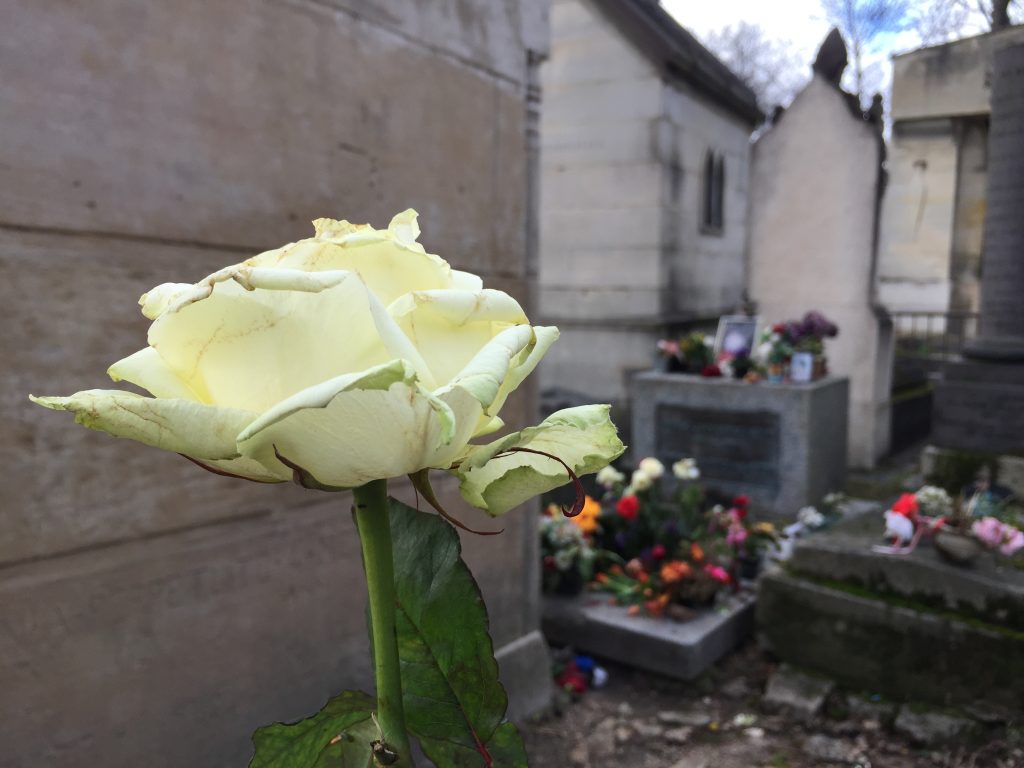
Nobody can say for certain how many people are buried here, but estimates vary from 300,000 to 1,000,000. We knew that some of the most visited graves are those belonging Jim Morrison and Oscar Wilde. Eventually we found Oscar Wilde’s – a rather odd sculpture. The tomb, designed by Jacob Epstein in 1914, features the sculpture ‘Modernist Angel’, which is roughly three meters tall and very impressive. It is surrounded by glass and a sign reads Don’t deface the glass because the Wilde family are responsible for the clean-up. Many Metro tickets had been thrown into the glass enclosure, along with a few letters. Apparently the tomb gets around a thousand visitors per day but there were only a couple of people there besides us. Even Jim Morrison’s grave was hard to find.
Grave of Jim Morrison
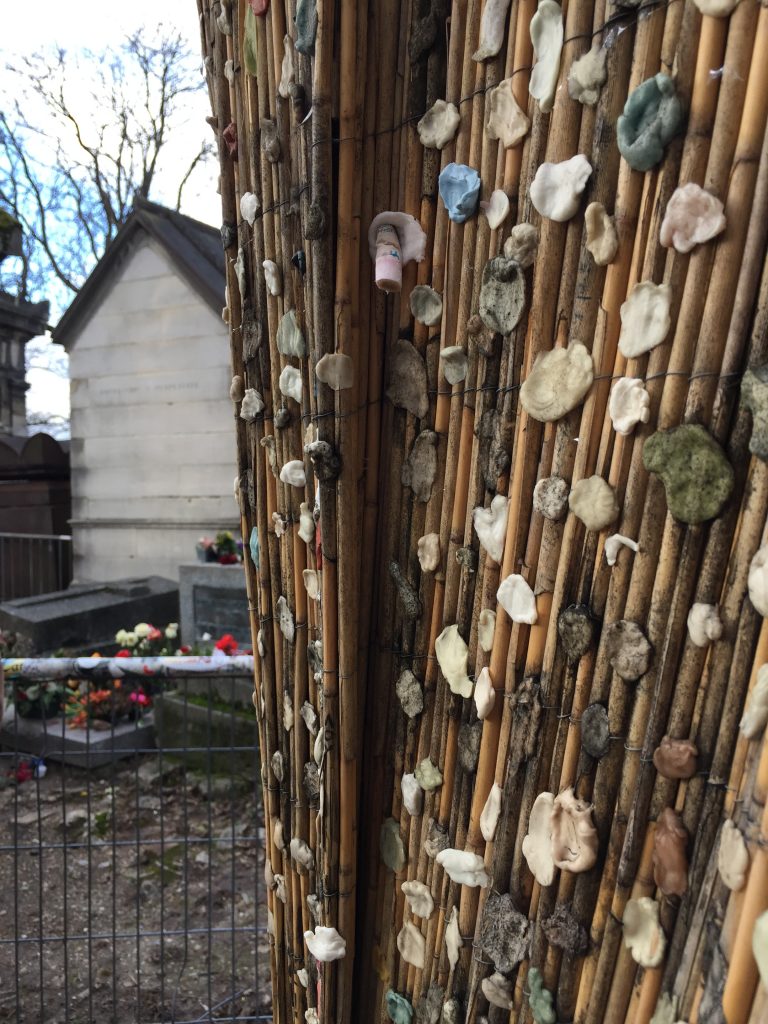
It’s tucked in behind others and covered with many flowers, and a bamboo screen covered in chewing gum (!) .
Gum at Jim Morrison’s grave!
Soon after Morrison died (in Paris, of a suspected drug overdose), his body was placed in an unmarked grave in the cemetery. When the decision was made to mark the grave with a simple sign it was promptly stolen. After the same thing happened to a bust of the musician, a guard was installed to ensure that visitors did not deface or destroy the grave in any way. The final resting place of Chopin and Edith Piaf were on my list but we’d just about given up trying to find them when we were approached by a gentleman, dressed in black, who introduced himself as Rafael.
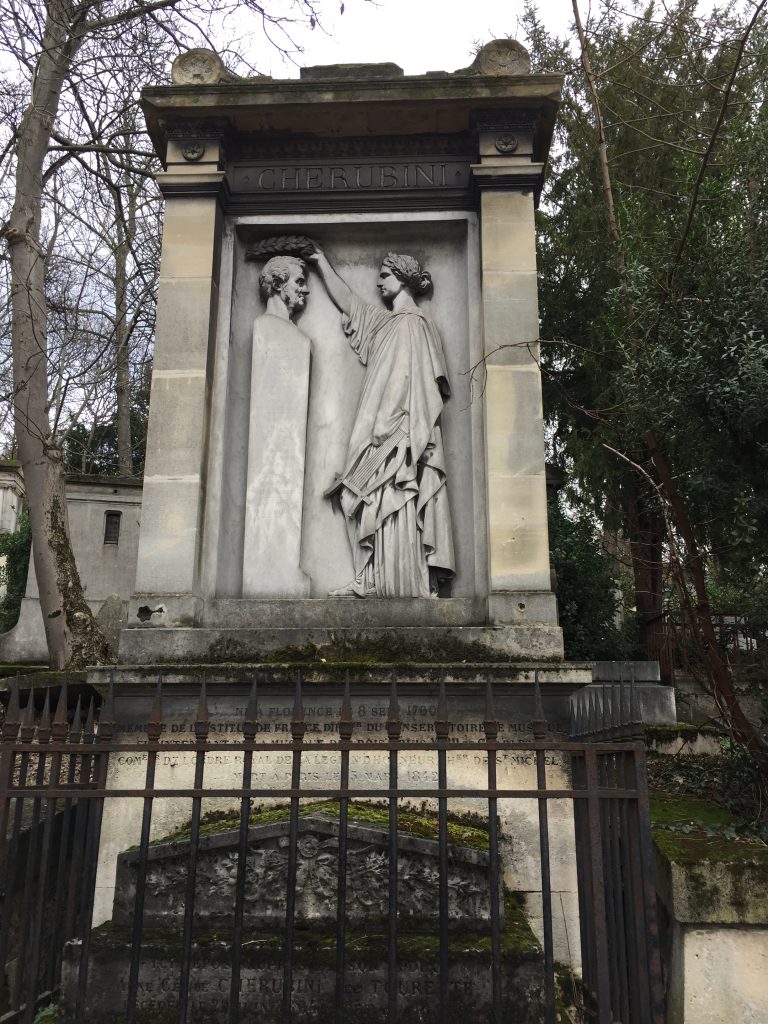
Grave of Cherubini
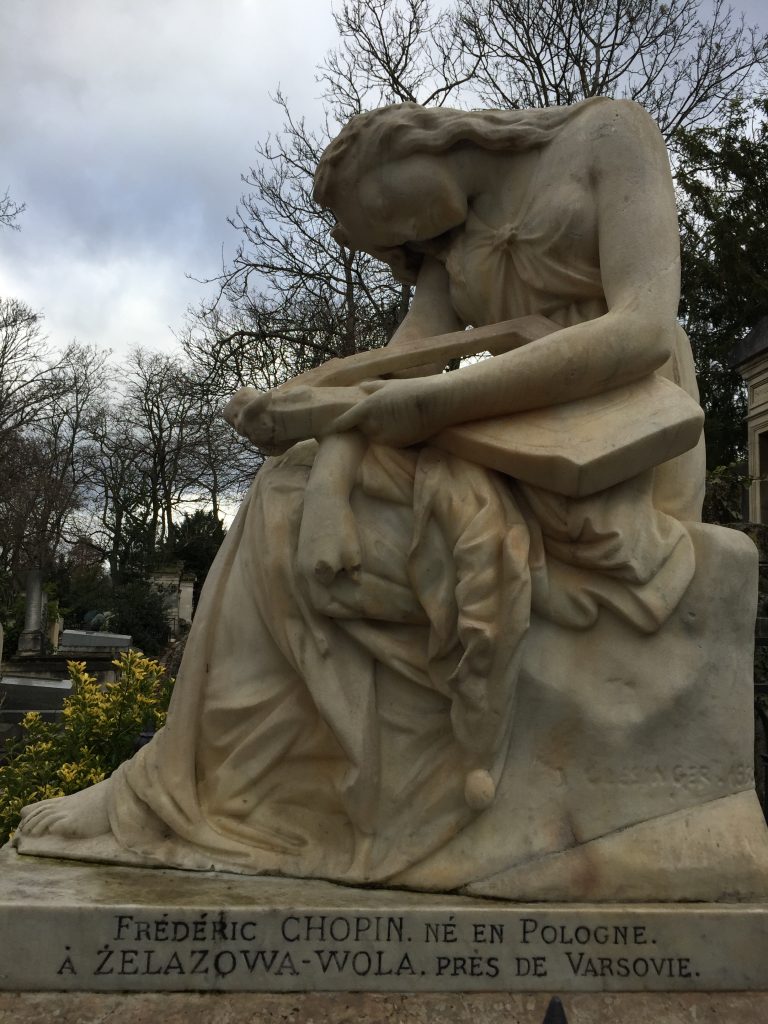
Grave of Chopin
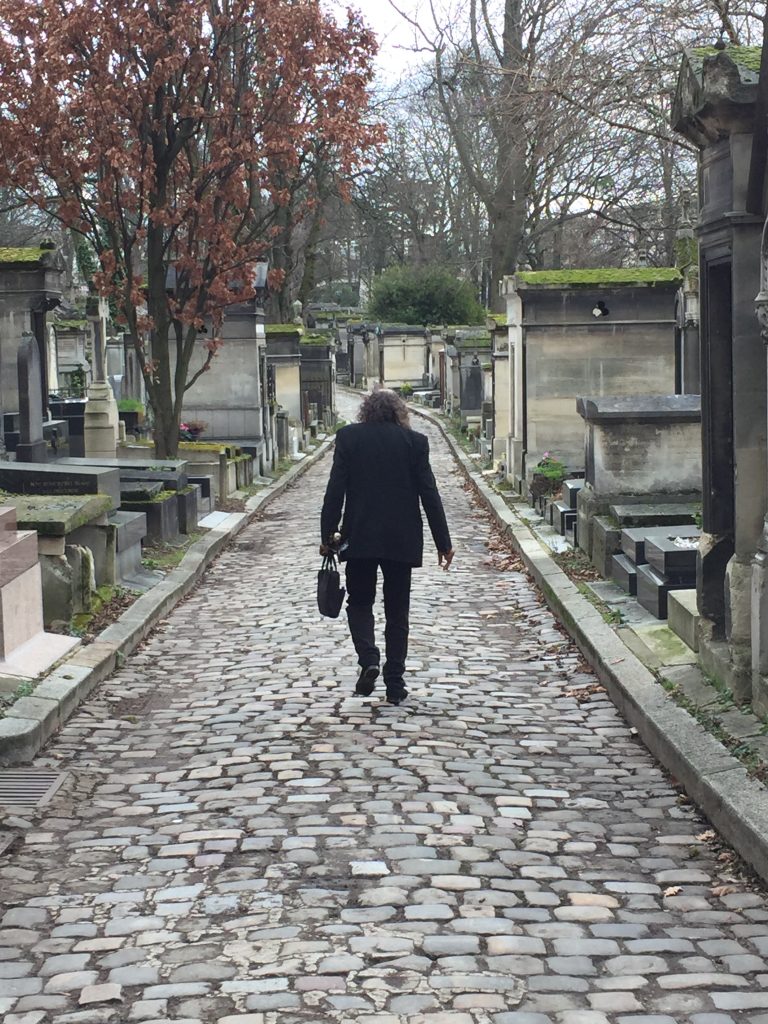
“You are looking for the grave of Chopin? I will take you there. Short cut!” And with that he set off at a gallop between graves, along slippery slopes, checking to see if we were following him and keeping up a running commentary about all the musicians associated with the cemetery and Paris in general.
Rafael leads the way
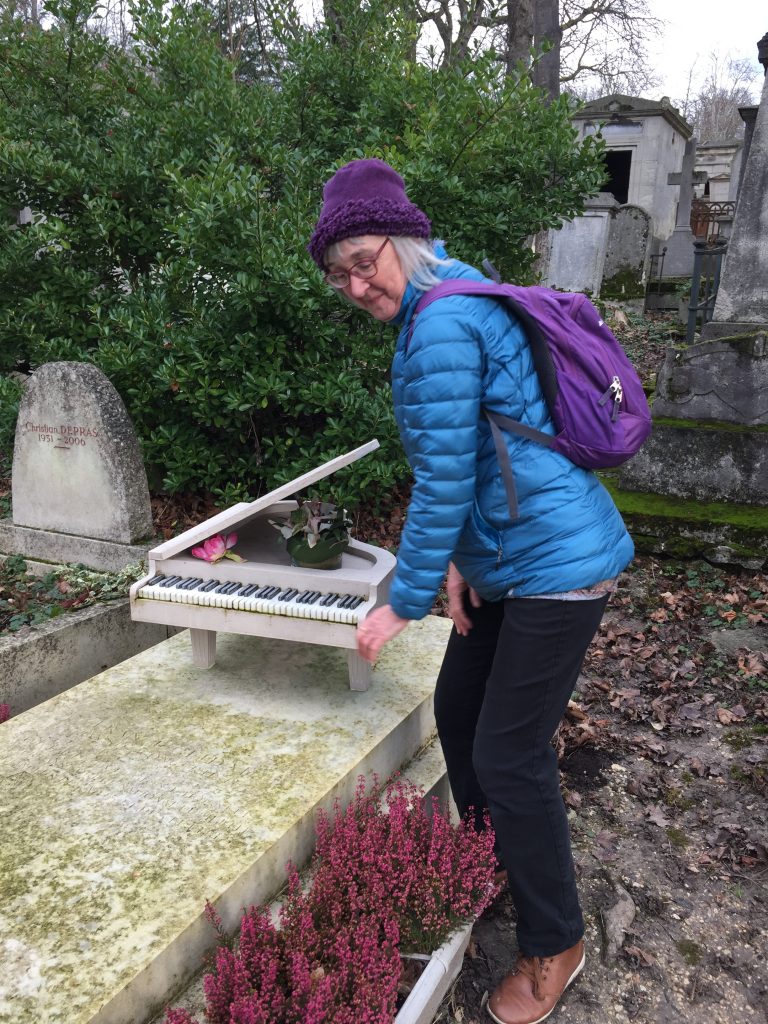
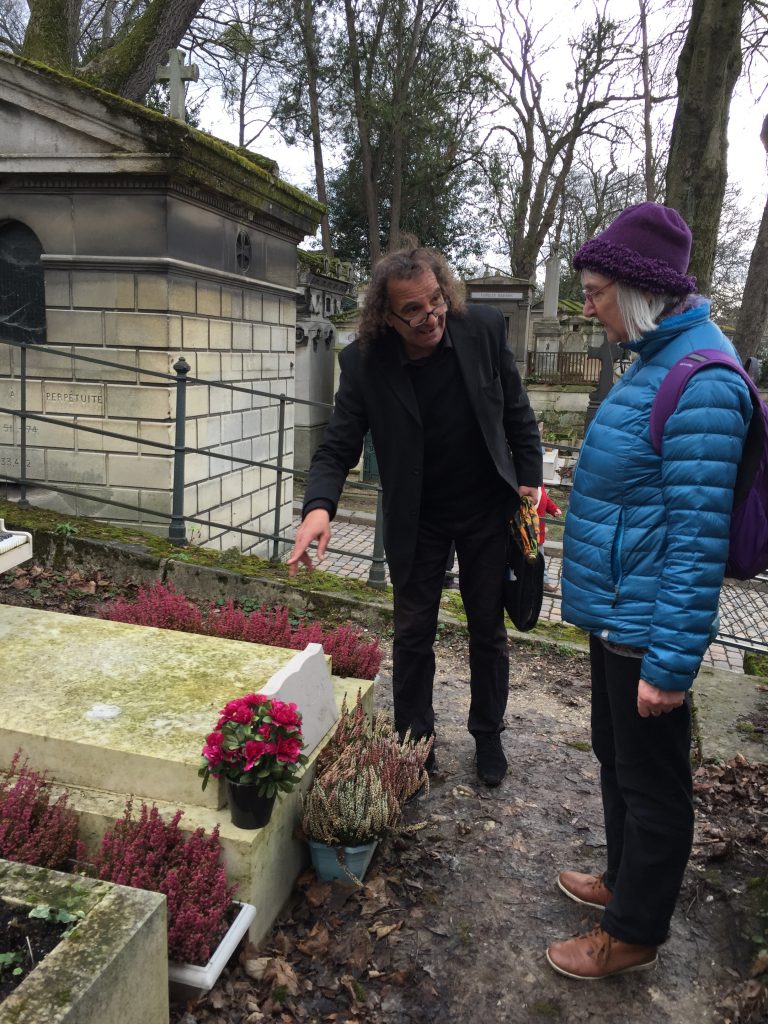
He seemed impressed by my knowledge but I was more impressed by his! Anna signalled to me her unease and indicated that Rafael would demand money from us, but, having just been about to give up in our search I was happy to hand over a few Euros. As I clung to iron railings surrounding graves to avoid slipping he reeled off the names of all the composers buried here. “Poulenc, Bellini, Pleyel, Erard, Cherubini, Bizet, Dukas, Enescu,” He even led me to a grave on top of which was a sculpture of a small piano, and insisted I pose for a photo. Feeling very fortunate to have been given our own personal guide we took our leave – and he didn’t complain too much about his tip!
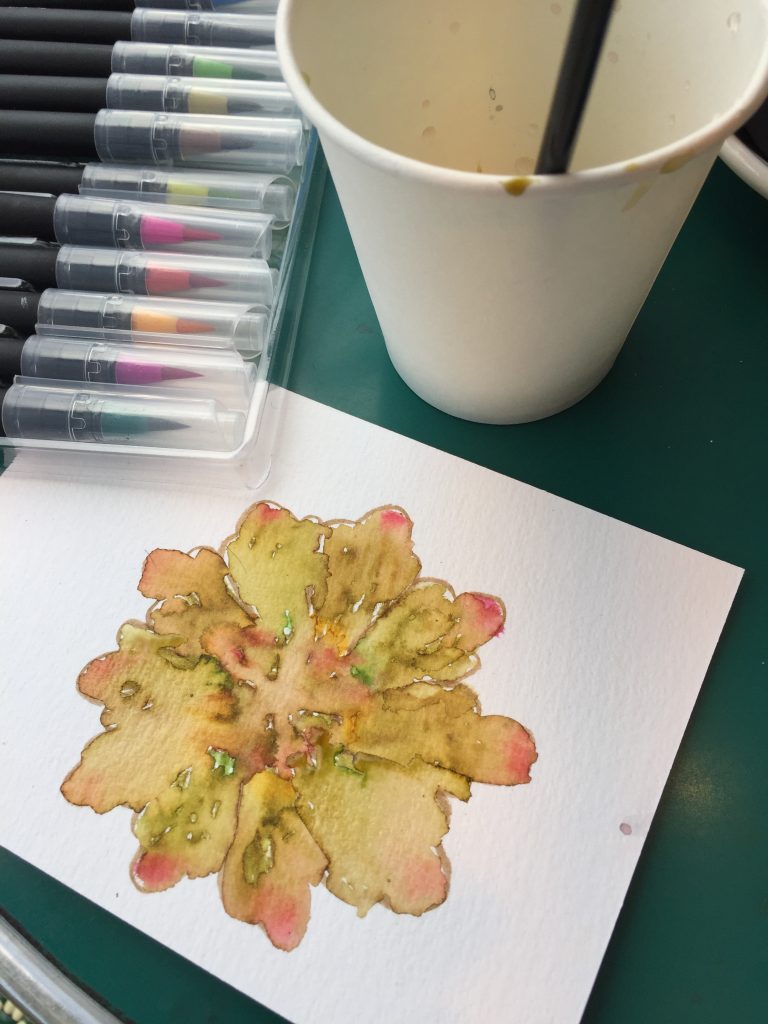
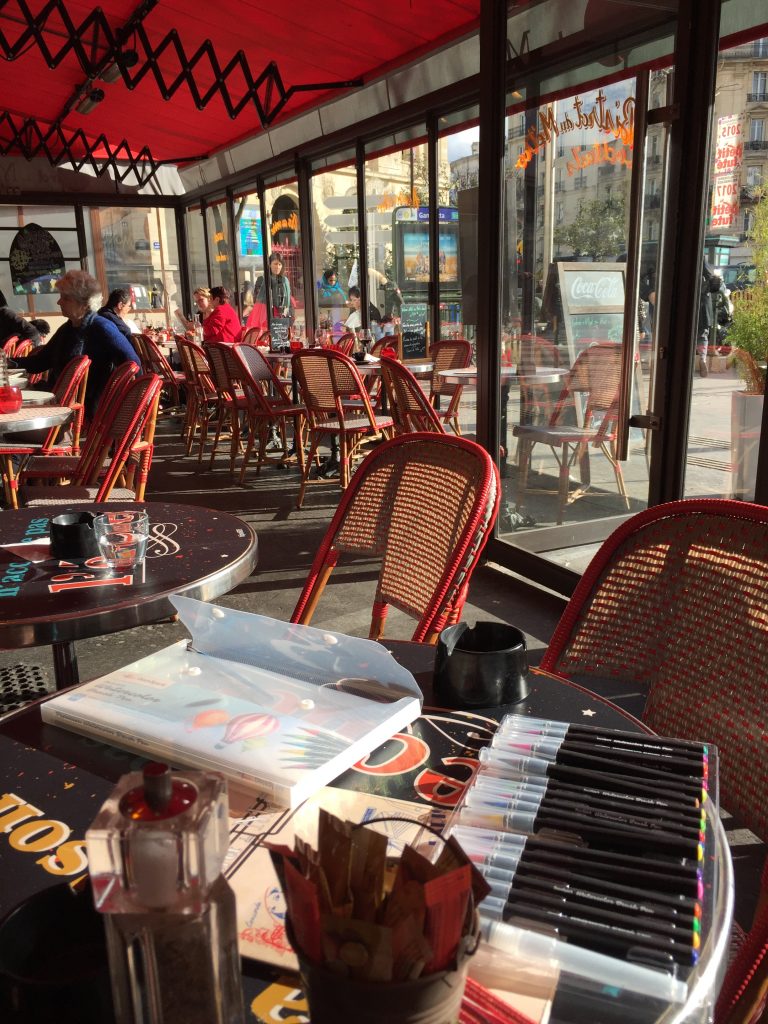
Before leaving the district we had lunch at the Bistro du Metro – coffees, crepes and fries. Just why are they called French? There are many explanations, but all I can say is that all the French fries we had on our trip were delicious. I brought out the watercolour pens that had been a Christmas present from Anna and we played with those for a while.
Artists at work
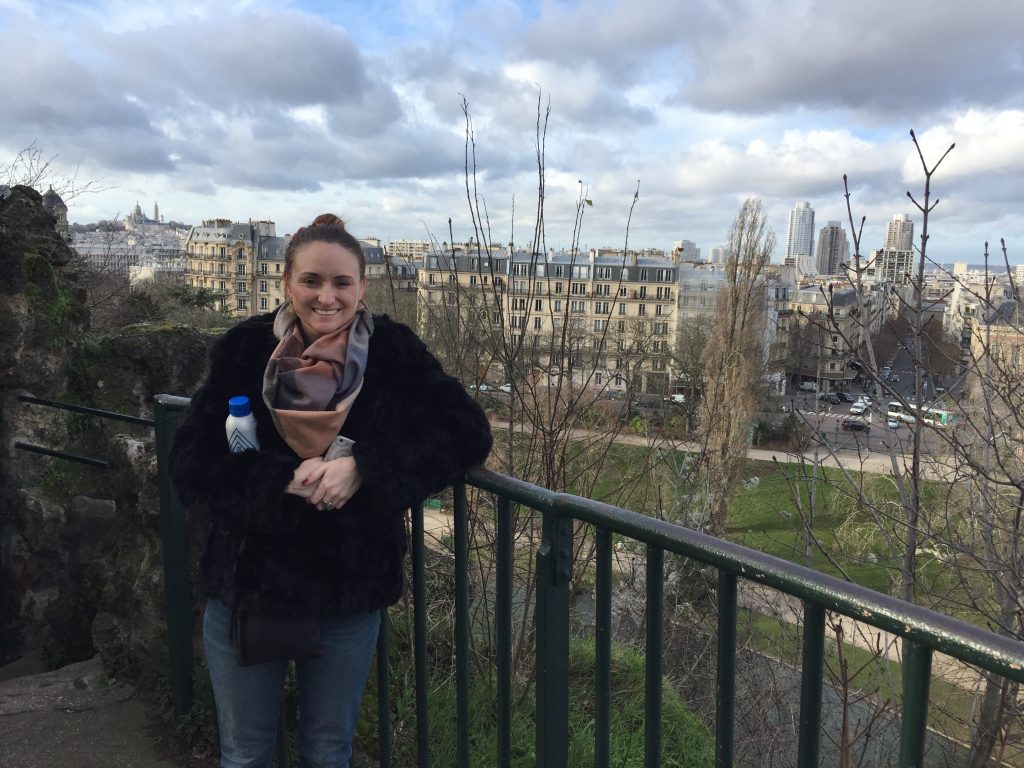
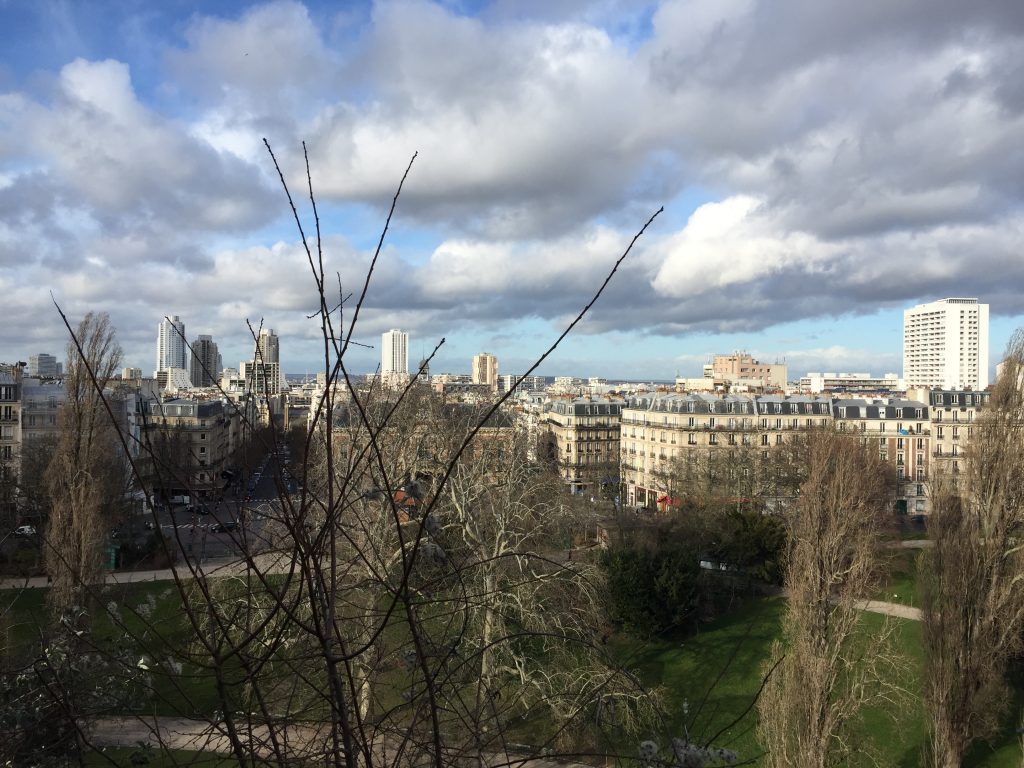
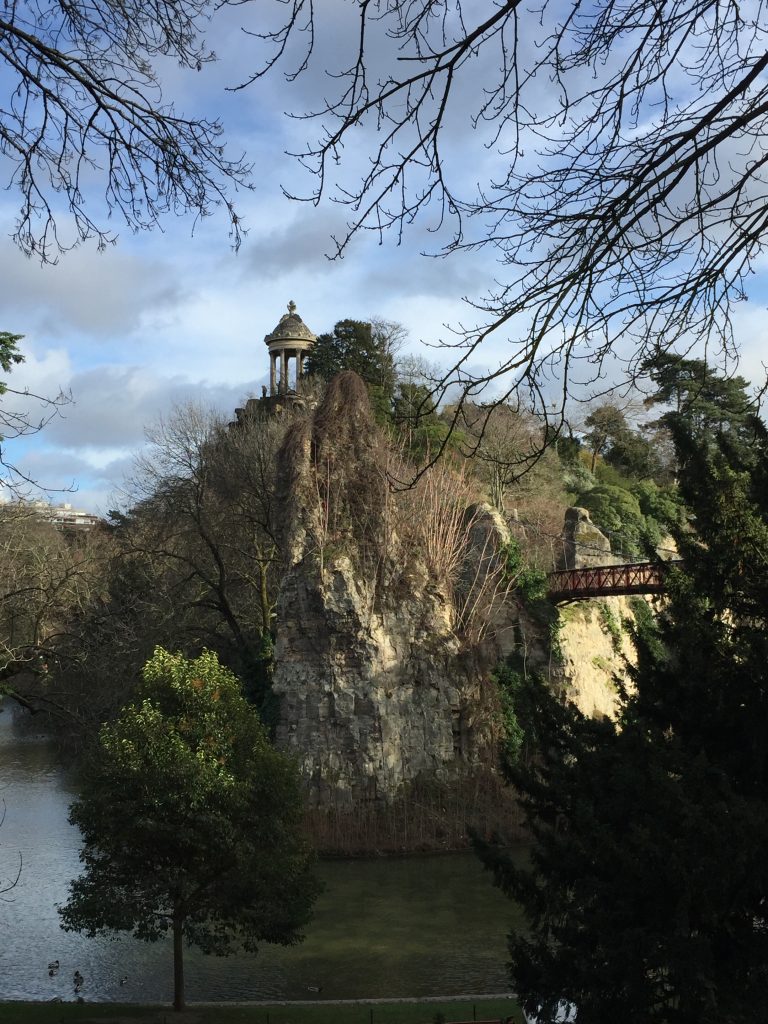
After lunch we were off to see Park des Buttes, a little oasis in the 19th arrondissement. The park took its name from the bleak hill which occupied the site and , had a sinister reputation; it was the site of a gibbet, the notorious place where from the 13th century until 1760, the bodies of hanged criminals were displayed after their executions. After the 1789 Revolution, it became a refuse dump, and then a place for cutting up horse carcasses and a depository for sewage. The director of public works of Paris and builder of the Park, Jean-Charles Alphand, reported that “the site spread infectious emanations not only to the neighboring areas, but, following the direction of the wind, over the entire city. ” In 1864 work began on turning the site into a park and the designer was Alphand who had designed the Bois de Boulogne. A waterfall, a grotto and lakes are spread out over 60 acres at the centre of which is a lake with a rocky island with steep cliffs made from the remains of a gypsum quarry. There’s also a miniature Roman temple that we were able to hike up to for a great view of the park and its display of winter pansies.
We headed back to the hotel for an hour’s r and r – a nap for me and a workout in the hotel’s gym for Anna and then we set off for our evening’s adventures.
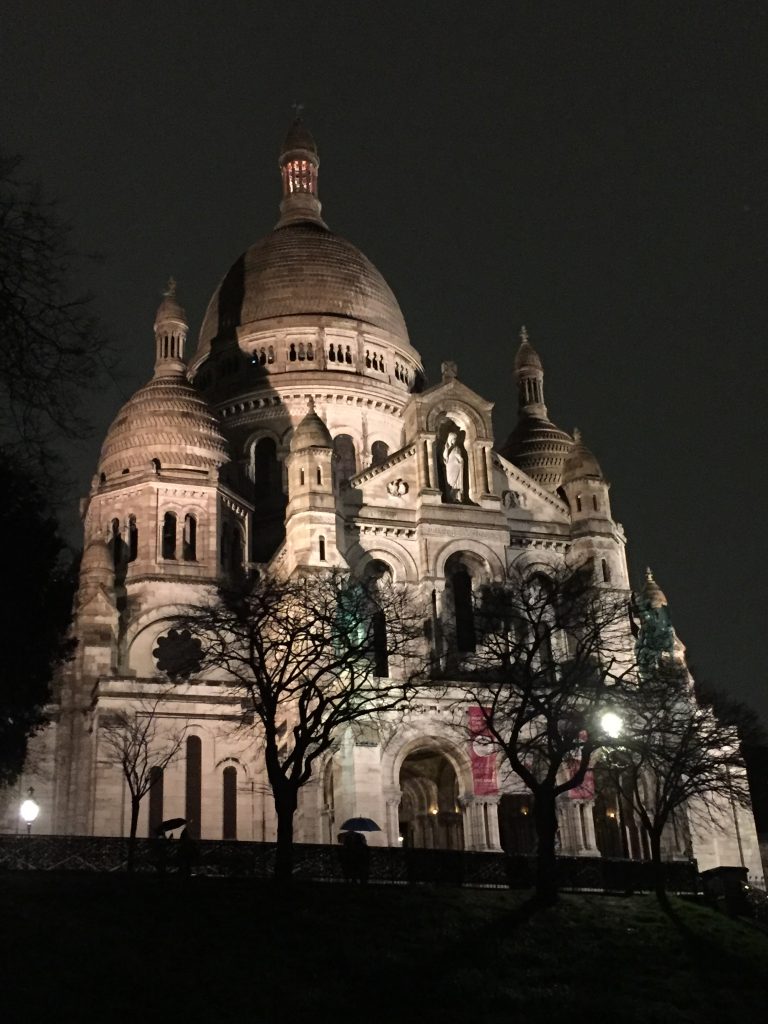
But as we exited the hotel we discovered that it was raining – heavily. I hadn’t brought my raincoat with me that evening and so I ended up getting my down jacket soaked though, all the way to the inner lining. Not a smart thing to do. I suggested that we took the funicula up to the top of Montmatre, since I’d missed that experience by walking up on my first morning, and though the windows of the cab were streaked with rain we had a glorious view of the floodlit church.
Floodlit Sacre Coeur
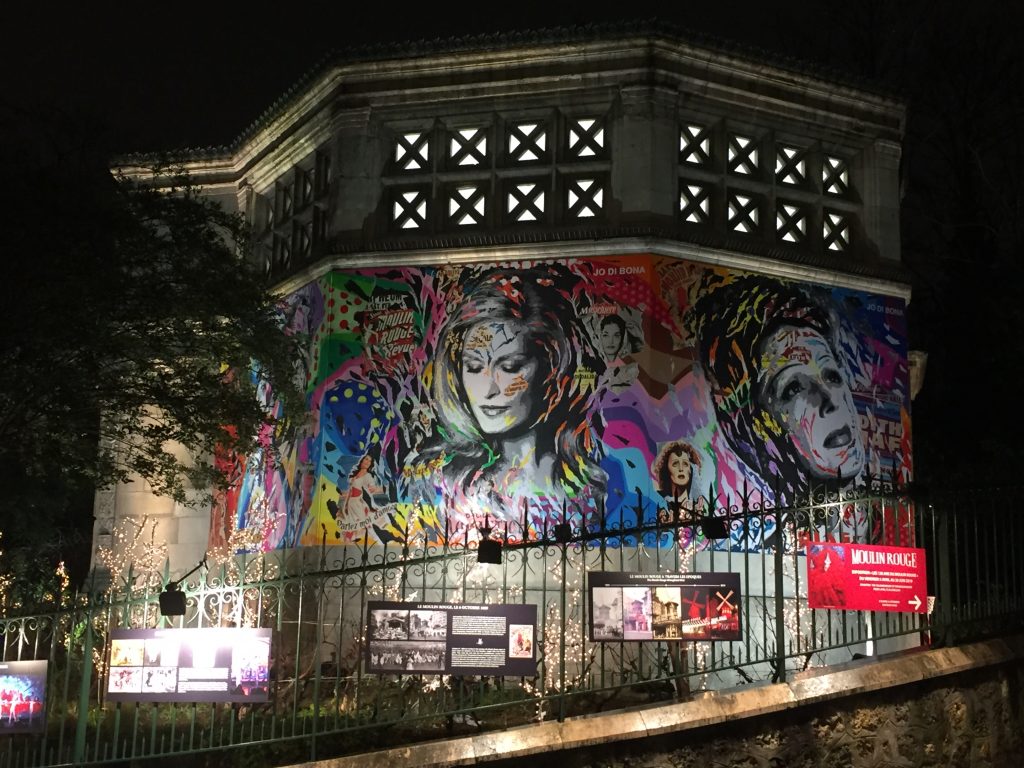
We were heading for dinner at Deux Moulins, a restaurant where the movie Amelie was filmed. This entailed quite a walk through Montmatre with the city lights reflected in the puddles and spray kicked up by passing cars and bicycles.
Street art, Montmatre
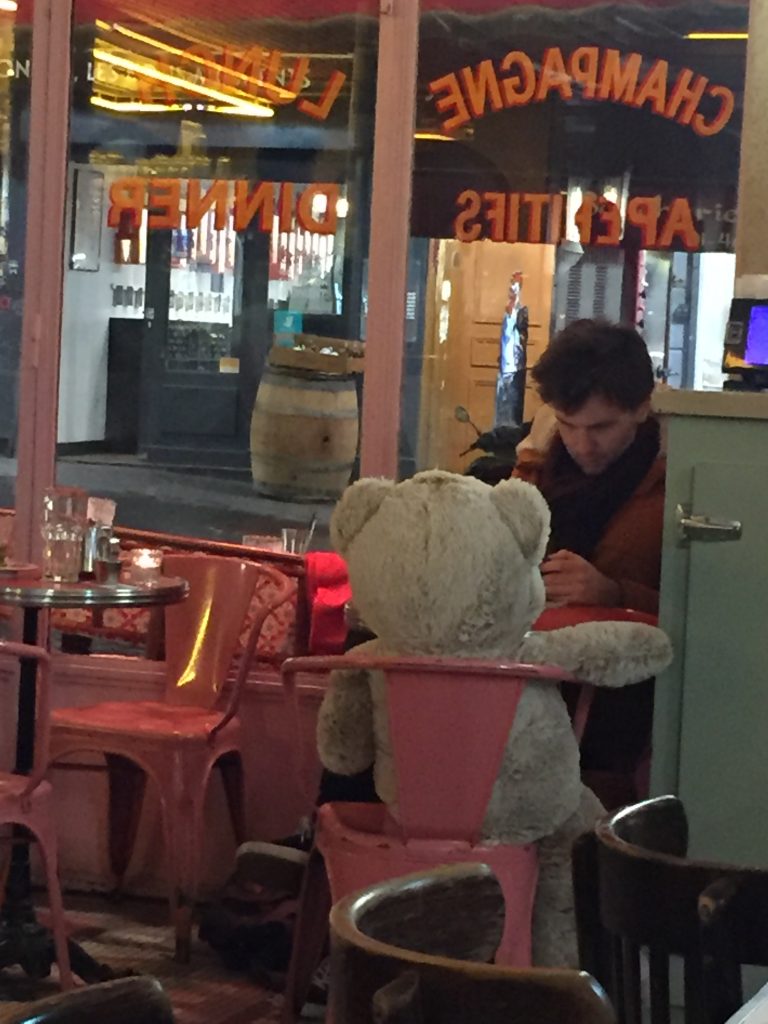
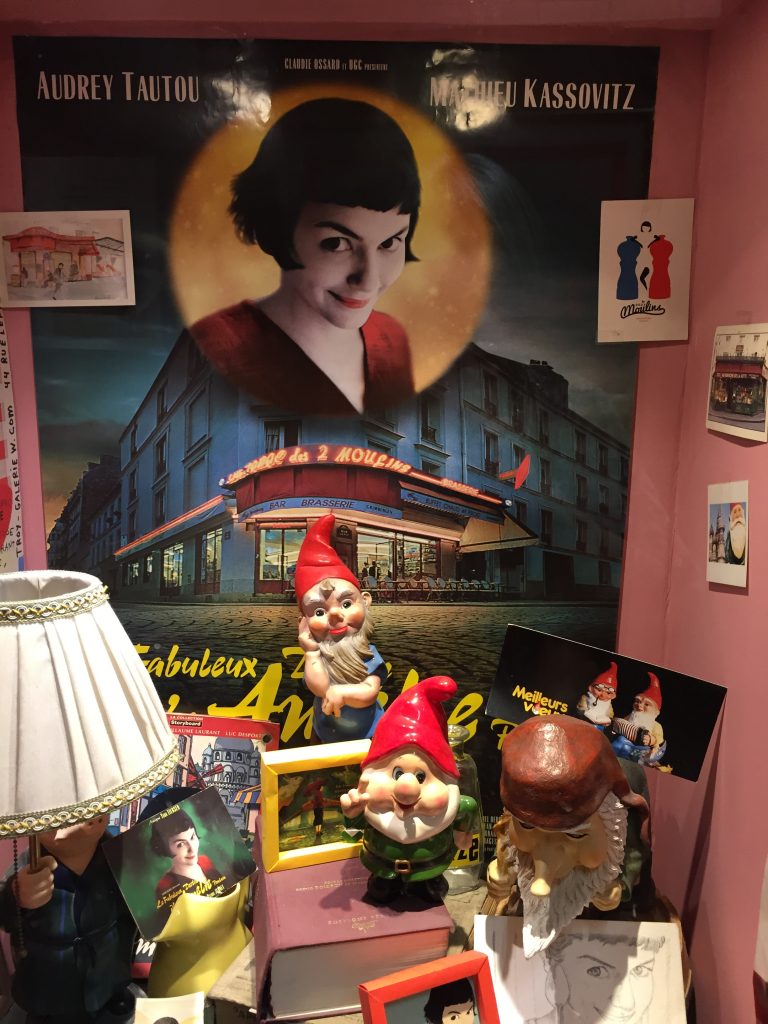
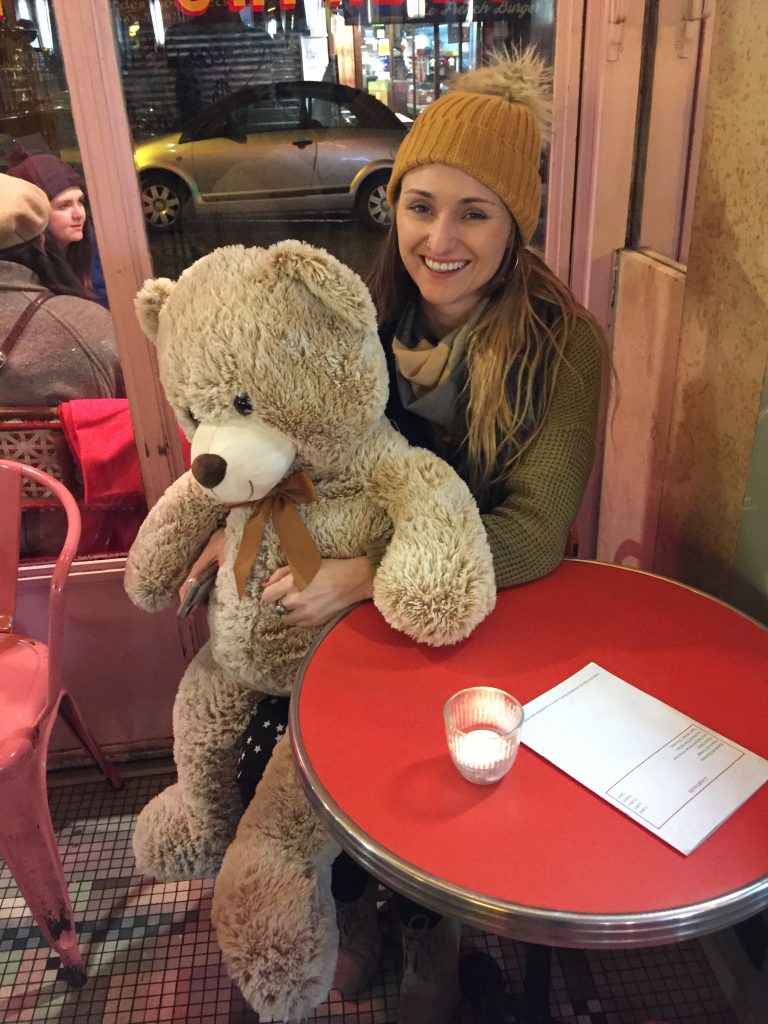
The restaurant wasn’t overly fancy but my dinner of salmon (cooked, this time) with mango, papaya and rice was delicious. Pictures from the movie were framed on the walls and in a display cabinet sat several gnomes. In a window seat was a man eating alone. Across the table from him, watching his every move was an enormous fuzzy teddy bear.
Man with teddy bear
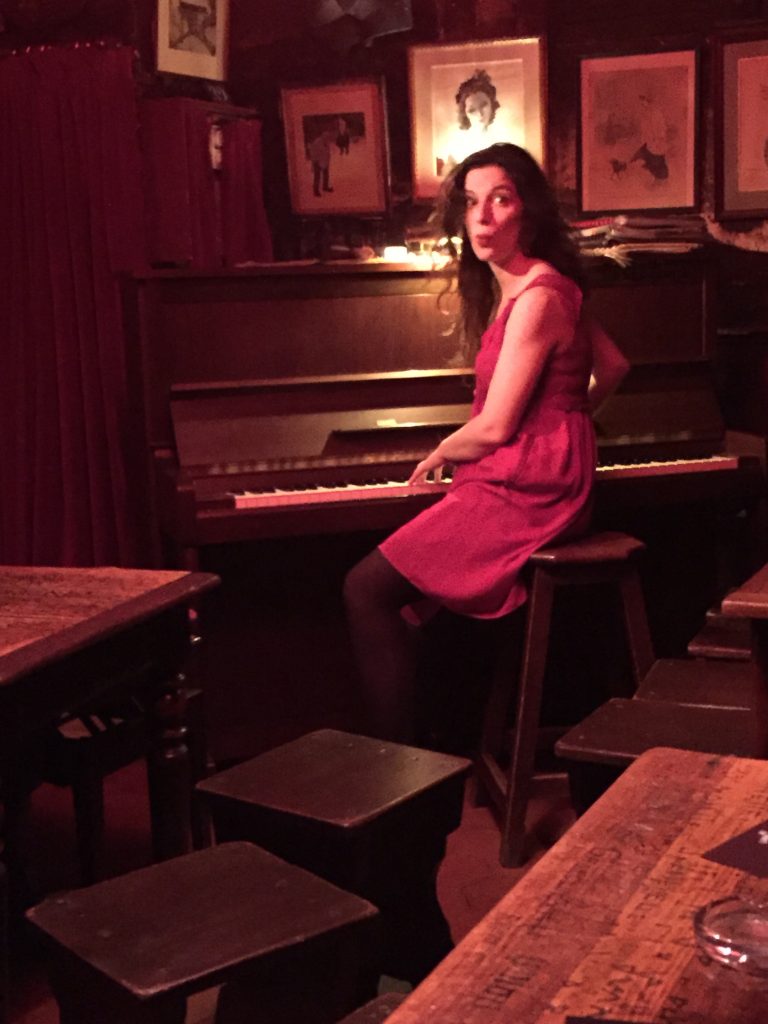
Close to the bar was a piano with the sheet music of the theme tune to the Amelie movie sitting on top. When the waiter came to take our order I pointed to the piano. “You must!’ he replied. He reminded me very much of the stand up comedian I had seen last week in Hebden Bridge, Marcel Lucont (https://marcellucont.com/), flirtatious, expressive, with a winning French accent. After we’d eaten I went over to the piano. The piped music came to a stop and I started to play. It wasn’t until I came to turn over that I discovered that there was no second page. I erupted in laughter as the entire restaurant applauded. That was fun. https://www.youtube.com/watch?v=CiR44lrl4BE&feature=youtu.be
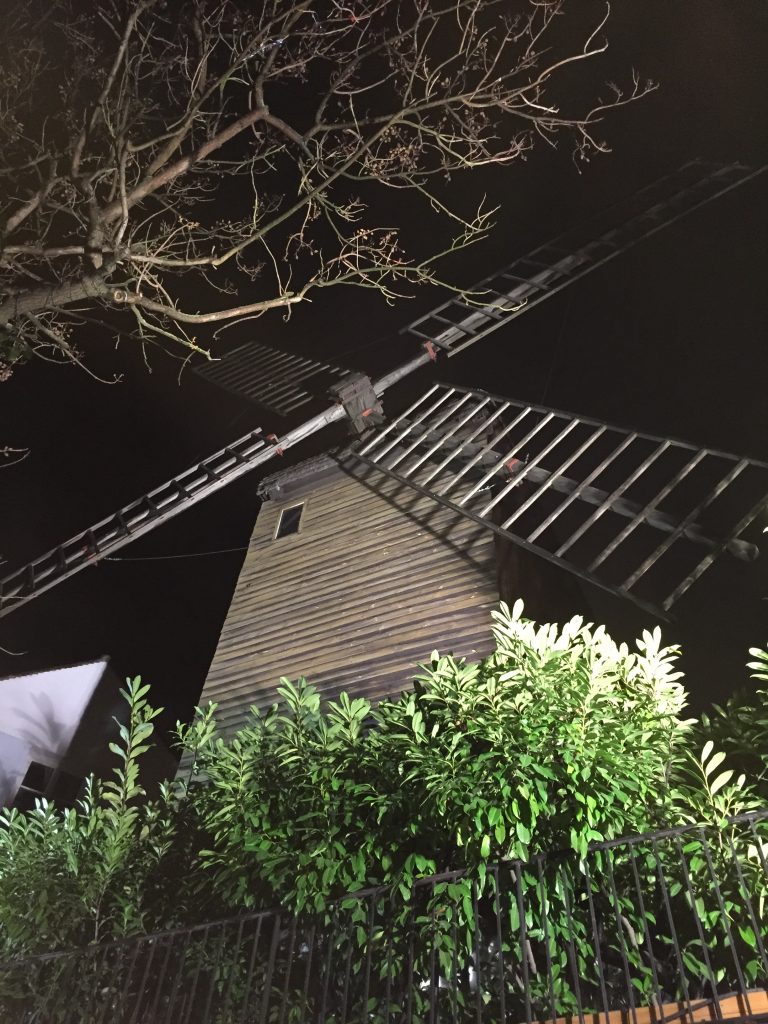
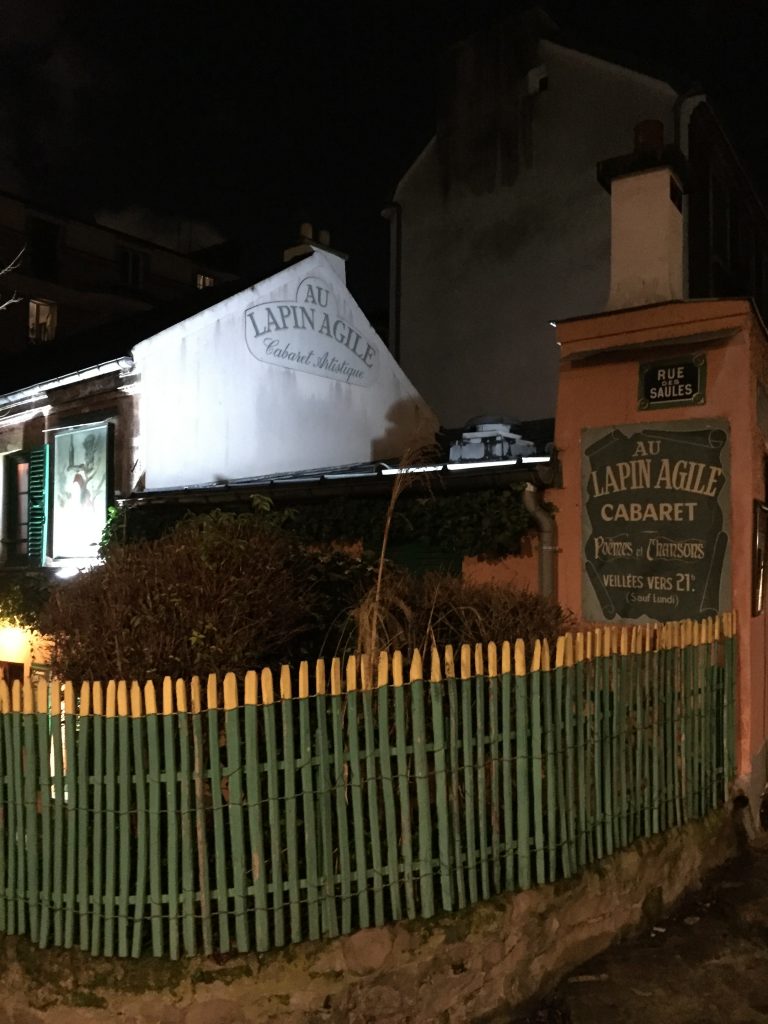
Soon we were on our way to Le Lapin Agile. I’d made reservations online at this cabaret where Debussy and Satie met. Picasso and Modigliani were regular attendees. It’s just a small building like a house. It existed in 1860 under the name Au rendez-vous des voleurs, and twenty years later the walls were decorated with portraits of famous murderers and the place became known as the Cabaret des Assassins.
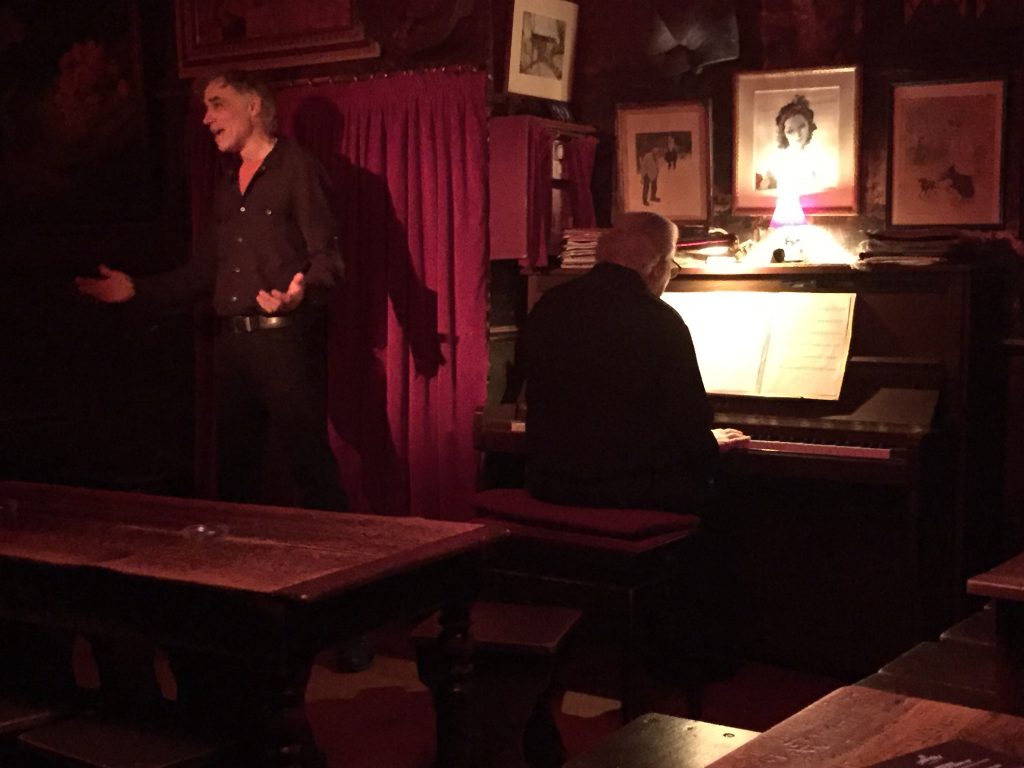
Tradition relates that the cabaret received this name because a band of gangsters broke in and killed the owner’s son in a robbery attempt. In 1875, the artist Andre Gill painted the sign that was to suggest its permanent name. It was a picture of a rabbit jumping out of a saucepan, and residents began calling their neighbourhood night-club Le Lapin à Gill, meaning “Gill’s rabbit.” Over time, the name had evolved into “Cabaret Au Lapin Agile,” or the Nimble Rabbit Cabaret. The original painting on canvas was stolen in 1893 and a reproduction on timber was painted to take its place. It was very dark inside with minimal lighting. We hadn’t paid online and my name was handwritten on a tiny scrap of paper at the desk. Our coats were taken and we were led to a table in a small darkly lit room where a man was playing the piano. And what a pianist he was. Although the piano was a simple Yamaha the sound quality he got, from the upper notes especially, was amazing.
About 15 people were sat at wooden tables deeply scored with the names of previous visitors, listening to this pianist. The two girls next to us were visiting from Belarus. The walls were filled with paintings and sculptures so that there wasn’t an inch of space remaining. About 20 minutes later 6 people entered and sat at a table together and we presumed they were just more visitors. But then they began to sing along to some of the songs from the piano man and we realized that this WAS the cabaret. The ‘real’ guests joined in with the singing of many of the songs, and one by one the artists sang solos and did turns on the piano. Judging by the reaction of the visitors many of the songs were hilariously funny but, of course, they were all in French, so we just watched, which was almost as much fun. https://youtu.be/tjtTqByI-gw
One singer accompanied herself on the piano but stood with her back to the keyboard and played it behind her back. It was almost midnight when we left this wonderfully evocative place that had been the starting point for so much music and art. We took a taxi back to the hotel where my sodden coat dried out overnight perfectly in the heated bathroom.
(Sitting in a cafe overlooking the street where I should see Anna pass as she leaves the station and heads for our hotel. Opposite my sitting spot is Cafe Marmite on the Rue de Paradis!)
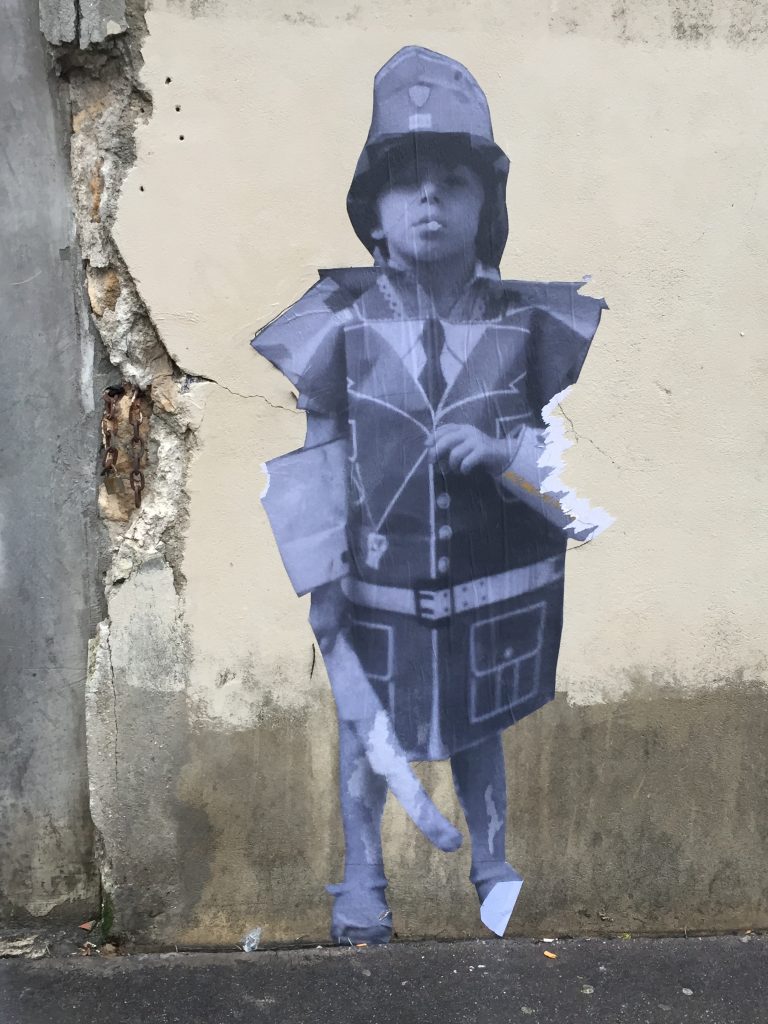
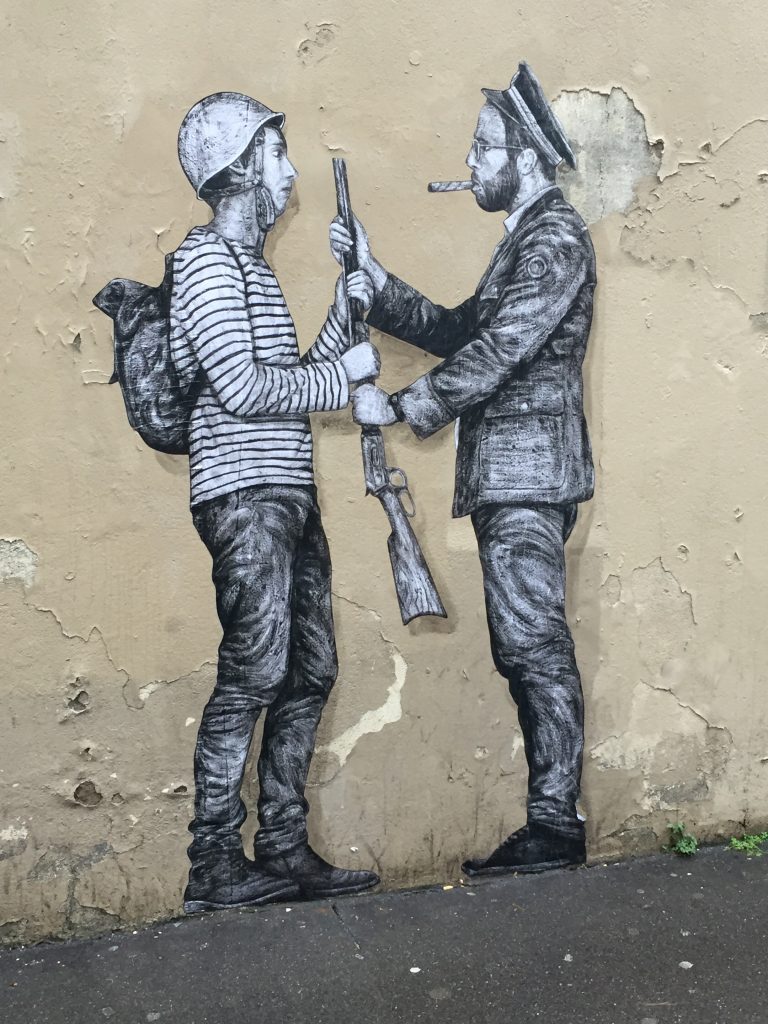
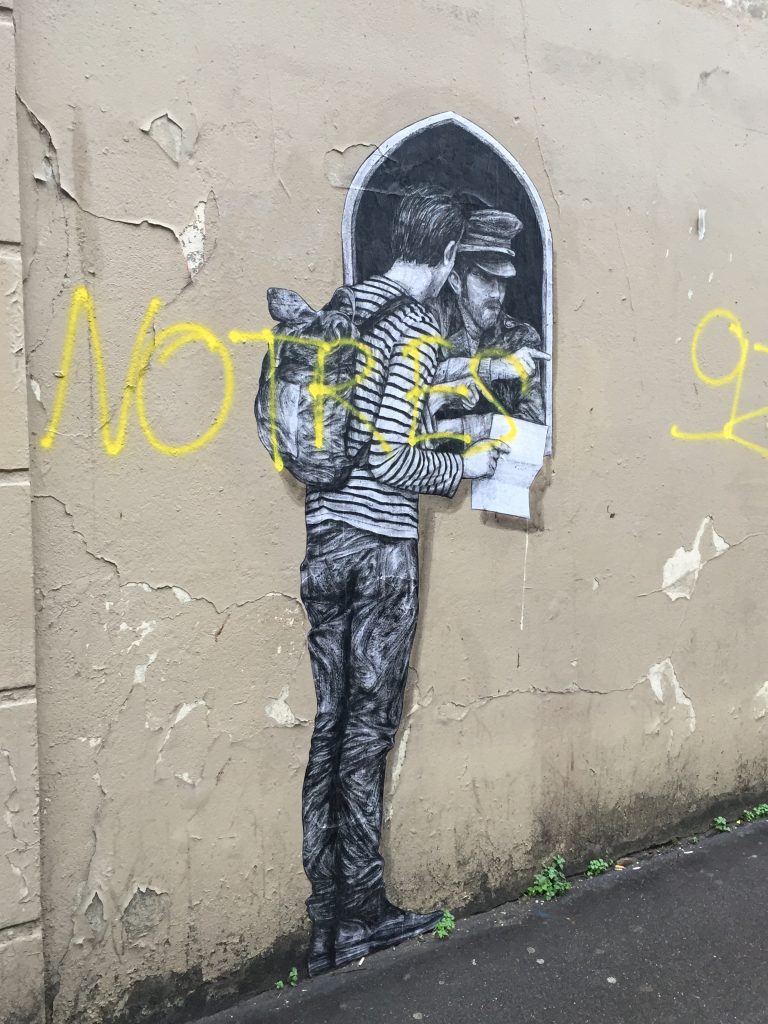
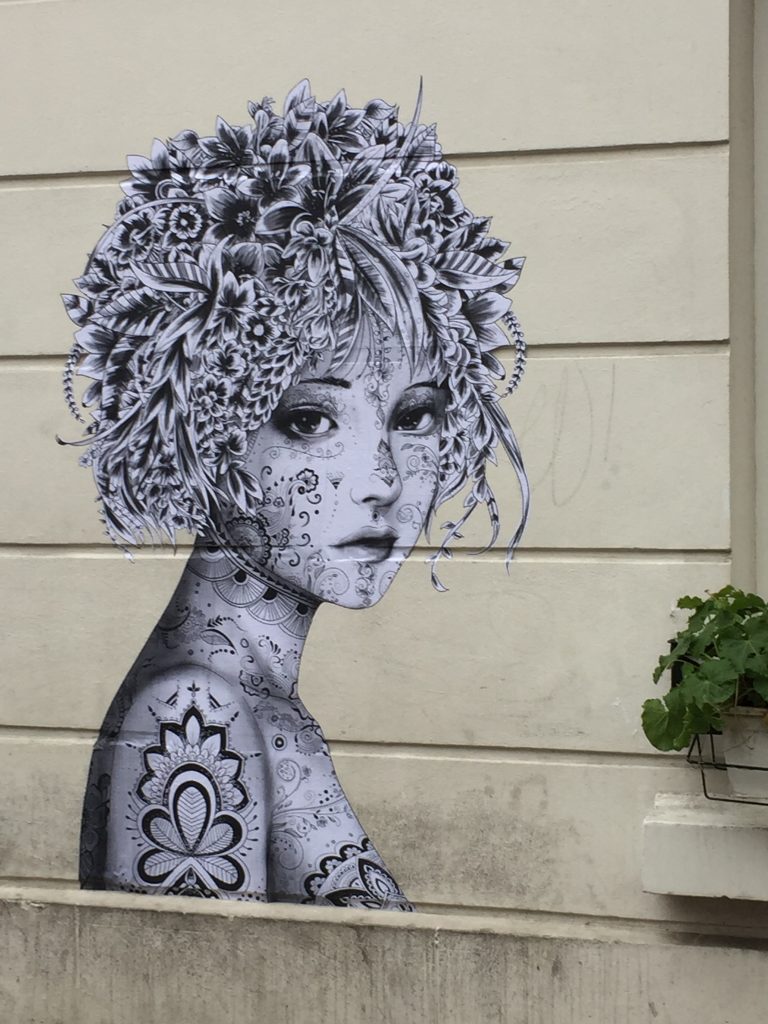
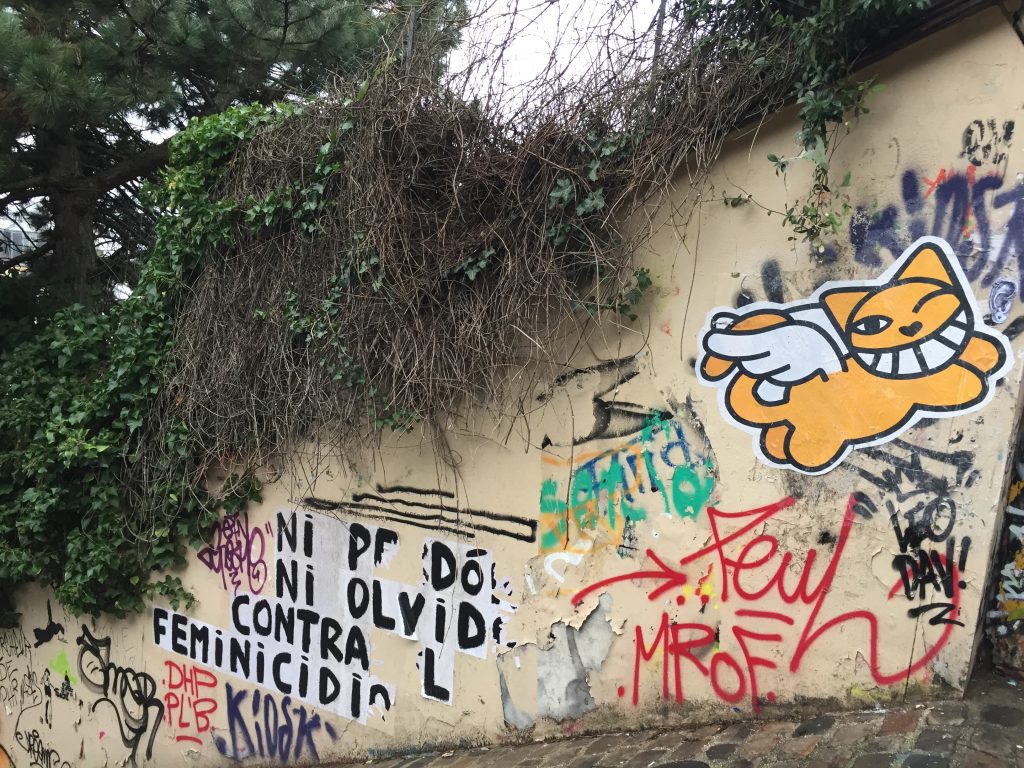
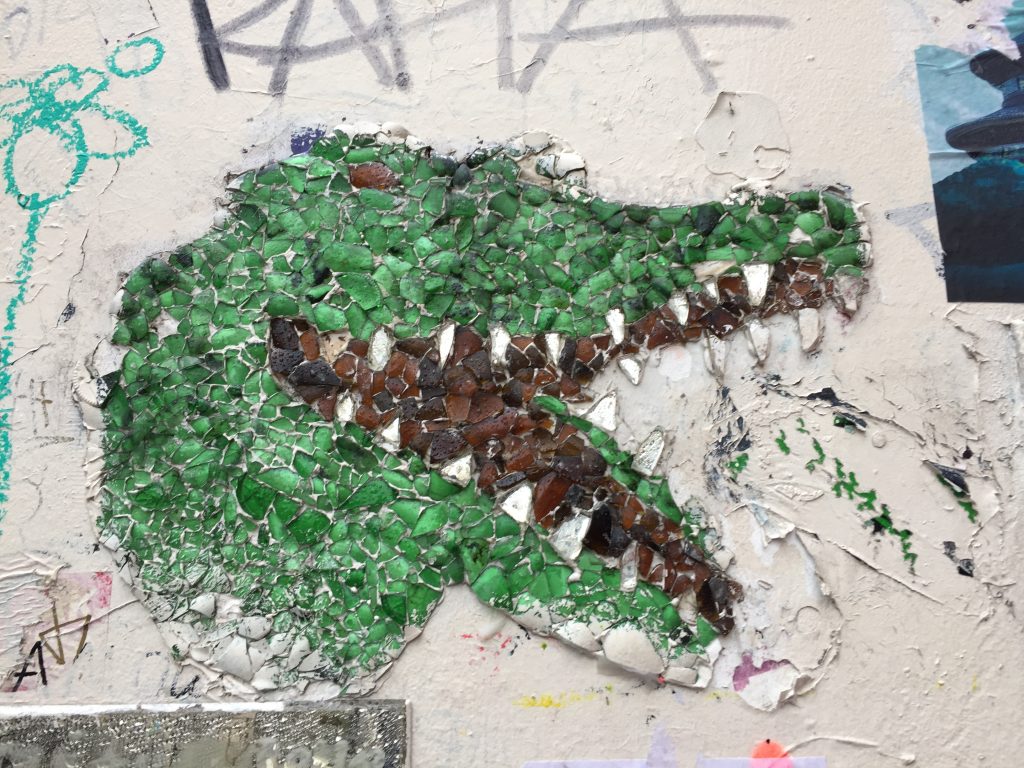
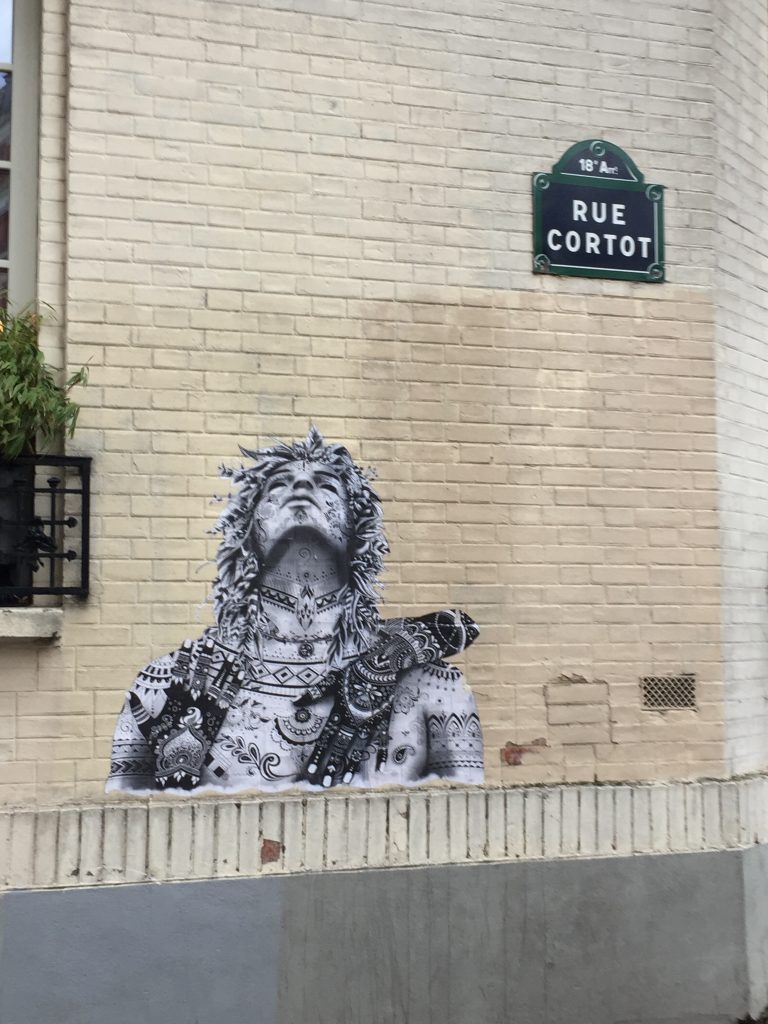
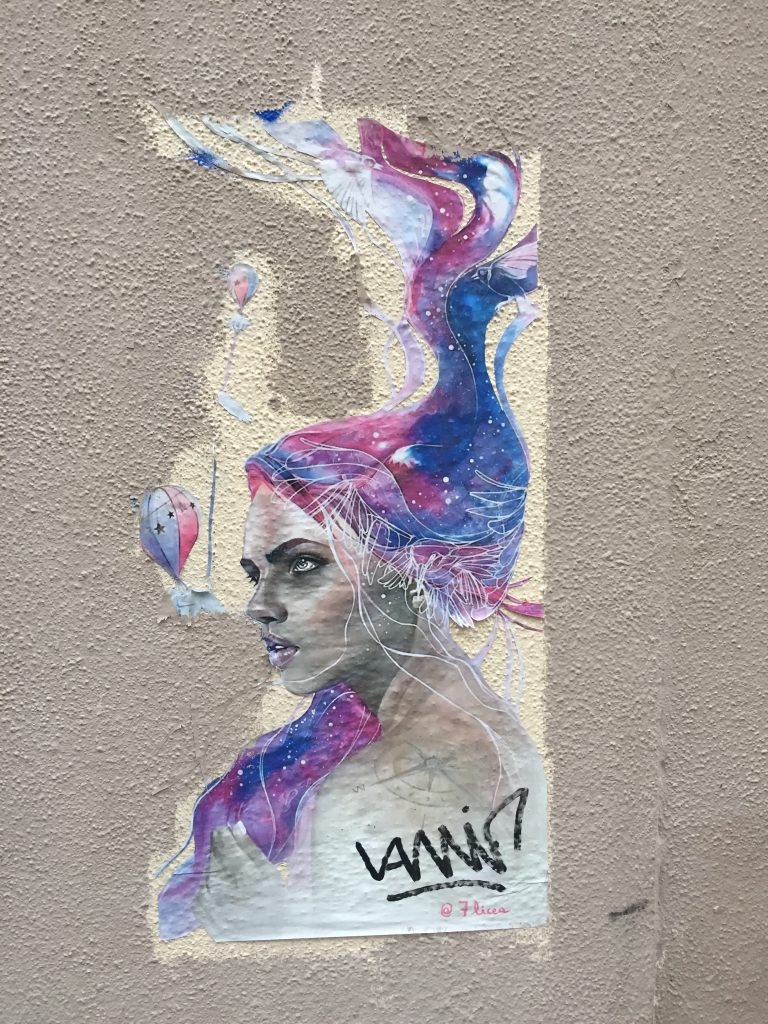
Paper street art
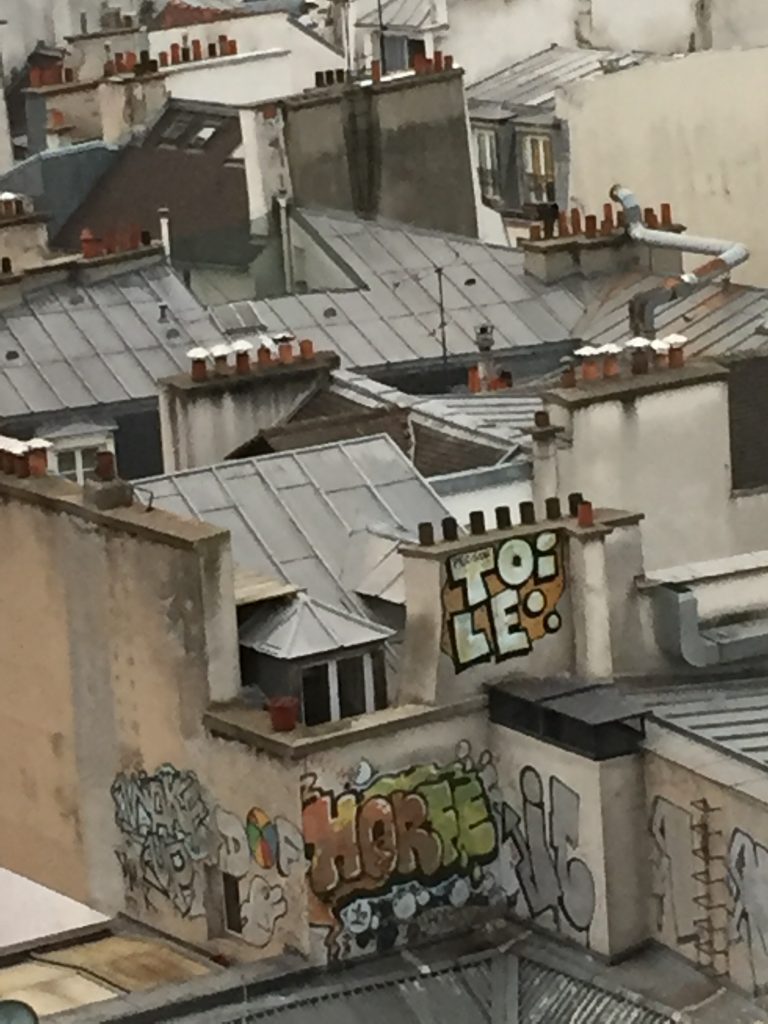
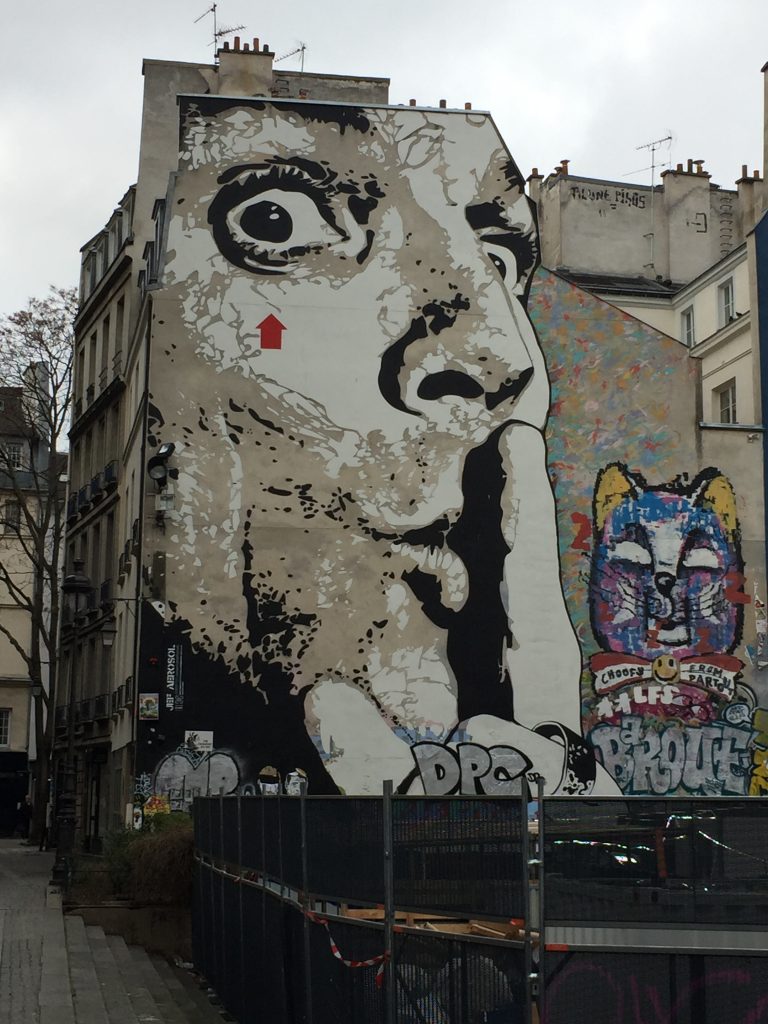
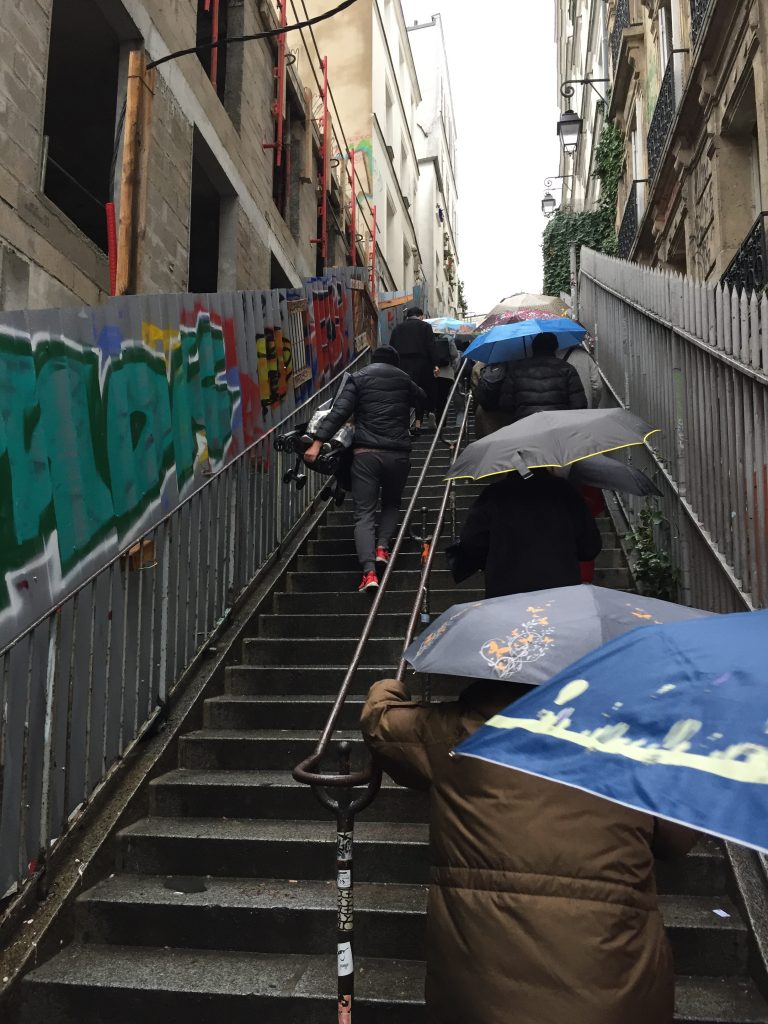
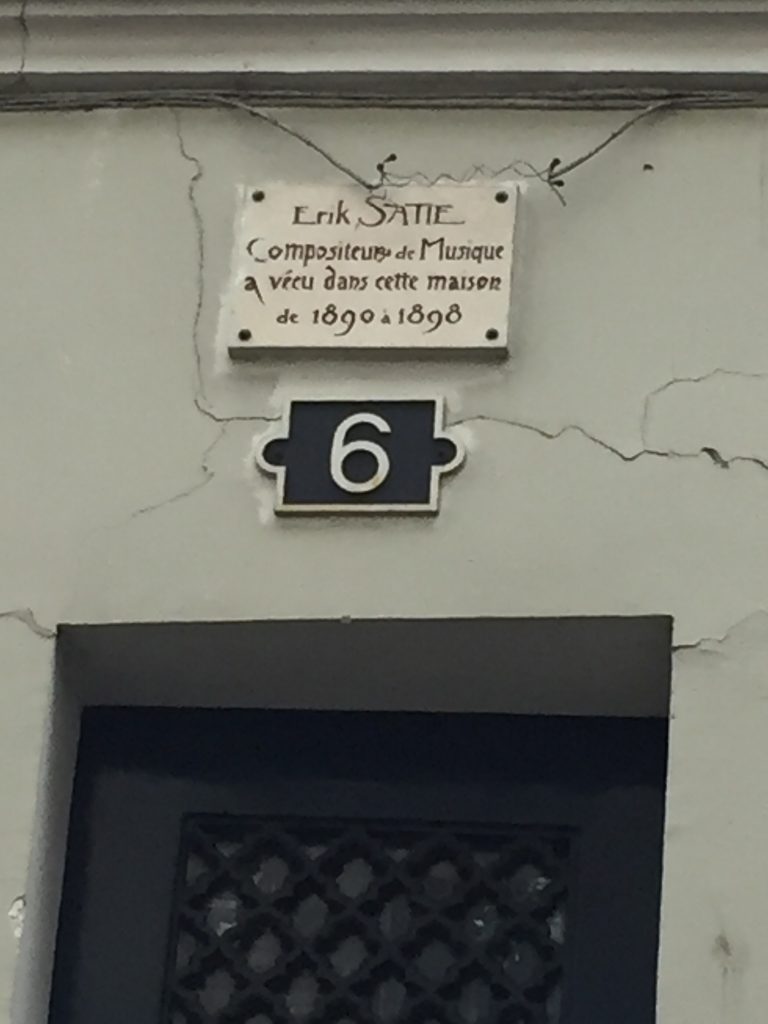
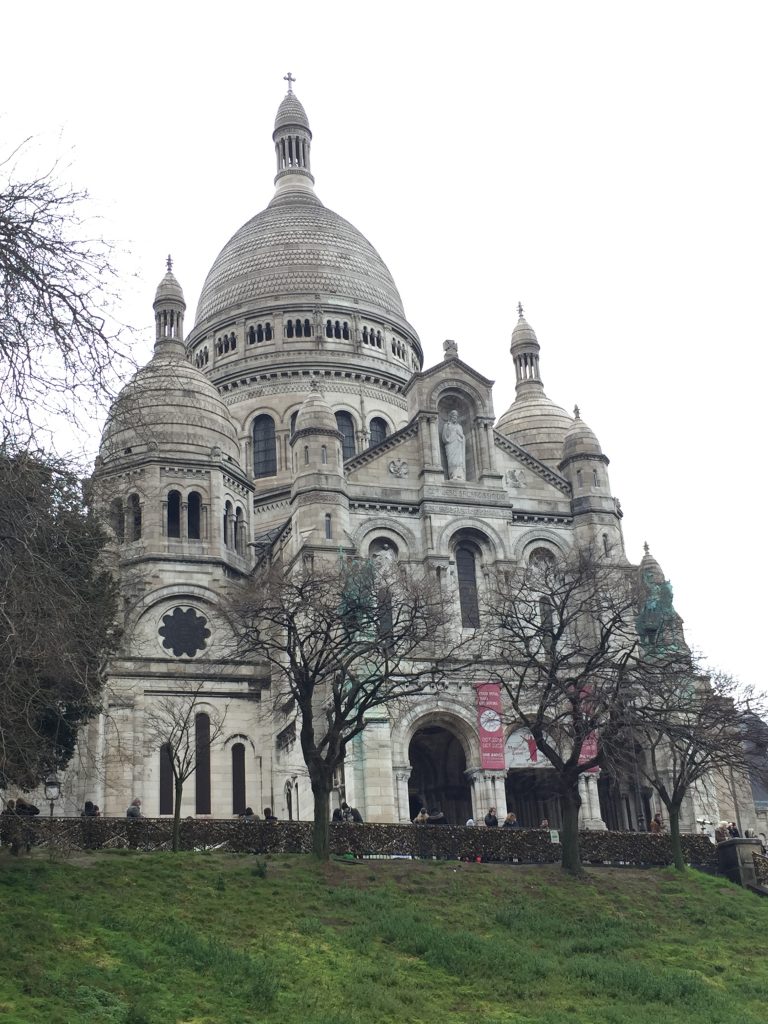
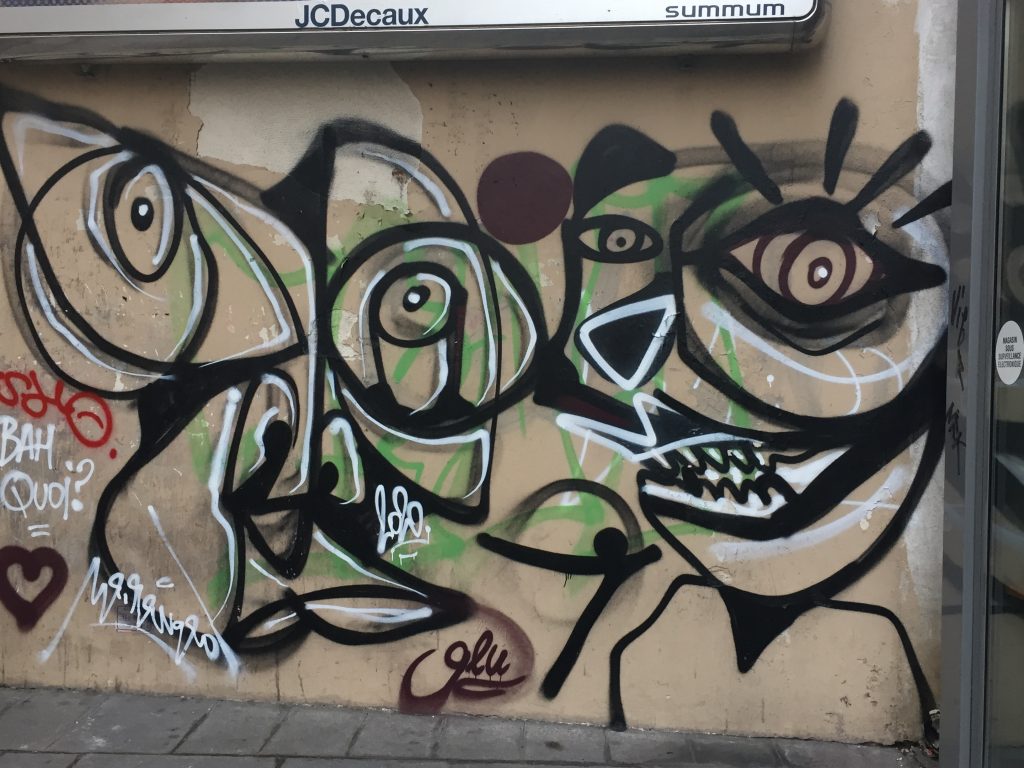
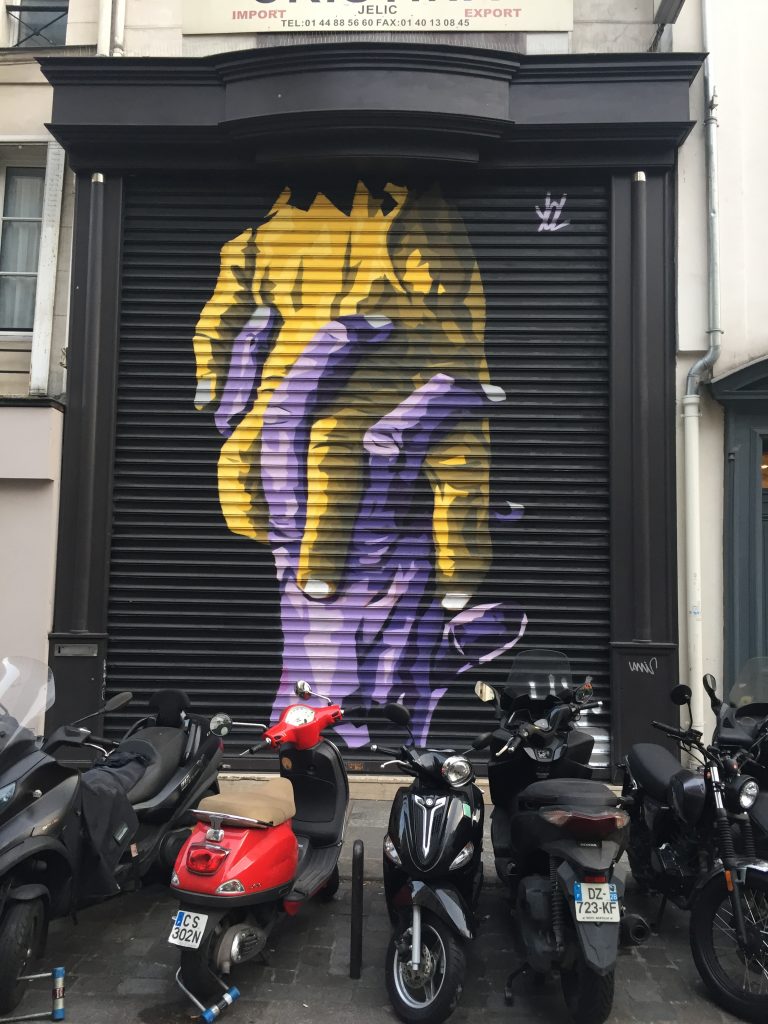
This morning I set off for 6 Rue Cortot, the one time home of Erik Satie. Once I get used to being alone in a city I really enjoy the freedom to do as I please. Satie hd lived close to the Sacre Coeur and I decided to take the back route which would enable me to take photos of the ‘alternative ‘ Paris, not the regular tourist photo stops. And I sure got what I was looking for on the steep staircase up the hill. Sandwiched between 4 and 5 stormy apartments the sides of the buildings are covered in graffiti.
Approaching Sacre Coeur
It wasn’t easy to take photos here: the steepness of the stairs being the least of my problems, but the stairs were crowded by large groups of tourists, mainly Japanese, all wielding umbrellas in the gentle rain. What with trying to avoid having my eyes poked out by the umbrellas and not tripping over feet it was quite an experience in keeping safe, let alone stopping to take photos of the artwork.
At the top of the stairs I found myself in an open square lined with tourist trucks preparing for the day but right now business was fairly quiet. I made a note to myself to come back at a busier time.
I think Satie would have liked this paper street art on his apartment block
I was at the back of the Sacre Coeur and Satie’s modest apartment was less than a minute’s walk from the church. Only a small plaque on the wall indicates his home, but appropriately enough a bicycle was leaning again the wall, something I think Satie would have liked. His apartment used to be a minuscule 9 m2closet, mysteriously big enough to fit his collection of 100 umbrellas, 2 pianos placed on top of each other and 12 identical corduroy suits, accounting for his pseudonym “the velvet gentleman”.I recalled that several years ago one of my adult students showing up for a recital to play some Satie music dressed as Satie. What a hoot! Satie wrote: Here is a time-table of my daily acts. I rise at 7.18; am inspired from 10.23 to 11.47. I lunch at 12.11 and leave the table at 12.14. A healthy ride on horseback round my domain follows from 1.19 pm to 2.53 pm. Another bout of inspiration from 3.12 to 4.7 pm. From 5 to 6.47 pm – various occupations (fencing, reflection, immobility, visits, contemplation, dexterity, natation, etc.)”
Satie’s house
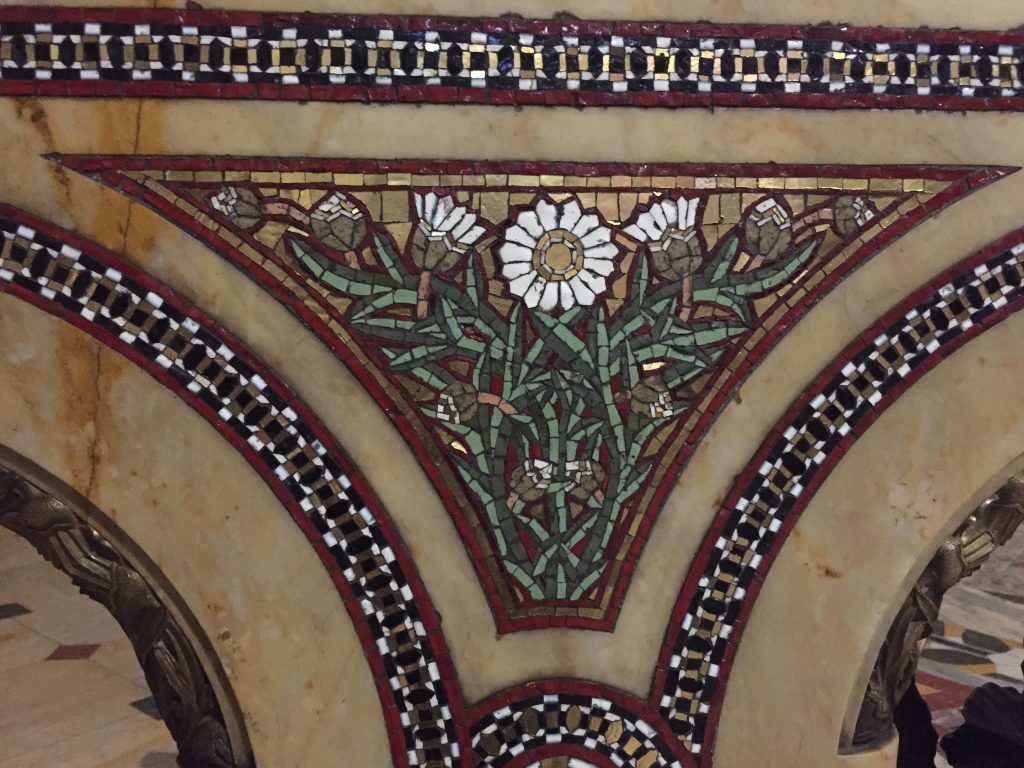
I joined the tourists and entered the church. A service was in progress but the 50 or so members of the congregation were significantly outnumbered by the tourists, who were, for the most part, observing the ‘Silence’ notices. I took several photos of simple floral mosaics thinking that they might be the inspiration of a future needlework project but I found that I didn’t feel any sense of awe or wonder inside the church. It didn’t have that feeling of an ancient building, a place of meeting for hundreds of years that I feel with many churches. And it wasn’t until I did some more research that I discovered that it wasn’t built until 1898. So when Satie had lived close by the building would have been under construction.
Exiting the building I came out onto the terrace with its wonderful view of the whole of Pairs, for this is the only hill, the only piece of raised ground in the city of Paris.
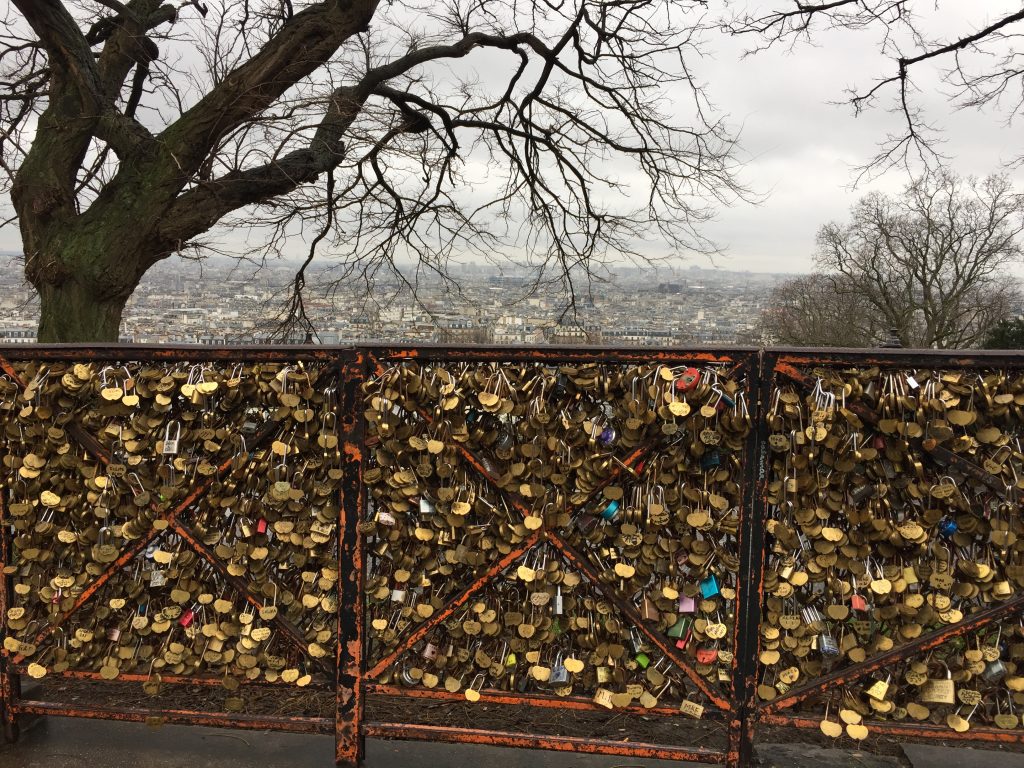
A wall of lox, no! Locks.
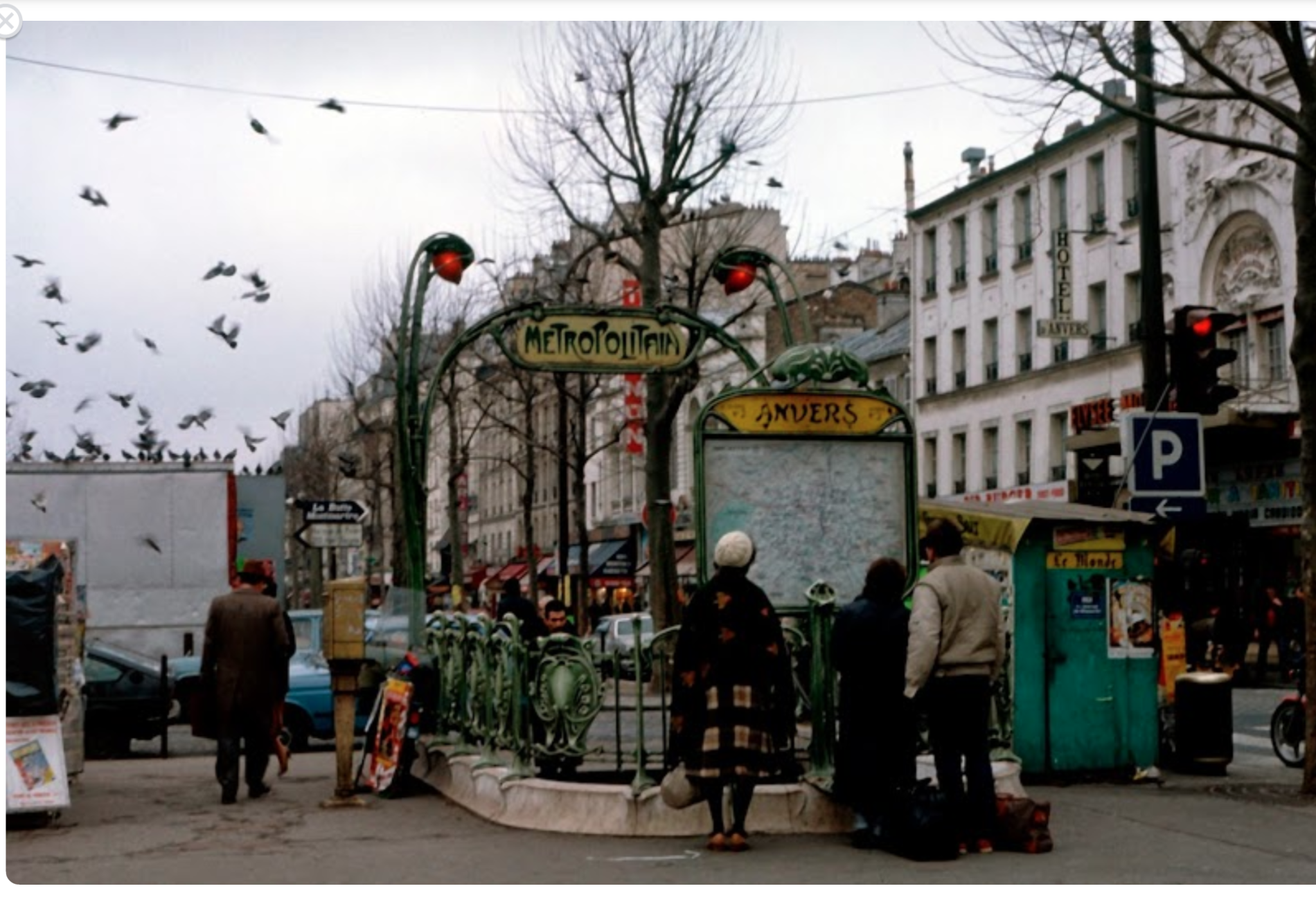
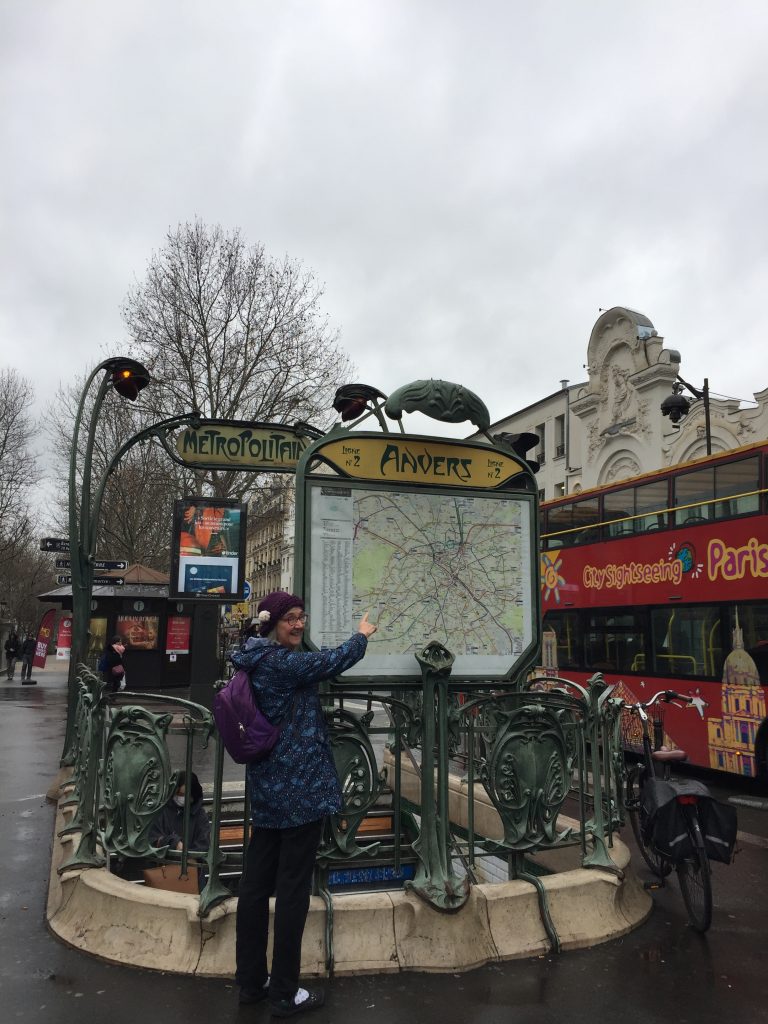
The fence on the terrace is completely covered in locks and street vendors were selling more locks and various trinkets on the steps. I headed down the steps taking the normal tourist photos, checked on Anna’s flight, which was over an hour late departing from San Francisco and suddenly, before me was a view that I recognized! Before my trip I’d been looking at photos of my only previous trip to Paris, 37 years ago (!!!), and had seen a photo of me looking at the map outside a Paris Metro station. And now, here it was right in front of me, in all its Art Deco glory. I found the picture on my phone, posed myself in the identical position. Even the tree across the street was still there. Being cautious in this tourist spot I selected someone to hand my phone over to, showed them the original photo, and asked her to take the same shot – ’37 years have gone behind.’ What fun.
Me, 1984Same spot: Me, 2020
Now it was time to head back to the hotel and wait for Anna – but, hmmm, it might be fun to see her arrive! I found a cafe on the Rue du Faubourg Poissonniere, took a table overlong the street, ordered coffee, (noted that I was only woman in the cafe – again) and wrote up my journal. 20 minutes later I looked up to see Anna across the road walking at speed towards the hotel, looking very determined, in fur coat, dragging her roly bag behind her. Oh dam! I haven’t paid for my coffee yet. I urge through the sea of men propping top the bar, pay, and head out onto the street. Already she’s way ahead of me and I break into a run to catch up with her, but to no avail. I arrive at the hotel door in time to see her enter and speak to the concierge. I fling my arms round her, surprising her – much to the amusement of the friendly concierge – and we head up to our room on the 4th floor.
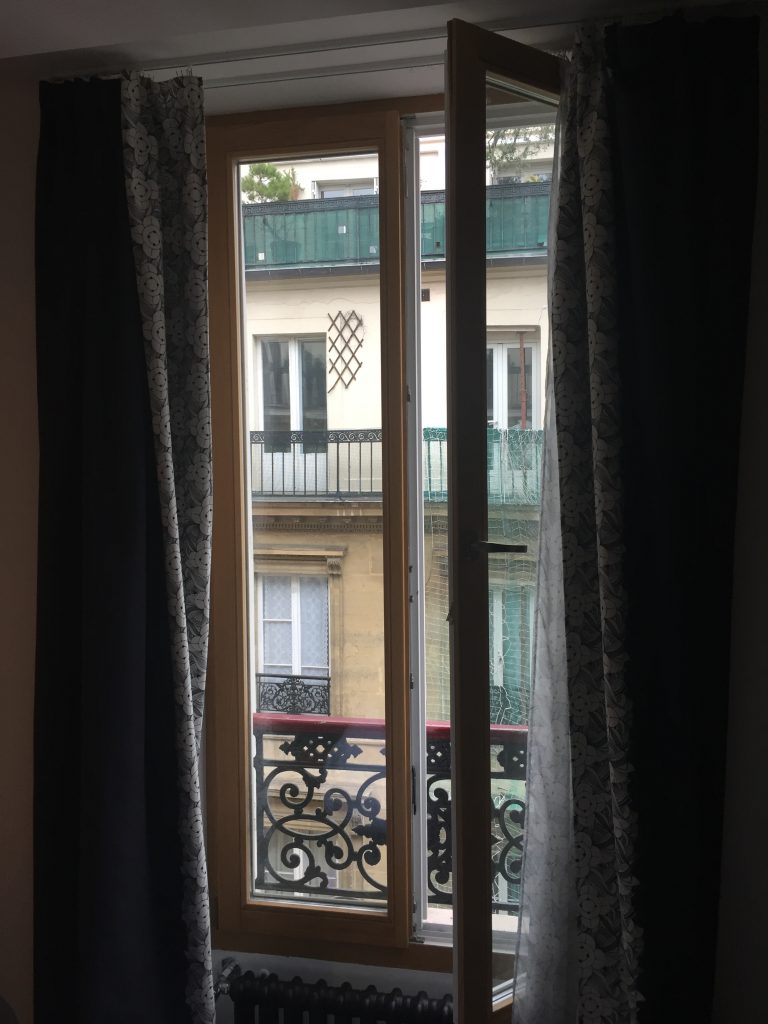
View from our room, Hotel Aida Opera in the 9th arrondissement
She’s just flown across the entire width of America and the Atlantic Ocean, her 10 hour flight but doubt morphing into at least double that in total journey time but after a quick shower we head out for lunch. Anna’s got her heart set on a baguette and we find a lovely little cafe providing a baguette, a quick and a doughnut. (Crazy fact I later learned from a Griff Rhys Jones documentary about Paris: baguettes aren’t a Parisienne invention – they come from Vienna!)
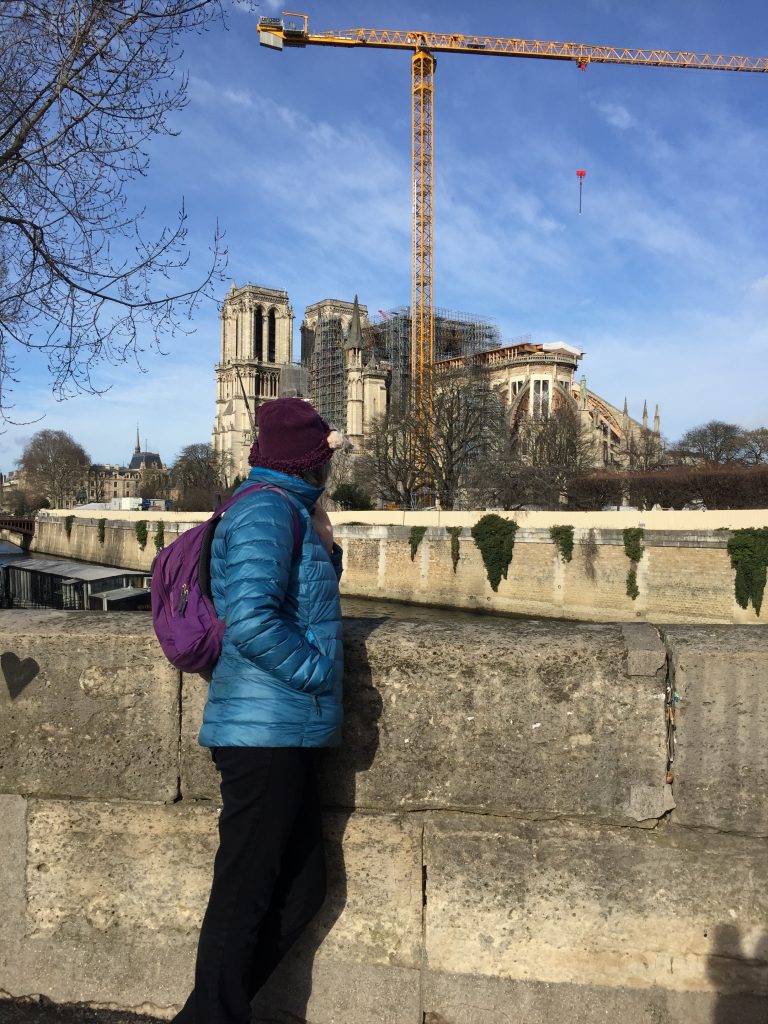
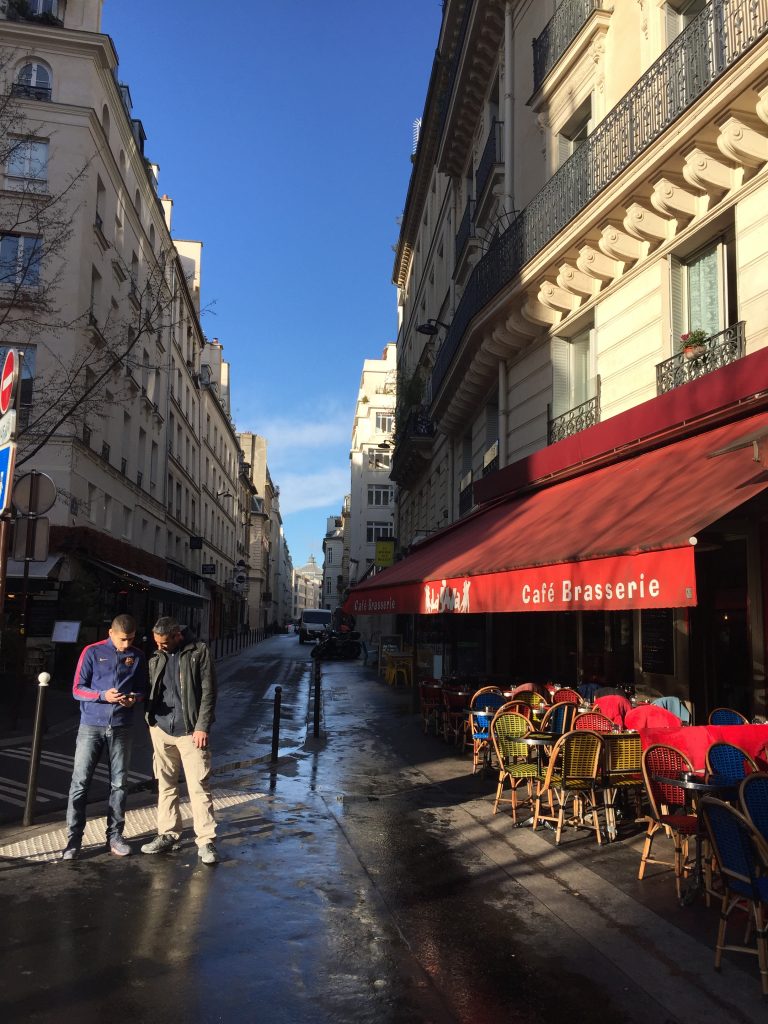
We wander round the streets admiring the tiny shops, with soft, enticing lighting. Some of the shops are smaller than my living room. The window displays are lovely. So, so very different from America’s ‘the bigger the better’ philosophy. The cafe bars with their colorful awnings supporting heat lamps are filled with people, chatting, laughing. The entire vibe is so different from Oakland – and Hebden Bridge. Everything looks inviting. We wander down to the Seine and as we cross the Pont du Neuf we see a flashing sign on a moored boat – Next Departure at 3:30. That’s in 2 minutes! We set off at a gallop and rush to the ticket desk. “Is there still time to board the 3:30 boat?” We gasp. “Yes,” and we board. It’s cold and rainy so we have to stay indoors and during our hour’s cruise Anna had a hard time keeping awake, not surprising. Out ‘guide’ cracks us up. She describes what we are seeing in French and then retells it in English b but her ‘English’ is voiced with exactly the some inflections and intonations as the French version and we are actually unable to tell when she switches from one language to the other! Hilarious. We pass under many bridges. I idly wonder why there are so many iron rings attached to the underside of these bridge. Surely it can’t be to moor. We pass the golden domes of the Russian church and find ourselves close to the great feet, and great fete, of the Tower Eiffel. Elegant statues adorn the bridges, and many of them have carved stone faces set into the stonework. We pass close to Notre Dame, now clad in cling wrap and dwarfed by the gigantic cranes.
Sur la pont, not d’Avignon but Neuf, with a view of the Eiffel Tower
We head back to the hotel so Anna can take a nap. She’s doing so well with the jet lag.There’s a 10 hour difference between Oakland and Paris. I stay awake and watch her sleep (it’s a mum thing) while busying myself with my last cross stitch panel of a hillside above Hebden Bridge. The colorful graffiti would make another interesting panel. I did one of those last year, of some street art in Manchester and enjoyed that project.
On the viewing platform
The dome
Should I buy these, Mum?
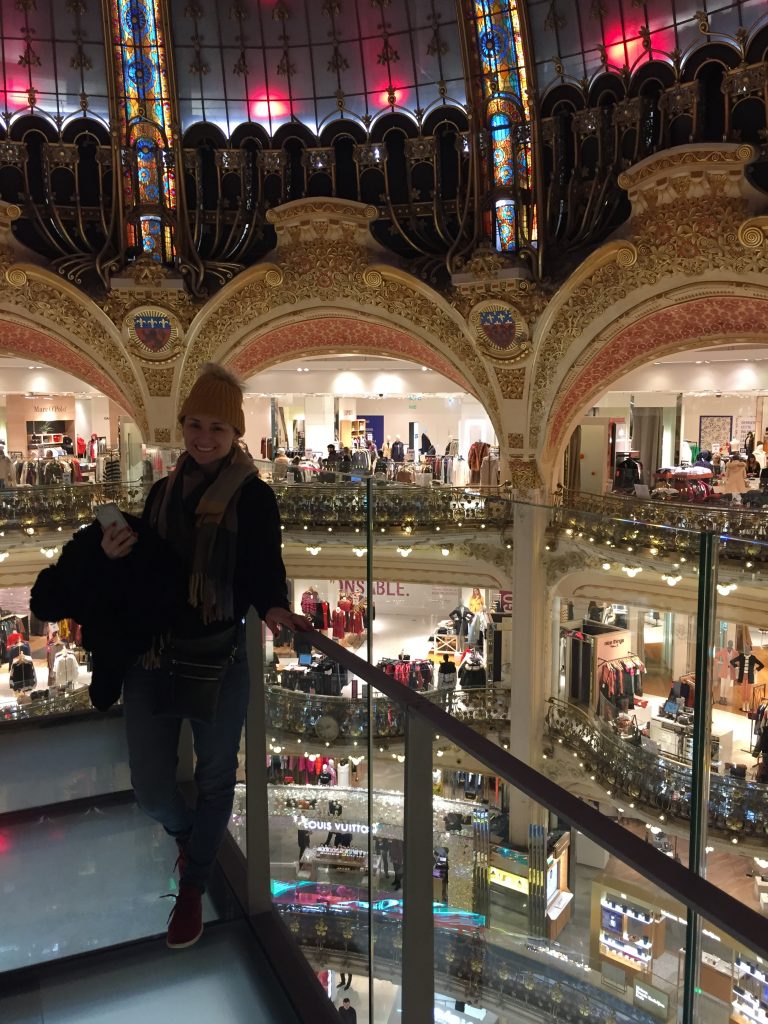
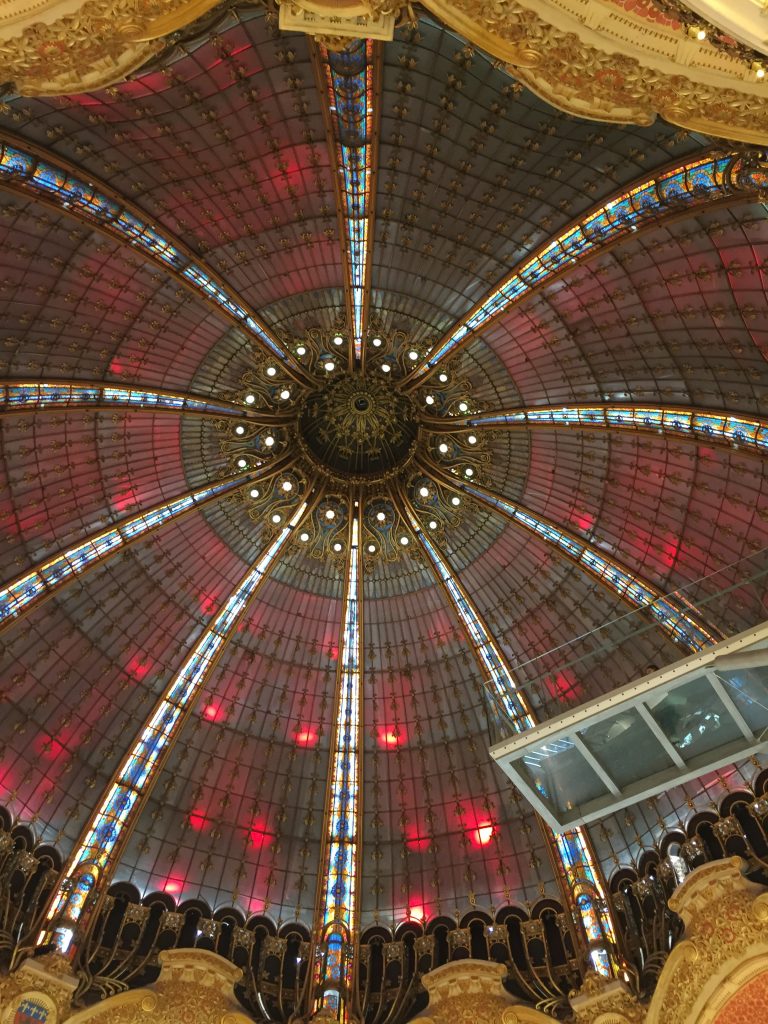
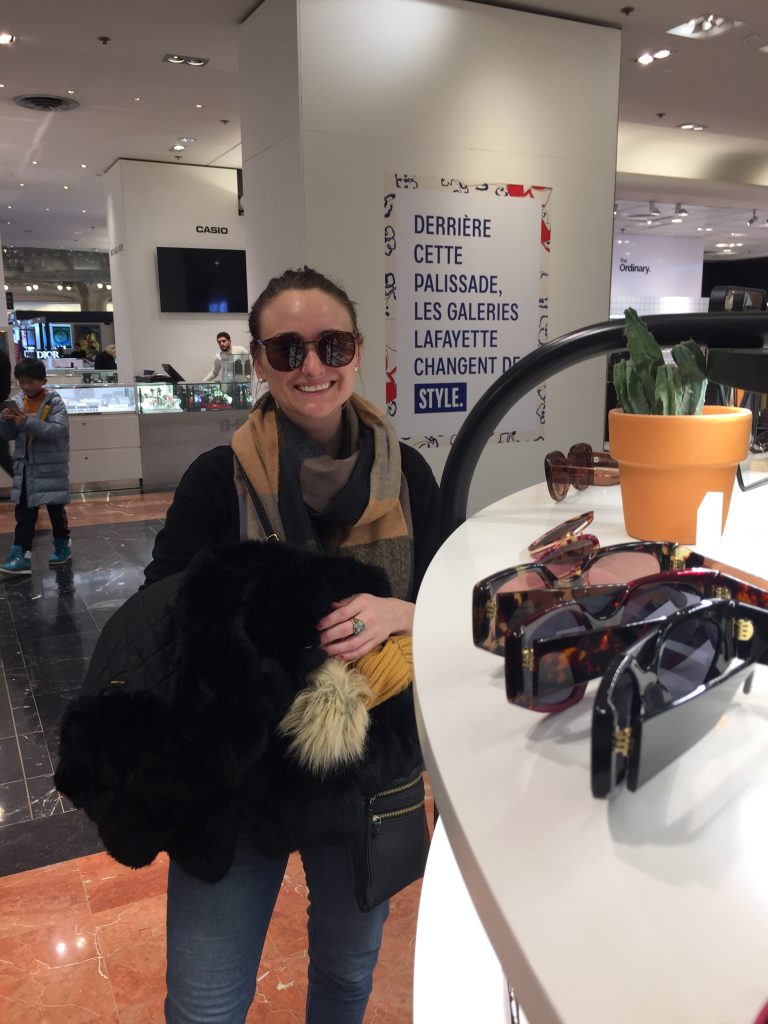
We were back out by 6:30 and remarked that it was definitely warmer, but wetter. We were heading for the Galleria La Fayette (sort of funny because we used to live in Lafayette, California). Out first attempt at following Google Maps to that location took us to their offices, but we were redirected to the building itself which can only be described as the Leeds Corn Exchange on Ecstacy. Top notch stores are housed in a beautiful building constructed of glass and steel and topped by a panoramic dome. It was built in 1912 and is Art Nouveau in style. Even just looking at the fashions I felt decidedly underdressed. Clad in my raincoat and woolly hat with my signature purple backpack I looked ready for a ‘hike on ’t tops’ – not an evening in Paris. There were lots of clothes that we actually liked, some tasteful souvenirs, and Anna was tempted to buy some sunglasses she tried on. We walked out onto the viewing platform since the dome was closed for the evening, but with a glass floor and a 7 story drop beneath me the most I could do was to take a quick photo of Anna without allowing myself to look down! We stayed in the shop until closing time at 8 and then went in search of dinner. I wanted a busy place with the buzz of the city and we found Comiere, a bar which filled the bill. My salmon salad was delicious, but, just as in Malta, I hadn’t expected the fish to be raw. We were back in the hotel by 10 after a very, very, long day for Anna.
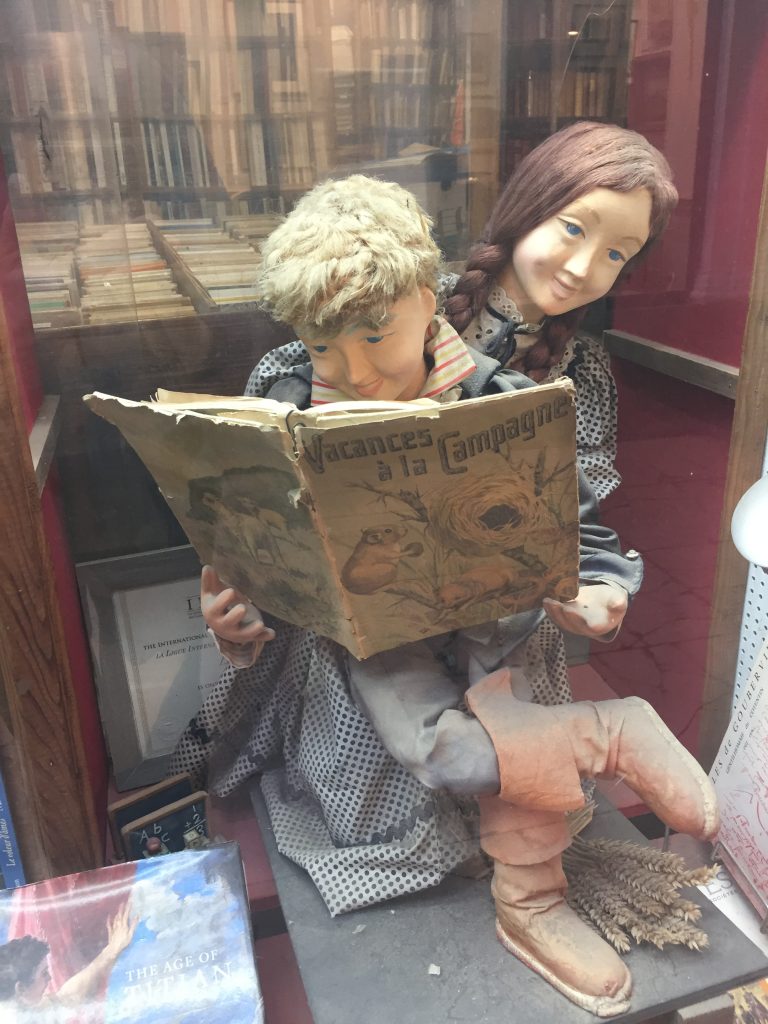
A book at bedtime – lovely window display in a book shop
(Written in Cafe Richard. I’m the only woman. All the men are standing at the counter, some reading the daily newspaper, others – construction workers judging by their garb – gulping down quick espressos before heading back to work in the drizzling rain)
First photo of my trip
“I feel as if I’m in a jigsaw puzzle.” So began my journal of a week in Paris, January, 2020. Not long ago on Boxing Day Anna had messaged me “by the way, if I accept this new job I’m thinking about going to Paris for a little a while. Would you be interested in meeting me there or would you rather I come to Hebden Bridge?” And so the journey was planned. Anna’s been to Hebden Bridge a few times now, and has seen my new apartment so there was nothing new to see and do here, but at the same time I felt that if we just zoomed around the tourist sites of Paris I would miss out on having ‘time’ with her just to sit and chat and be together. On the other hand I’d really enjoyed our tip to Staithes together in the summer so we both started to make lists of things we’d like to do in the city. And I dug around and found some hilarious photos (from slides, of course) that Colin and I had taken in 1984, the only other time I’d ever been to Paris. Anna, on the other hand has already visited the French capital 3 times and had therefore ‘done’ many of the ‘must see’s. On my previous trip we’d both ended up with terrible food poisoning and I’d spent all my afternoon at Versailles throwing up in the toilets, the same at the top of the Eiffel Tower, and had ended up rushing out of a cafe bar in the Place Pigalle to throw up in the gutter – sorry, no reflection on the quality of Roxy Music soundtrack in the bar. Perhaps because of these associations I was apprehensive. But then, I’m always apprehensive before a trip of any kind. It’s almost to the point that the day before I want to call off the whole trip because I’m just too afraid. Too afraid of flying, of misplacing my travel documents, of finding my way to the hotel, locating the correct train at Charles de Gaulle airport, of having to spend a couple a days in the city by myself, eating out alone etc. You’ve got the idea.
There was as much graffiti art as in Sicily
I took a taxi to Manchester airport. It was foggy all the way through the flight so I didn’t get any view at all. The train station wasn’t easy to find at the airport but once on the train I began to relax. The journey into central Paris was very much like the train from Frankfurt to Wurzburg that I had taken last August. But then, I reasoned, that’s not surprising because that was the last train journey I’d taken through Europe since goodness knows when . . . 1999?
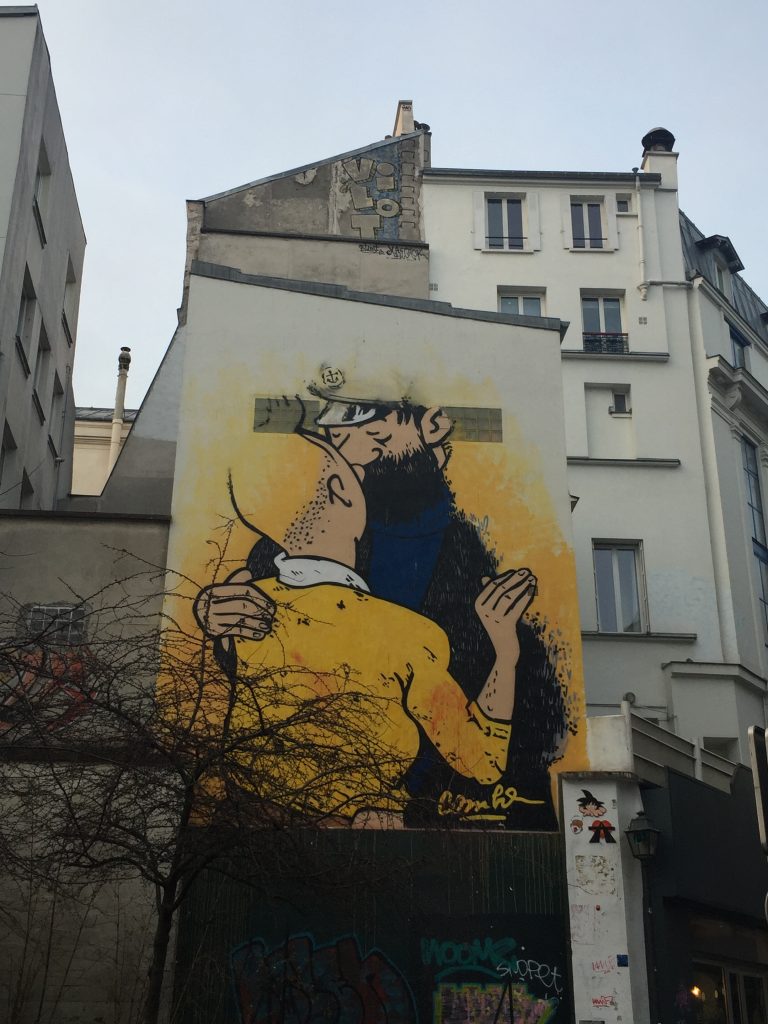
TinTin and Captain Haddock. Apparently this is on the LGBT list of things to see in Paris. I took the photo because my daughters loved the TinTin stories
Last night I had dinner in an outdoor cafe – the only person dining alone. Despite the chilly evening the overheat heaters made sitting outside a pleasure. Obviously I’d managed to find Hotel Aida Opera. It was quite an easy walk to follow on my GoogleMap once I’d found the best exit from the huge Gare du Nord, with its multitude of police in full combat gear brandishing machine guns – just a regular security patrol but it startled me for the instant. I’d asked for assistance from the info desk and it was given. Excellent. Our room was on the 4th floor overlooking a street of 4 and 5 story apartments. I noticed immediately that it didn’t have a kettle. I asked the concierge if I could have one but no, no kettle. However, he did come back with a thermos flask and since there was boiling water in the lobby 24/7 I could drink my tea to my heart’s content.
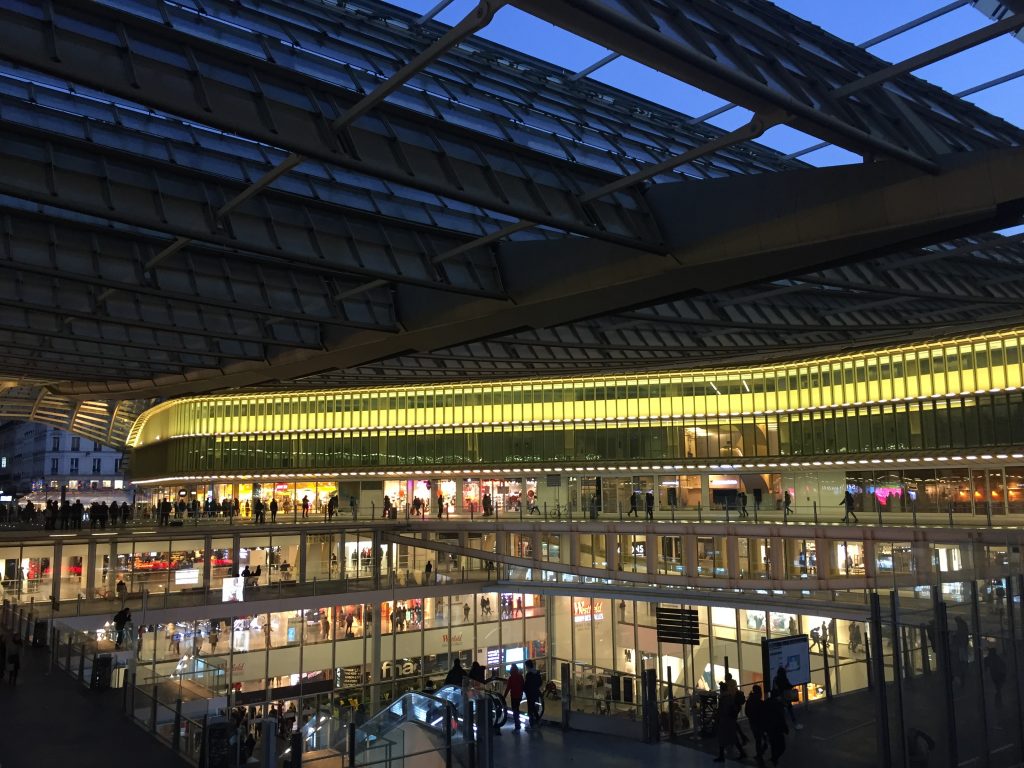
I had a well-needed cup a tea, nibbled on some pretzels provided by the hotel and in less than an hour I set out to explore the neighbourhood. I just couldn’t believe how many people were out in the streets. I mean, this was 4:30 on a Sunday afternoon. The narrow streets, some no wider than passageways were crammed with people, bicycles, crazy scooters, cars. Everyone appeared to be in their 20s or 30s and often in groups. Even in Sicily the passeggiata didn’t start so early. I headed towards the Seine and soon found myself in Les Halles. This is a large open square and garden with a Westfield Shopping mall opened in 1979 at one edge, and the 16th century church of St Eustace with its impressive flying buttresses at the other.
St Eustace
In the eleventh century, a market grew up by a cemetery to the northwest of Paris in an area called the Little Fields. It was mainly a dry goods and money changing market. In 1183, Philip Augustus took full control of the market and built two market halls – halles – to protect the textiles. He also built walls around the market, including land which had recently been confiscated from exiled Jews. When he then built walls around the city, these embraced the market, which quickly became the city’s largest.
Sculpture at Les Halles
The market would have ups and downs over the coming centuries and was rebuilt more than once. Over time, an increasing number of halls were built explicitly for food, but the dry goods market remained central to the (increasingly cramped) space. The market was dismantled in 1971 and one of the glass and wrought iron pavilions was re-erected in Yokohama, Japan!
Shopping at Les Halles
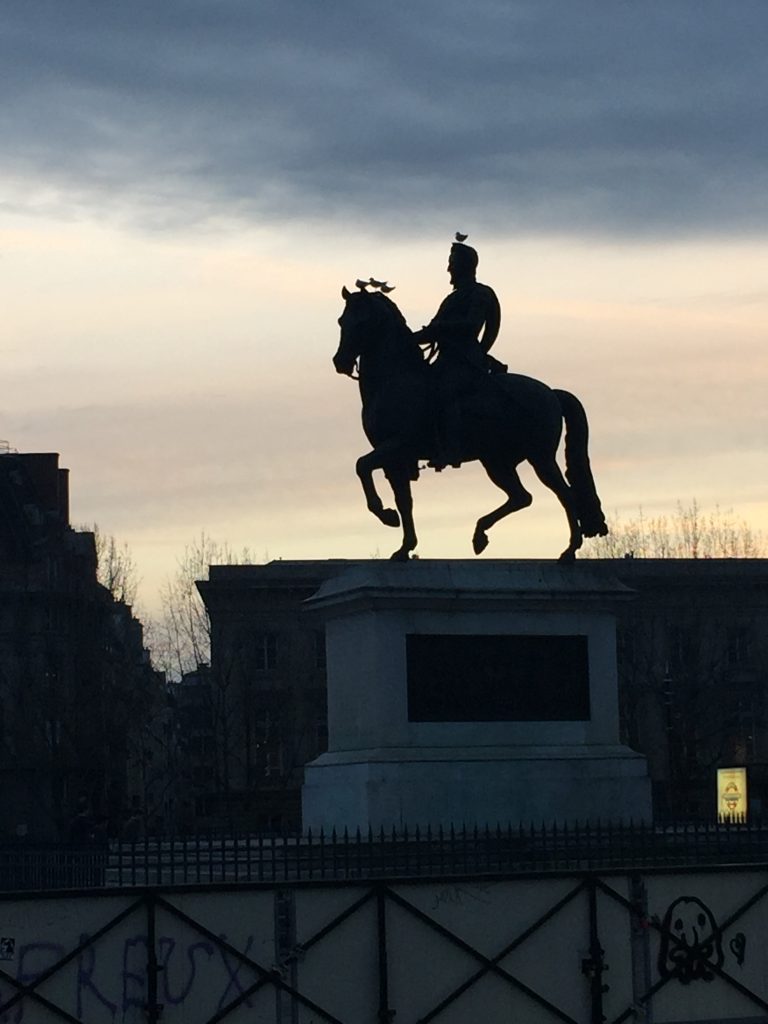
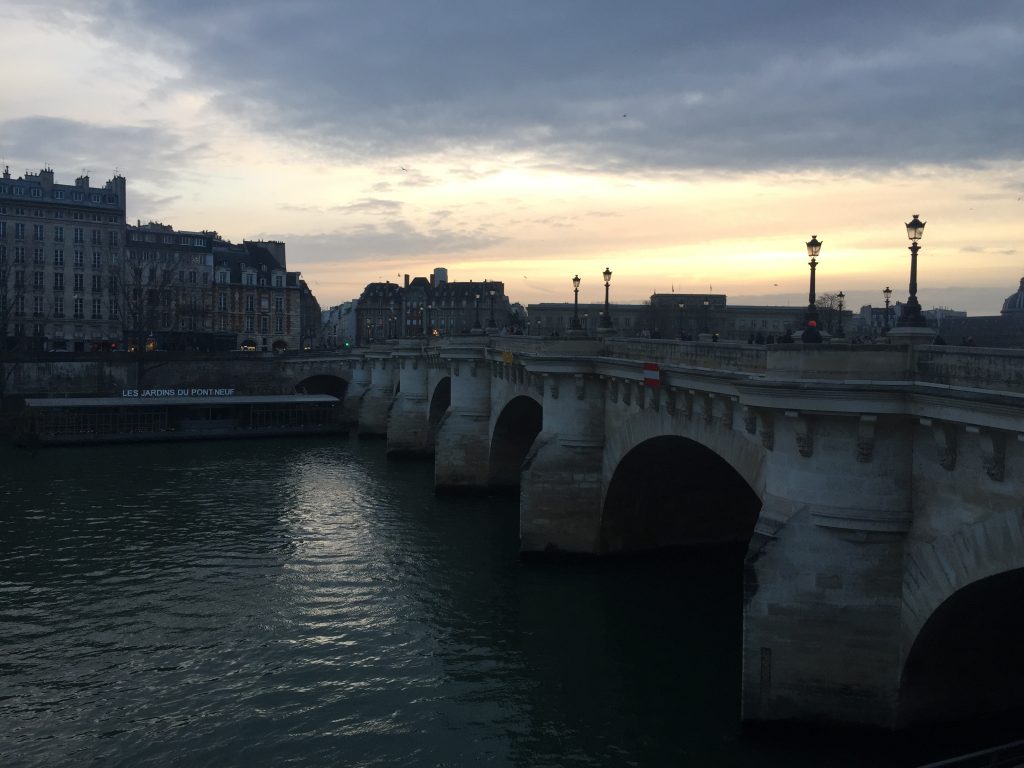
I pressed on, eager to get to the river before dark. I’d forgotten that since Paris is on Central European time it would get dark one hour later than in England. I have no recollection of all these cobbled streets in Paris. Stockholm, yes! From the Post Neuf, Pari’s oldest standing bridge across the Seine, I could see La Tour Eiffel in the distance. The bridge was constructed in there 1570’s and was inaugurated by Henry lV in 1607. His bronze statue, in full fighting regalia astride his horse, stands proudly, providing the perfect resting place for the pigeons as they searched for the perfect spot to roost.
George lV (with pigeons) on the Pont Neuf
In 1862, Édouard Fournier traced its history in his lively two-volume Histoire du Pont-Neuf. He describes how, even before it was completed gangs hid out in and around it, robbing and murdering people. It remained a dangerous place even as it became busier. For a long time, the bridge even had its own gallows.
This did not prevent people from congregating there, drawn by various stands and street performers (acrobats, fire-eaters, musicians, etc.). Charlatans and quacks of various sorts were also common, as well as the hustlers (shell-game hucksters, etc.) and pickpockets often found in crowds – not to mention a lively trade in prostitution. Among the many businesses which, however, unofficially set up there, were several famous tooth pullers.
Pont Neuf at sunset
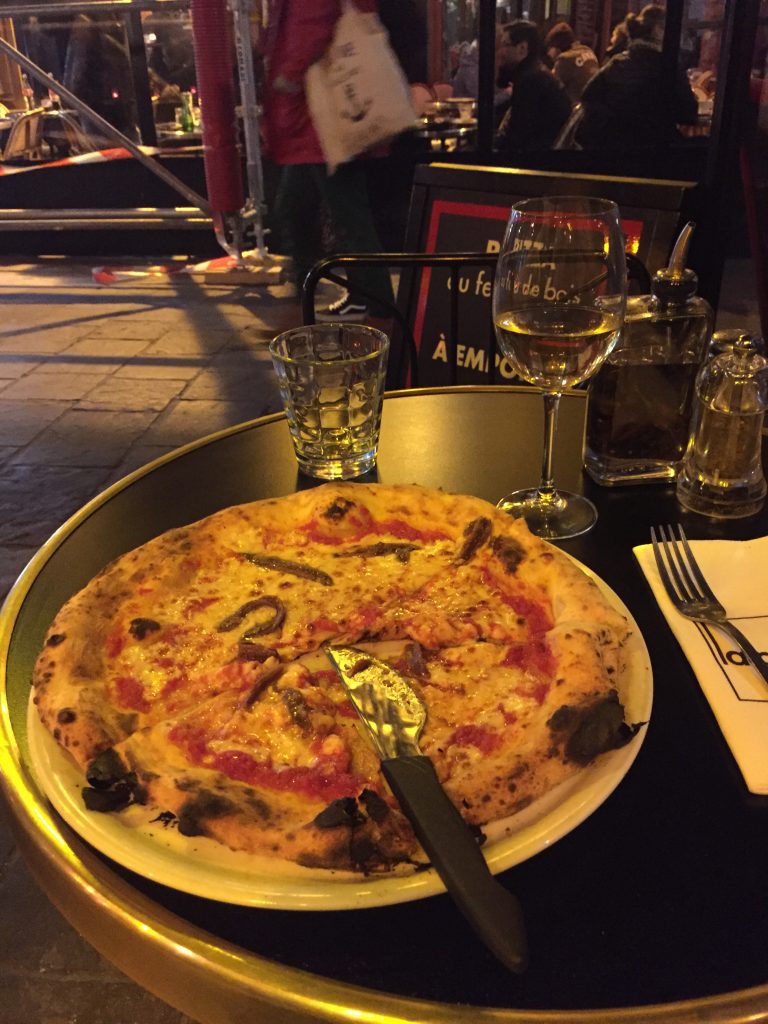
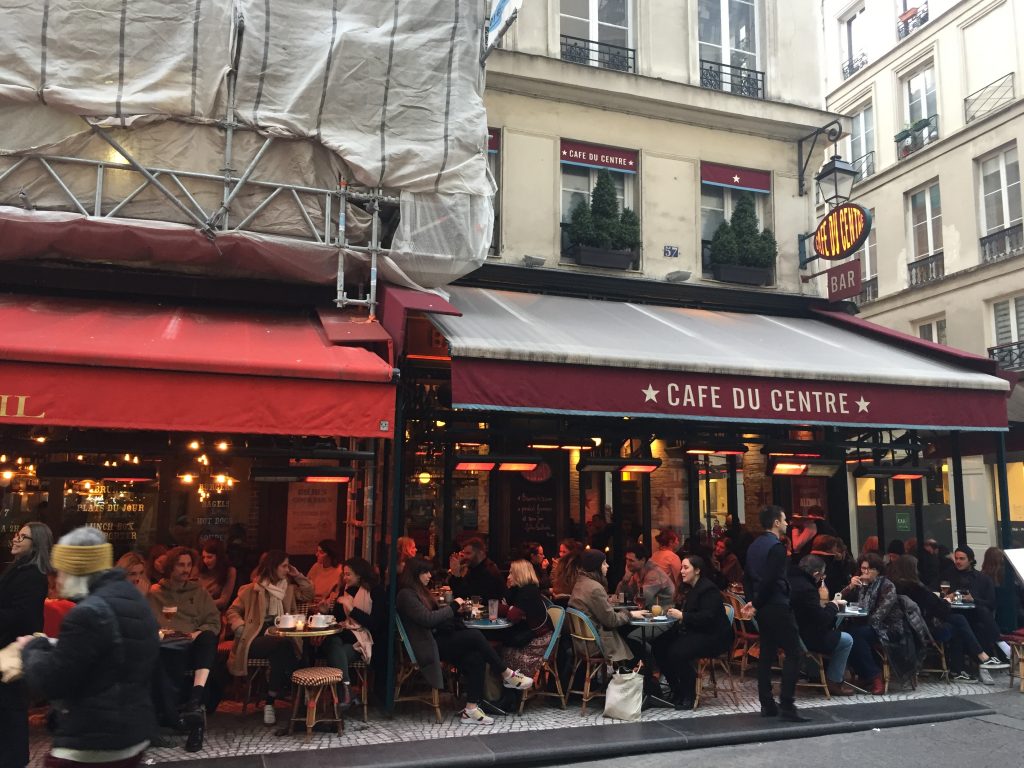
I elected to eat rather than have my teeth pulled out, however, and soon found a street overflowing with wonderful bistros with outdoor tables. I selected one that looked busy, with crowds of people spilling out onto the sidewalk. My table was the perfect spot to people watch for an hour or so while I tucked into a delicious Italian thin crust pizza and a glass of French Chardonnay. I was trying to replicate my late night adventure on the night I arrived in Sicily, and though this was much earlier in the evening it had the same vibe. From time to time a car would somehow manage to negotiate its way along the street forcing everyone in its path to dive into shop doorways.
Dinner
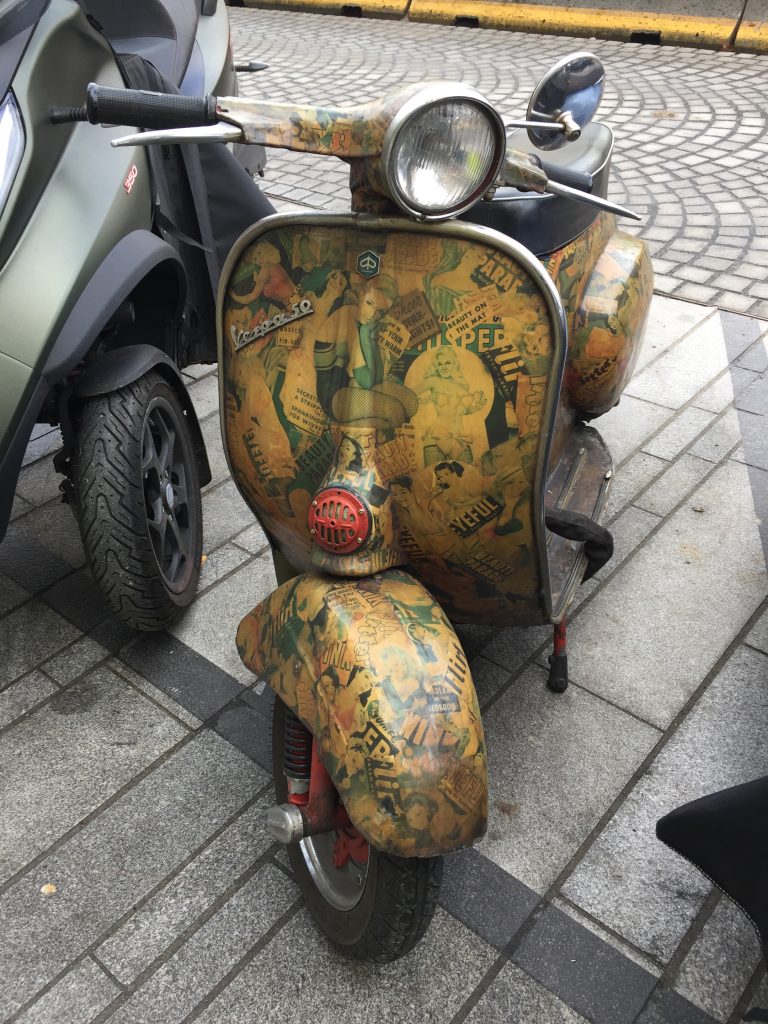
What a lively place! The biggest craze in town appears to be the motorized scooters which can be rented from machines and then appear to be just left anywhere. These, and the ubiquitous bicycles are a nightmare for unsuspecting pedestrian tourists who rely so much on hearing a vehicle approach rather than seeing it.
Buzz
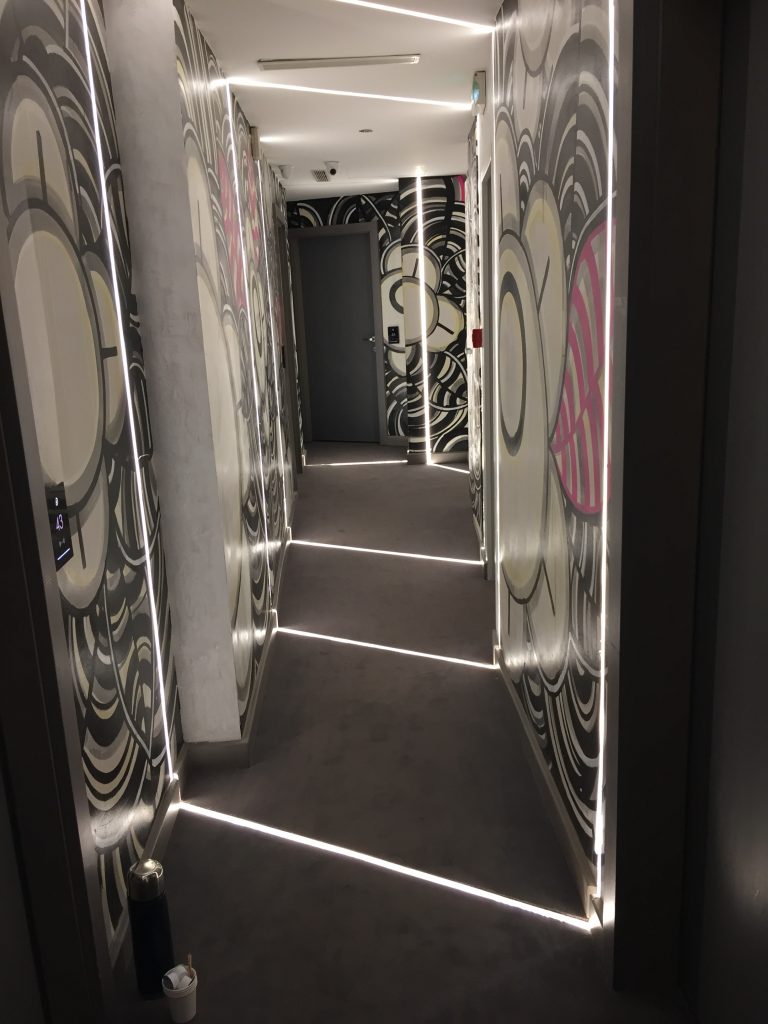
My route back to the hotel took me past the glitter and glamour of the Rex cinema on the Boulevard de Bonne Nouvelle and then quite by accident I found myself at the Folies Berger but it appeared closed at this early hour. Anna had selected our hotel. It was fitting that as a family we had seen a live performance of Aida at the Roman amphitheater in Verona in 2000. Can that really be 20 years ago??? Each floor of this hotel was decorated differently and some intriguing lighting made the hallways look as if they were lit up by streaks of sunlight. Our room had splatter painted discs decorating the walls, and what I had taken for a mirror filling the entire wall turned out to be a TV! I only realized that when I discovered a remote control on the bedside table. My English speaking TV choices were between CNN discussing Trump and BBC world news getting their last little breaking news pieces about Brexit which will happen on Friday. I think Alan Beswick on Radio Manchester is much more entertaining night cap!
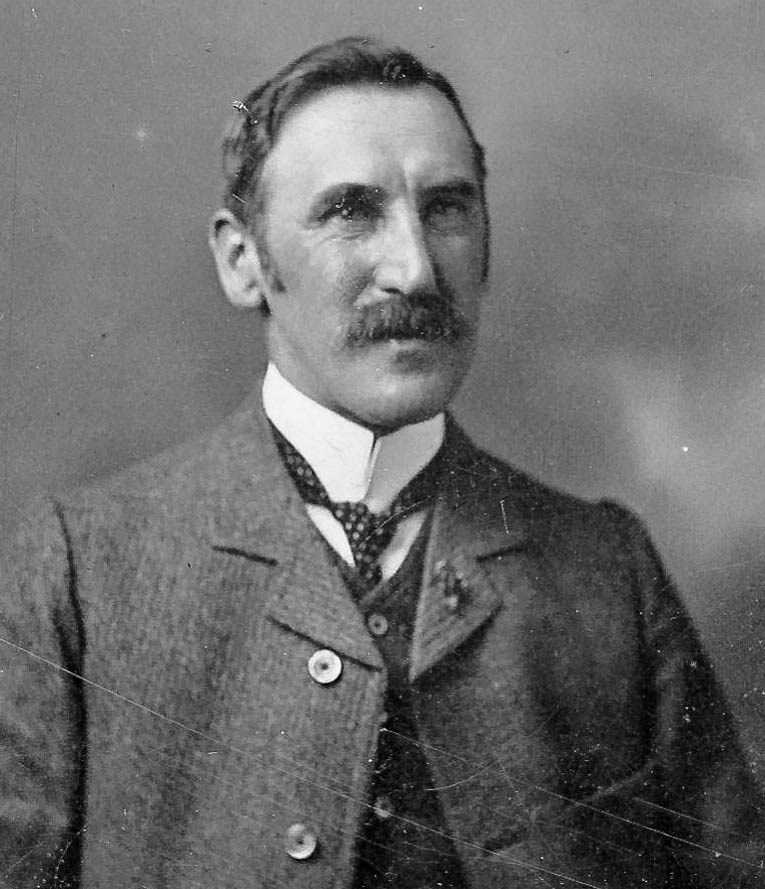
Son of Thomas and Hannah Gibson. Thomas was a butcher on Bridge Lanes, Hebden Bridge and had also lived at Winters (see post). As was common at that time their first son was given Hannah’s maiden name, Stott as his Christian name. He was baptised on May 6, 1855 at the parish church in Hebden bridge. 8 siblings were to follow. 1861 sees the family living in Bridgegate, the house before the White Lion on the census route. By 1871 the family have moved to Old Gate and while his dad continued to run the butcher’s shop Stott has now joined the vast numbers of fustian cutters employed in the town.
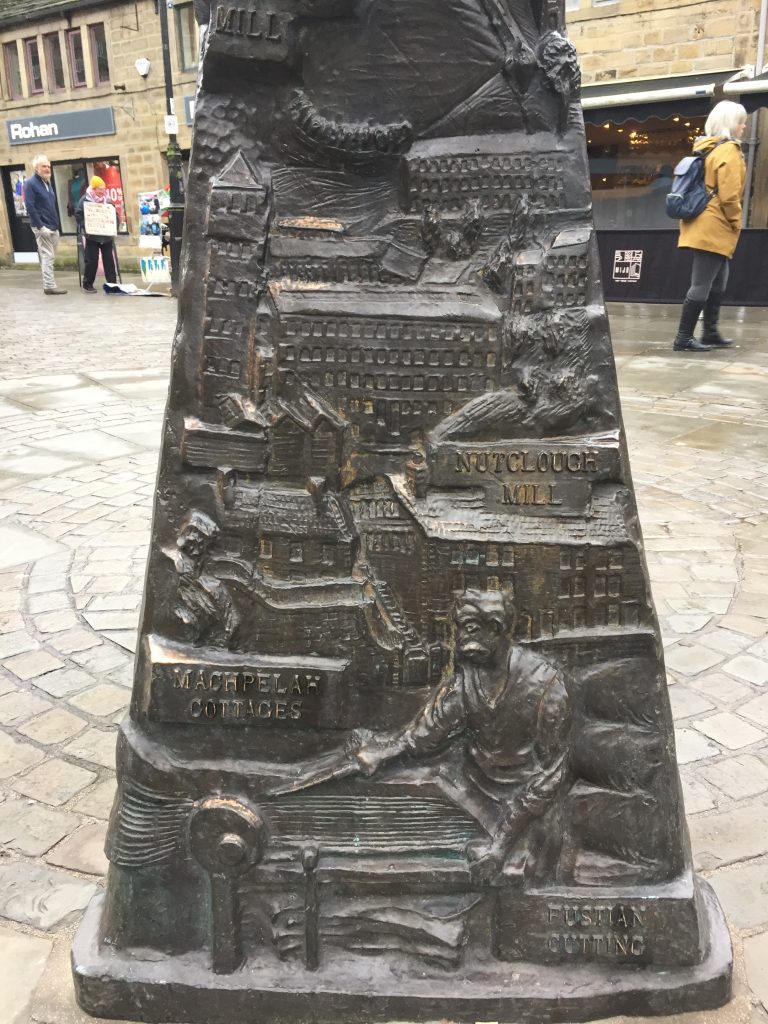
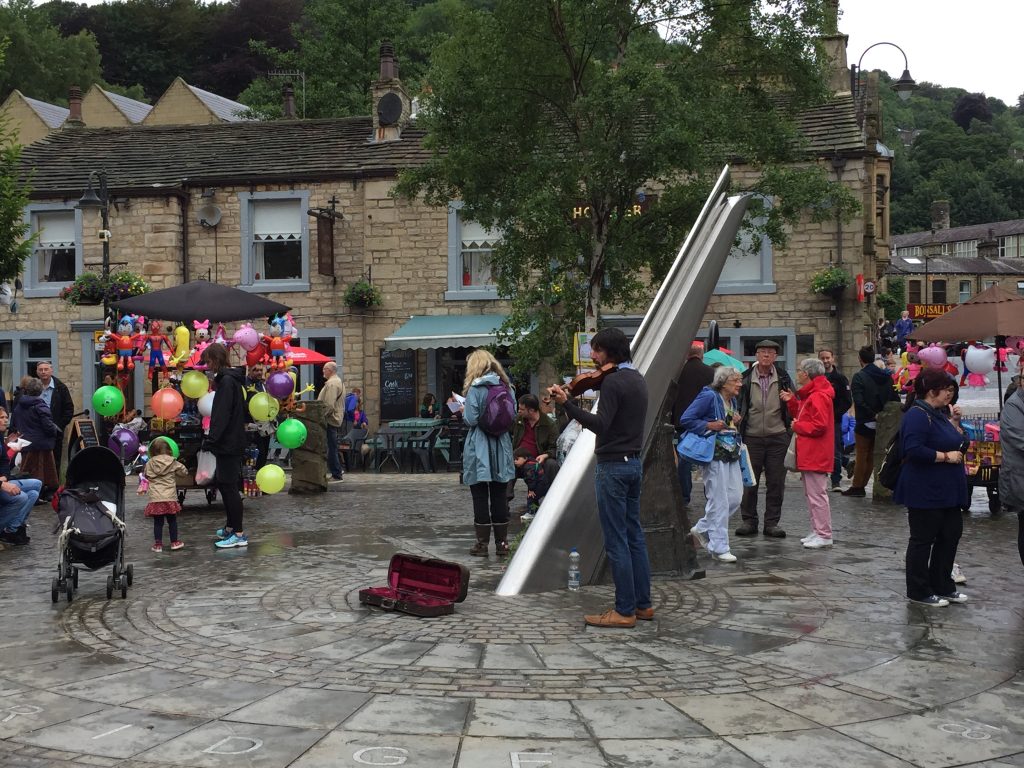
Sculpture celebrating the fustian industry in Hebden Bridge Square
On September 24, at the age of 19 Stott married Sarah Ellen Thomas at Halifax minster. Only her mother is named and on her marriage certificate there is a blank space for her father. If her father had been deceased he would have been named and then ‘deceased’ added. Stott and Sarah had 10 children. A month after their marriage they had a son who was baptised in October but died the following month. He’s buried at St James’s.
Two years after their marriage Stott gets caught up in a fight that appears to have been sparked by rivalry between the Heptonstall and the Hebden Bridge brass bands!
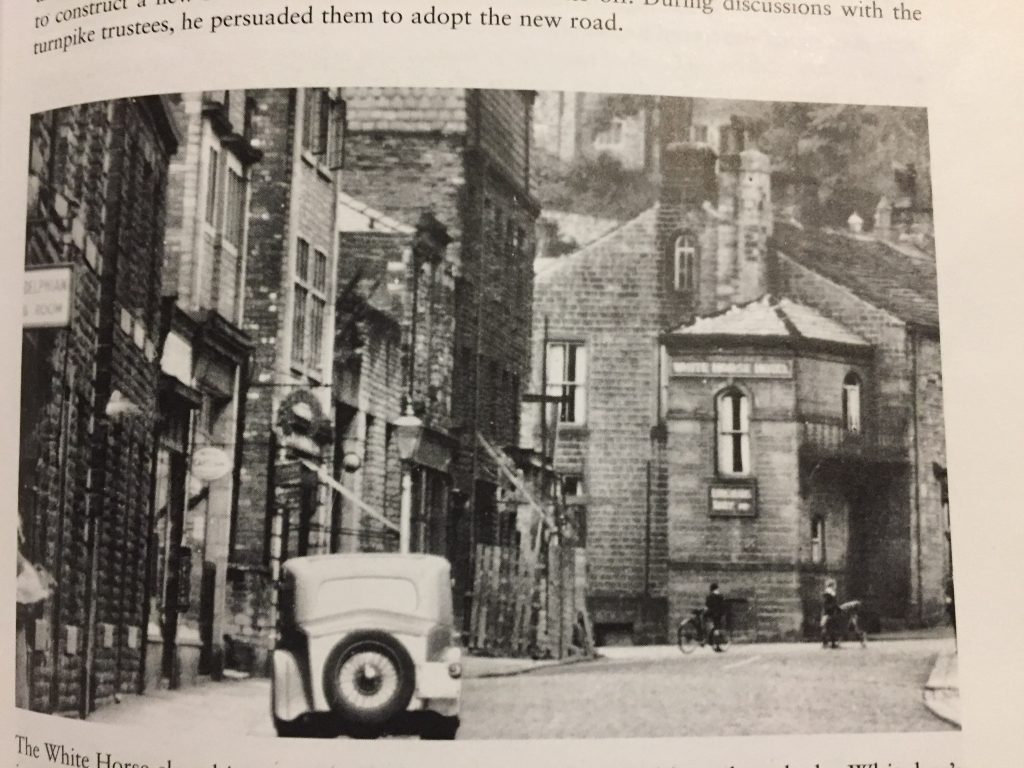
Hole in the Wall Inn on right. Royd Terrace rear centre. Buttress Brink on left
Todmorden & District News – Friday 29 September 1876
DISCORD AMONGST MUSICIANS —UTTLEY V. SUTCLIFFE—Mr. Craven appeared for plaintiff, and Mr. Ashworth (Rochdale) far defendant. Mr. Craven in opening the case said the matter arose out of an affray between the members of two local bands.- His Honor: Two bands of music ?—Mr. Craven: Yes, but on this occasion not of a very harmonious character—Mr. Ashworth: There was too much drumming for much harmony. (Laughter).— Mr. Craven, continuing, said that on the 22nd July certain parties connected with the Heptonstall and Hebden-bridge brass bands were at the Shoulder of Mutton inn, and a dispute arose about the musical abilities of each band. On leaving the Shoulder Mutton Inn a fracas took place amongst some of them. Soon after this the defendant got hold of his client, and threw him a distance of four or five yards, the result of which was that his ankle was dislocated; whilst on the ground the defendant got upon him and struck him in the face. His client claimed 6.11s.6d damages; he was stone mason, and was away from work two weeks; his wages were 32s a week; he paid 7s 6d. for medical assistance, and claimed 3 pounds for the pain and suffering which he had undergone. –
Plaintiff on being examined said: I was at the Shoulder of Mutton Inn on the night of the 22nd of July; I had one glass of beer there, and I had previously had two glasses of porter and a bottle of cider during the day. When I left the Shoulder Mutton Inn I was making my way home, and went over the Old bridge with James Simpson and Thos. Sutcliffe, whom I accompanied to Buttress Bottom. I did not see the defendant; there were a great number of people about. The Heptonstall band had been to a demonstration at Todmorden; there was a majority of the band at the Shoulder of Mutton Inn. I had been in company with a man of the name of Stott Gibson, and when I got to Buttress-bottom I saw him on the door-step of his house, and someone was bothering him, and I was going to protect him when the defendant got hold of me by the collar and threw me a distance of four five yards to the ground; he then got on top of me, and gave pair of black eyes; he hit me with his fist when I was down, and there were three or four persons kicking me at the same time.I never saw the defendant after. I went home by the roadside as best I could, and on the morning following I called in a doctor, who said the ankle was put out. I was kept sway from work two weeks in consequence of that injury. I paid my doctor 7s 6d. I had very much pain during the time of my illness. -I strictly followed out the doctor’s orders. I can swear that defendant was the man who threw me.—
By Mr. Ashworth; I had been at the Shoulder of Mutton about twenty minutes; I had one glass there. I had been at the Hole-in-the-wall and the Swan Inn before going there;
The old inn, The Hole in the Wall, at the bottom of the Buttress next to the Old Bridge prior to its demolition and eventual replacement in 1899
I had two glasses of porter and a bottle of cider. I went work that day at half past seven, and worked til 12 o’clock during which time I never tasted intoxicating drink. Stott Gibson had been with me at the Hole-in-the-wall and the Swan Inn, and he to went to the Shoulder of Mutton with me. He was stirred in drink at the last-named place, but not drunk. I play in Hebden Bridge band; Stott Gibson also plays in the same band. The defendant is not a musician that I am aware of; he lives at Nutclough. When the Heptonstall band came up my friend did not make any remark that I heard; he did not say he would have a “b—row.” He left the public house when I did. There was a row outside, which took place on the other side of the bridge. It was not one continuous fight from the Shoulder Mutton to the bottom of Buttress. Within 5 or ten minutes after that the row between the defendant and myself began. I was going to where the row was taking place. I did not hear defendant complain of someone striking him; I had not struck him. We were both on the ground together. He threw me four or five yards, and followed close upon me; I never struck or offered to strike anybody. I got home without any assistance a little after 11 o’clock. I took no part to the general scuffle. The scuffle was between the members of the Heptonstall and the members of the Hebden-bridge bands; I am a member of the latter, and so is Stott Gibson, but I took no part the scuffle. “Straight-up” was having a row with Stott Gibson. I attended a brass band contest at Todmorden on the following Saturday, but I was not able to work; I went to the contest in a spring cart. I was never drunk during the time of my illness. I did not throw on to any club.—By Mr. Craven: I went to try to work on the Monday following, but I could not stand at the bench. I received no additional Injury through attending the contest.—Thomas Naylor was called in supporting the plaintiff’s evidence, and spoke to seeing the parties at the Shoulder Mutton Inn, and afterwards seeing Stott Gibson home; there were lots of scufflings going on but he could not swear to the assault committed upon the plaintiff as he did not recognise either of the parties in the general scuffle. -Mary Hannah Southwell said: I know Thomas Uttley; I saw him on the night of 22nd of July at the bottom of Buttress between half past 10 and 11 o’lock.there were a good many people about. I saw a young man take hold of Uttley and throw him sideways; I did not see him again that night. I did not know who it was that there him – should I know him if i saw him again; I cannot swear that it was the defendant. I knocked down accidentally in the affray. –
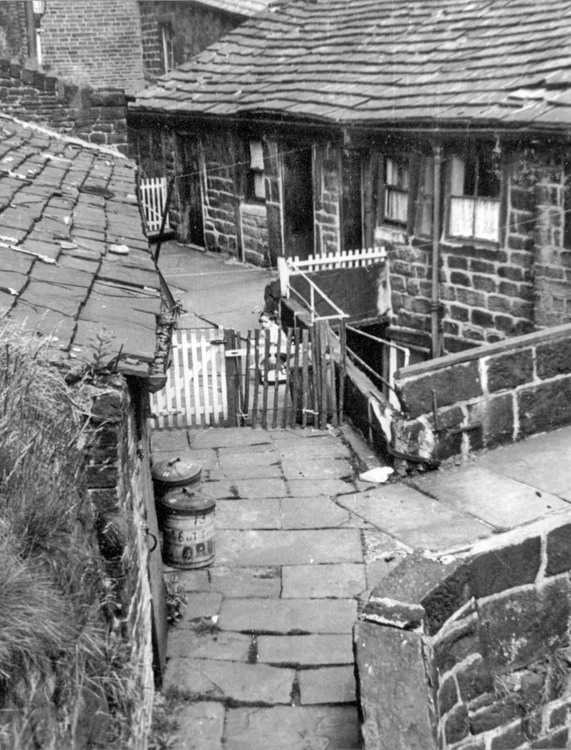
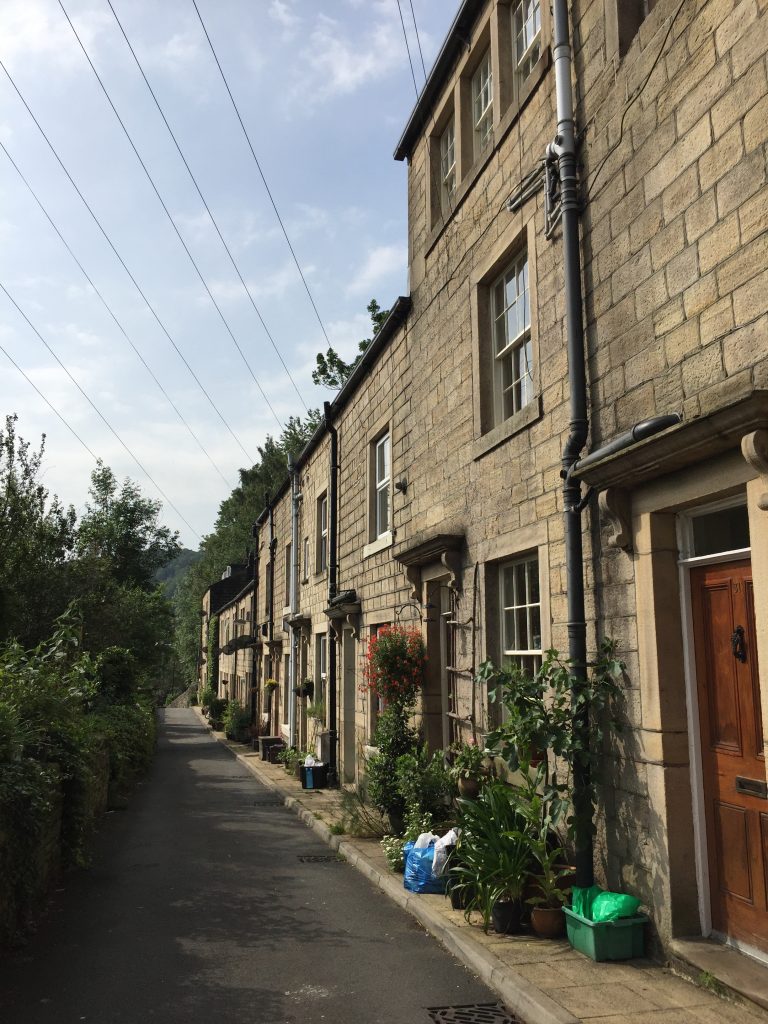
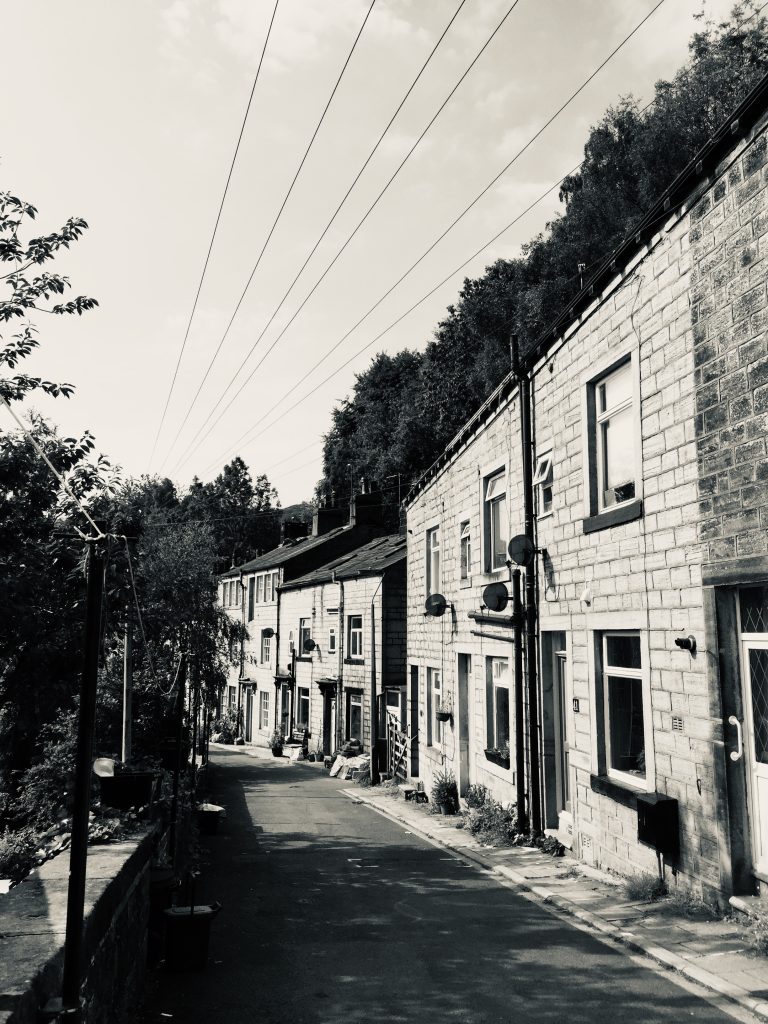
Higgledy piggledy tenements of Buttress Bottom
By Mr Ashworth: There was a good deal of jostling and fitting going on; they did not seem to be behaving like Christians to one another. – Jonathan Whitely said: I was at sale on the Monday following the affray, and defendant was there. I called him one side and asked him about it, and he said he had thrown Uttley down, but Uttley struck him first. I told him what in jury Uttley had sustained and he expressed sorrow. – This being the plaintiff’s case Mr Ashworth addressed the court for the efense, after which he called upon the defendant Richard Sutcliffe, who said: On 22nd of July I was at the shoulder of MuttonInn, and that day there had been a demonstration at Todmorden where the Heptonstall band had been engaged. . I went to the Shoulder of Mutton Inn at 10 o’clock. I was quite sober. The plaintiff Thomas Uttley was there, and appeared to be sober.I did not see Uttley leave the house. I saw him near Stott Gibson’s house: he was then rushing towards Gibson and I stopped him and was going to tell him that Gibson’s wife was in charge of him when he turned round and struck me in the chest. I then got hold of him and we both went to the ground together. No-one separated us. I never was on top of him. I left him at the end of Royd Terrace.
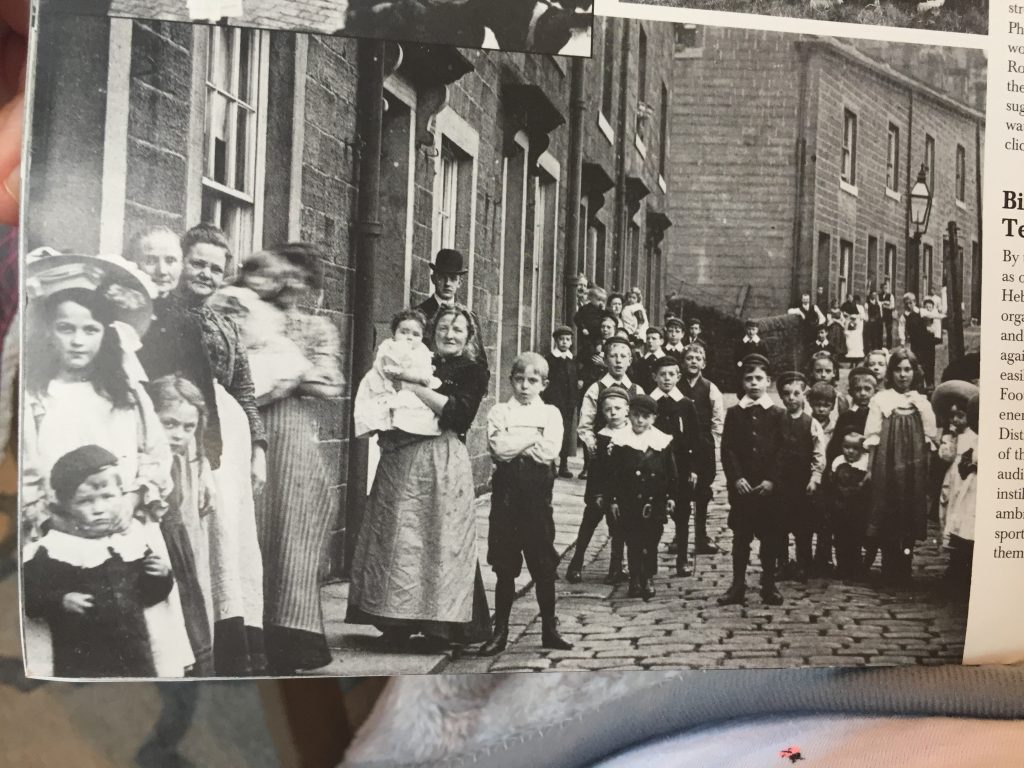
Residents of Buttress Bottom outside their homes, with houses of Royd Terrace behind
I saw Whitely on the Monday following and he told me of Uttley’s in juries but I did n to express my sorrow. I told him that Uttley struck me in the breast and then got hold of him. I did not know that he was hurt until whitely told me. Uttley struck as hard as he could. –
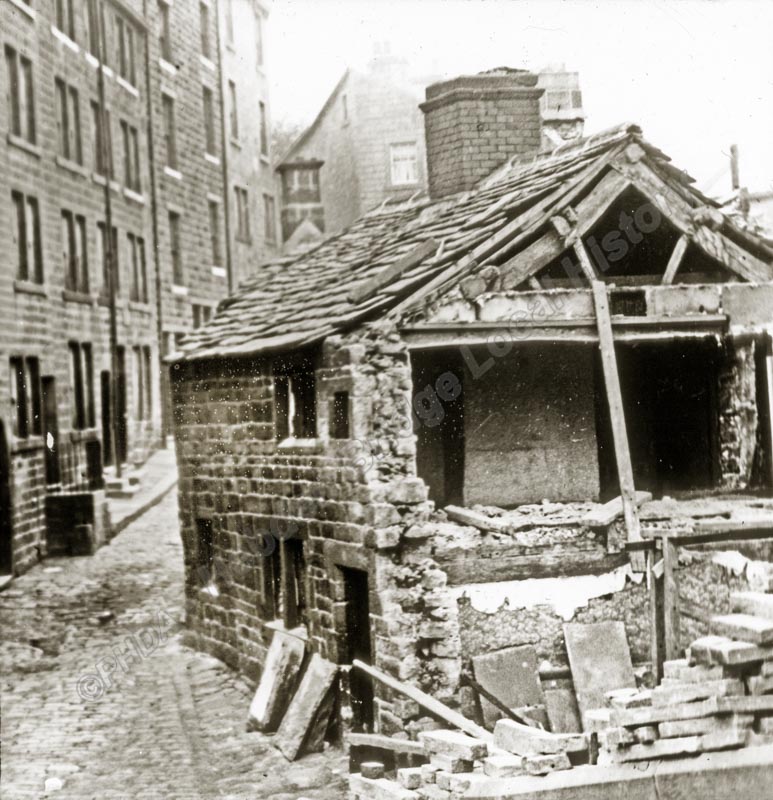
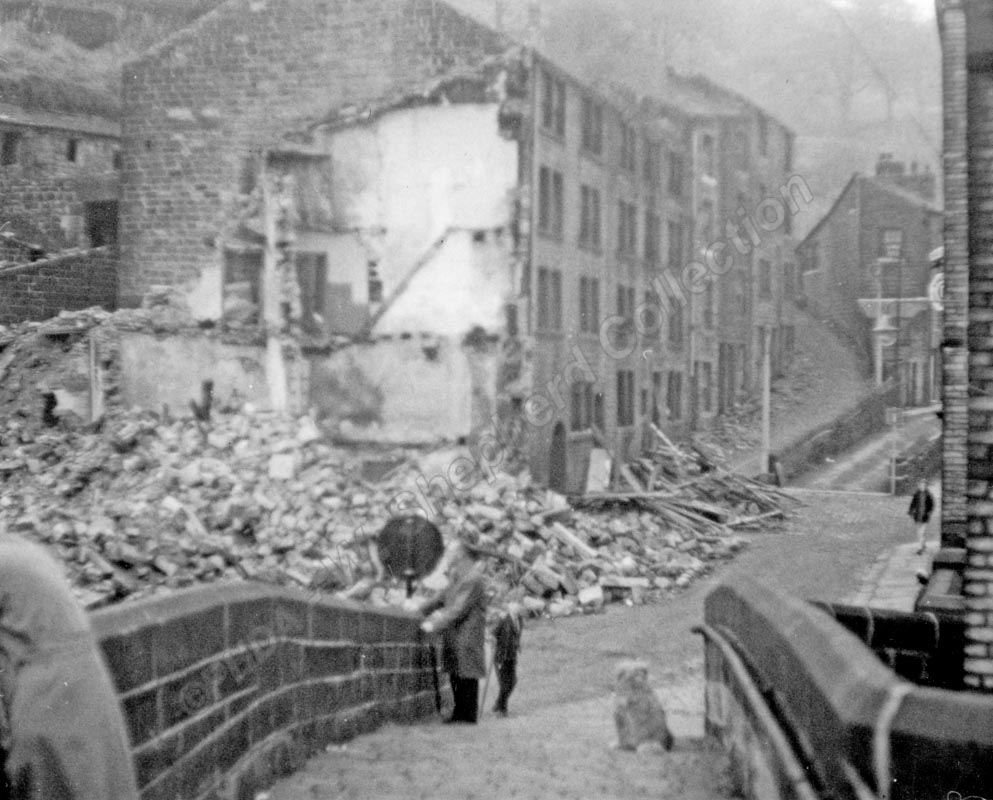
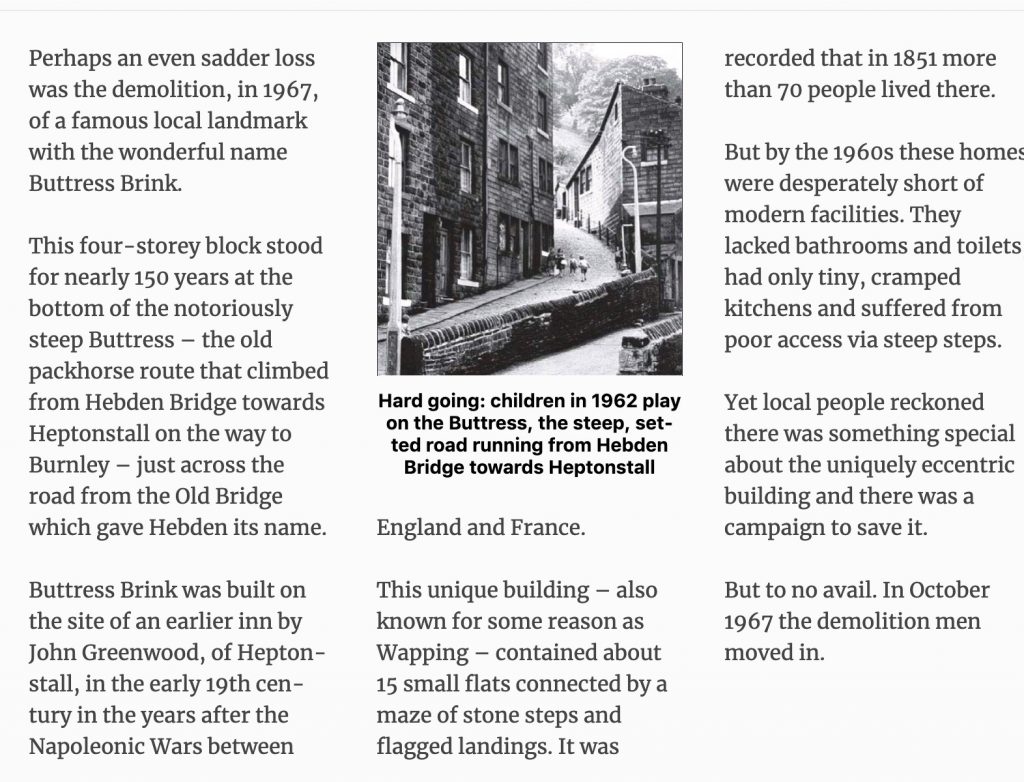
Taken from the Old Bridge looking up to the Buttress with Royd Terrace on the right. The tenememts at the bottom of the Buttress were demolished in the mid-1960 as unfit for human habitation.
By Mr Craven: I got up and left him lying on the ground. I did not wait to see whether he got up or not – I was not aware that I had injured him. Stott Gibson shouted the Heptonstall band whilst playing. (?) I am n to a member of the Heptonstall band but my sympathies are with that band. I stopped Uttley to tell him who it was who was getting Gibson into the house. The blow was intentionally given to me; I did not strike to to my recollection whilst on the ground. –
From the Halifax Courier
William Sutcliffe corroborated defendant’s evidence as to the plaintiff striking first. Mr Ashworth intimated that he had other witnesses to call if his Honor was not satisfied. His Honor said he did. Not think the plaintiff had any right of action against the defendant, and ordered a nonsuit.
The family were now, 1881 living at Buttress Bottom, Hebden Bridge and in the 1891, 1901 and 1911 census they are #6 Buttress Brink.
Sarah died in 1917 and so far the only Stott Gibson’s death record I can find is in Conway, Wales in 1925 but that seems unlikely. I did, however manage to locate photos of Stott’s children from a relative on Ancestry.com
Sarah Elizabeth
Ruth
Harry (with baby Enid), Thomas and William
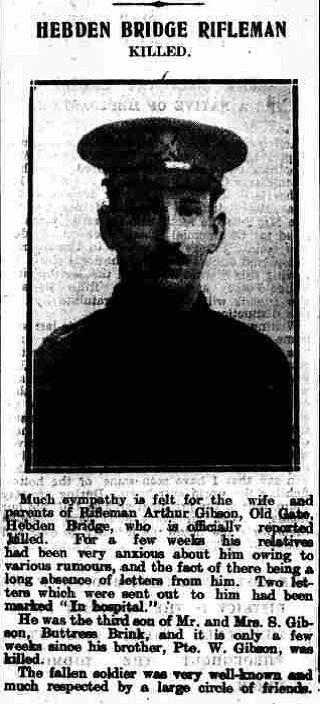
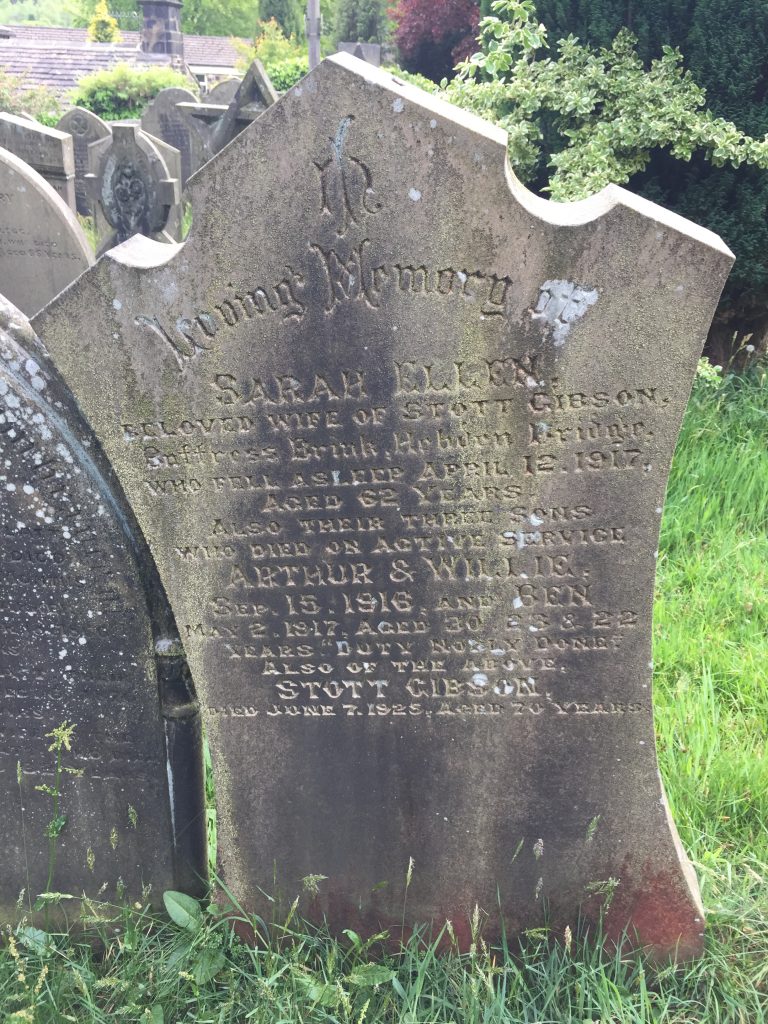
Stott’s son, Arthur, was killed in WW l in 1916 the day after his brother, William was killed. 8 months later their brother Ben was also killed. Today I was invited to go to see the new Oscar nominated movie ‘1917’ but I declined.
Update: May 2020. I eventually found the family grave at St James’s, Hebden Bridge
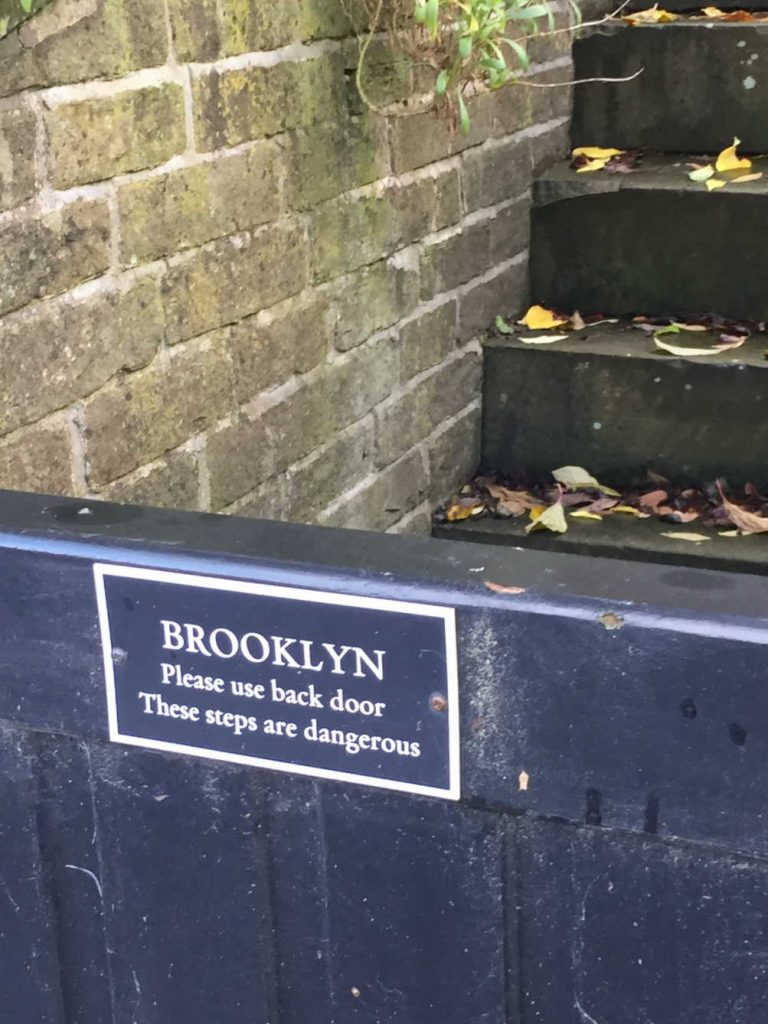
On November 26, 2018 I climbed the steep hill of Birchcliffe Road above Hebden Bridge. I was in search of several buildings that had been lived in, and in some cases specifically built for, my ancestors. Yes, these are quite distant ancestors, but at this gloomy time of year when it’s dark by 3:30 p.m. going in search of houses that I can walk to from my apartment is an interesting way to spend some of the daylight hours, and so then in the evening, I can research online more about what I’ve discovered during the day. So as I searched the street perched on the hillside with one of the best views in town, which I later, by the way, learned was known as Snob Row (!) I saw a sign on a gate: ‘Brooklyn. Please use the back door. These steps are dangerous.’ I’m not sure what caused me to take a photo of the sign on the gate but recently I discovered that these steps had played a very important role in the life, or rather, death of one Abraham Moss.
The steps
Now Abraham was the father-in-law of my 3rd cousin, two times removed. As I said, a rather distant relative. He was the son of Hague Moss, (26 June, 1824- July 1870) a career fustian cutter, born at Machpelah, a section of Hebden Bridge devoted to the fustian industry. Hague’s father was James Moss jn (1804-1868) and his wife, Mary. Fustian is a thick, hard-wearing cloth made from cotton that was once used for military uniforms and railway workers. Hebden Bridge was the centre of the fustian industry and was known sometimes as Fustianopolis. In the market square there’s a large sculpture of a fustian knife showing what a central role this industry played in the town.
Close up of the fustian knife in St George’s Square showing scenes from the fustian industry. It even shows Machpelah cottages where Abraham lived.The fustian knife in St George’s Square
By the time Hague was four years old the family had moved to Thorn Bank, close by, where Sarah and I had stayed in an Airbnb in 2017! Coincidence number 2.
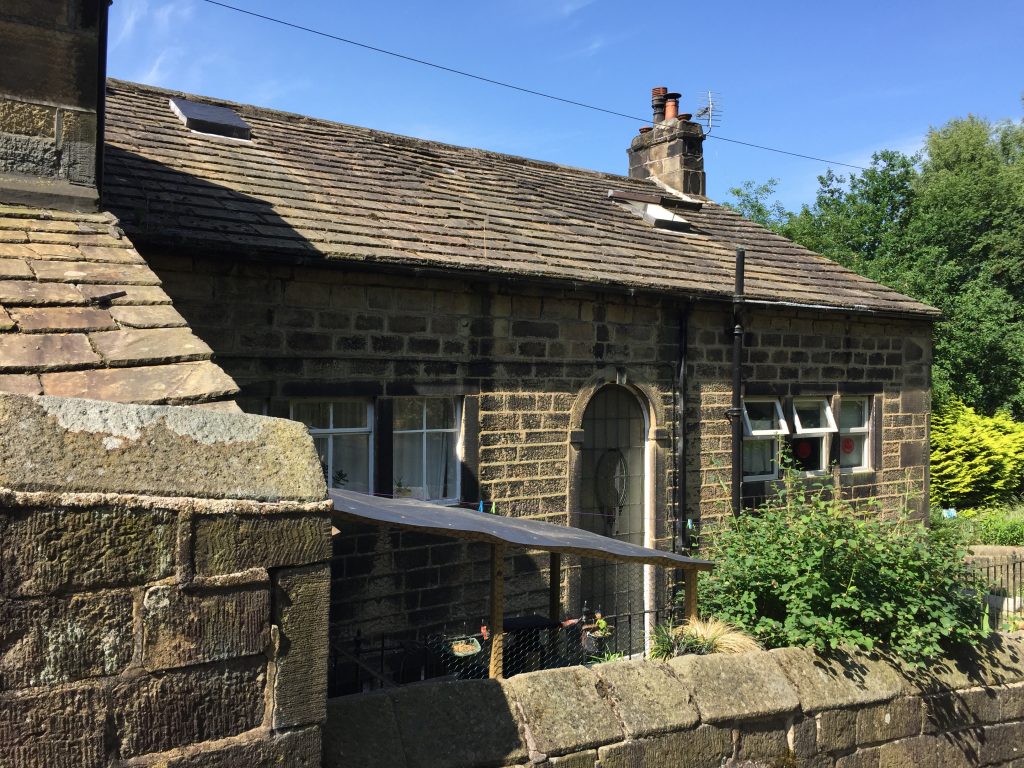
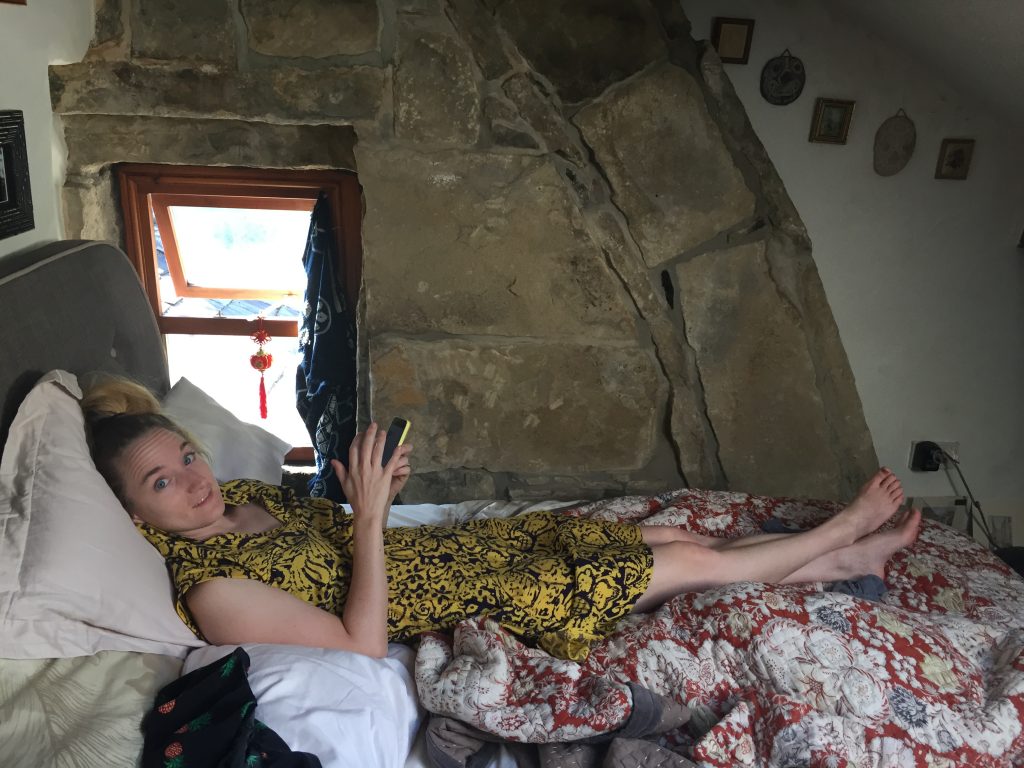
Thorn Bank where Sarah and I stayed in 2017Thorn BankSarah in the attic at Thorn Bank
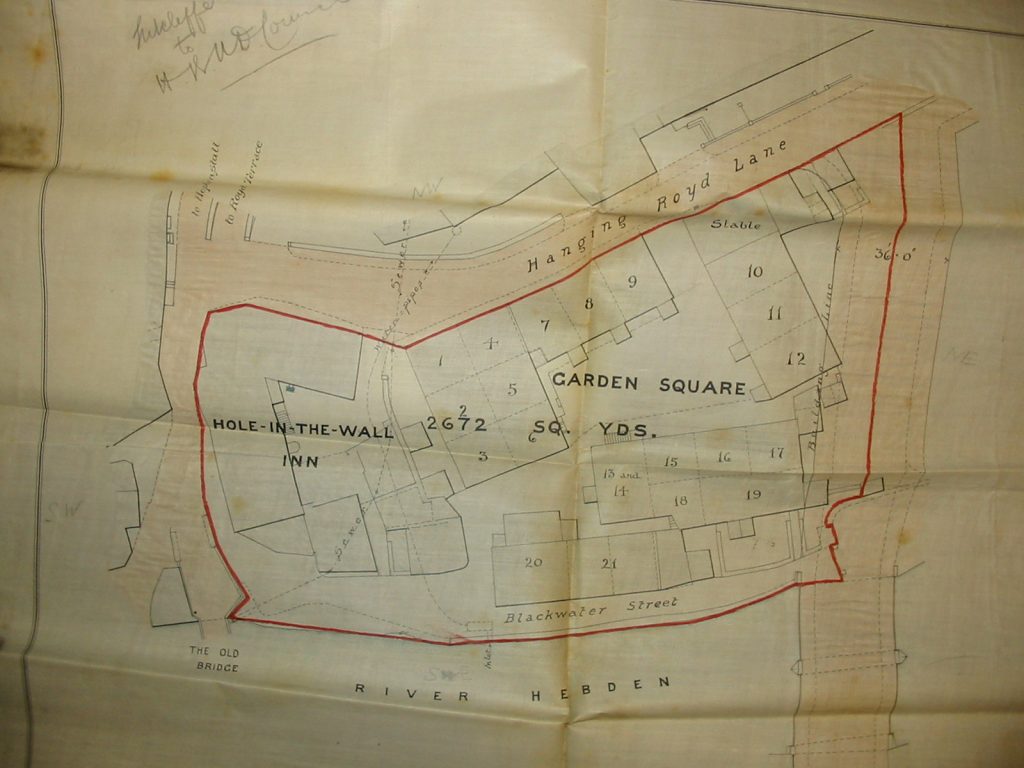
By 1841 the family were living at Garden Square and Hague’s father James is a fustian cutter. They were living next to William Wheelhouse, 45, a joiner with his wife, Mary, and 4 children. Hague Moss married Martha Sarah Wheelhouse on June 23, 1845 at Halifax minster where I once had the privilege of playing the organ, and I’ve also sung at evensong, and also in Faure’s Requiem in 2019.
The newly weds made their home in Garden Square on which land the town hall was subsequently built.
Garden square before demolition
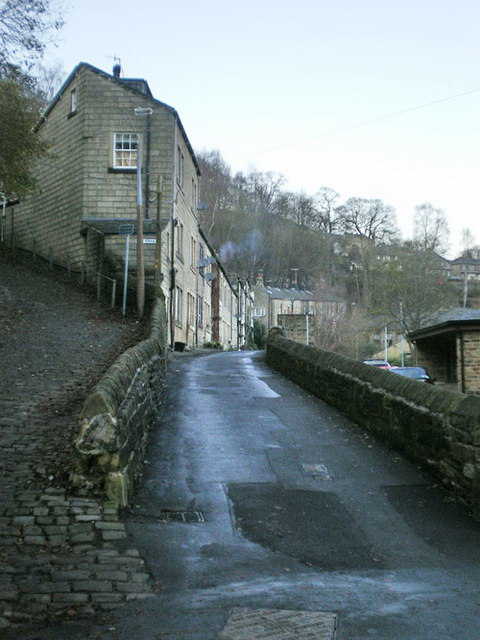
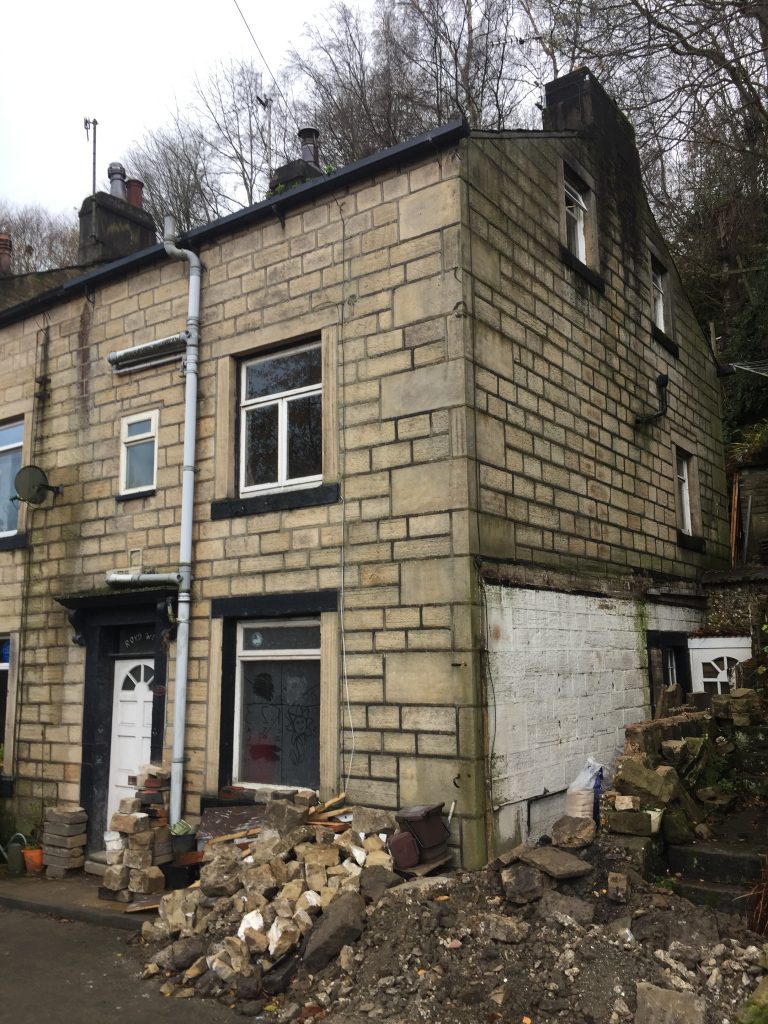
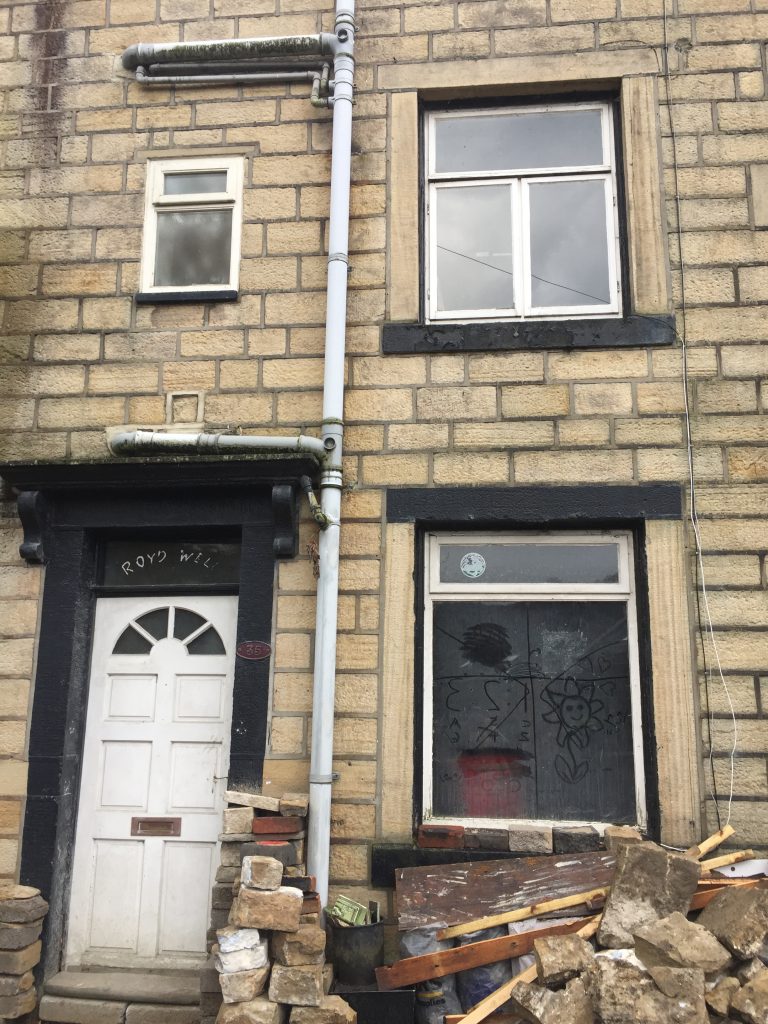
8 children followed in the next 15 years, Abraham being next to the youngest. By the time Abraham was born the family were living at High Street, Bridge Lanes. The area of Bridge Lanes was mostly demolished in the 1960’s the terraced houses having been neglected and left unoccupied for many years and it had become an unsightly entrance to Hebden Bridge from the Todmorden side. Abraham’s father died when he was only 11 years old and by that time the family had moved to Royd Terrace, at the lower end of the Buttress, the still cobbled steep road up to Heptonstall.
Royd Terrace with the cobbles of The Buttress on the leftAbraham’s house on Royd Terrace
During the battle of Heptonstall in the Civil War, 1643, the Parliamentarian garrison of around 800 men holding Heptonstall had rolled stones down The Buttress to prevent the Royalist forces, also numbering around 800 men. The attackers were routed but during the following 2 months the Parliamentarian garrison evacuated the village and the Royalists were able to capture the village with no resistance.
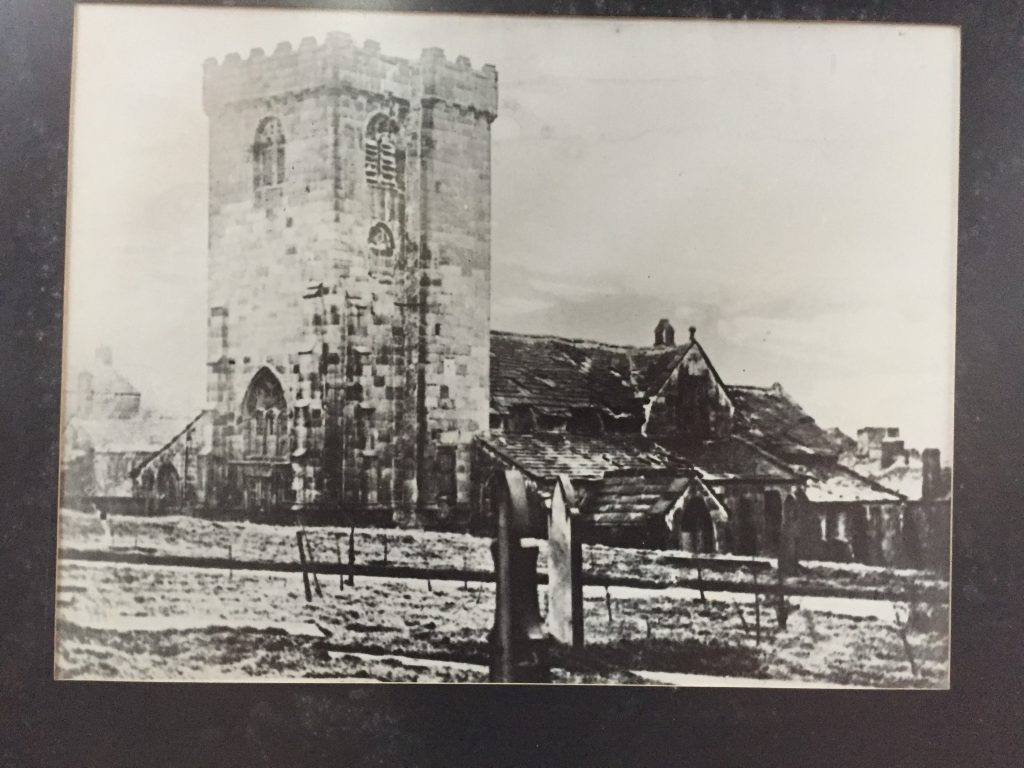
Heptonstall old church
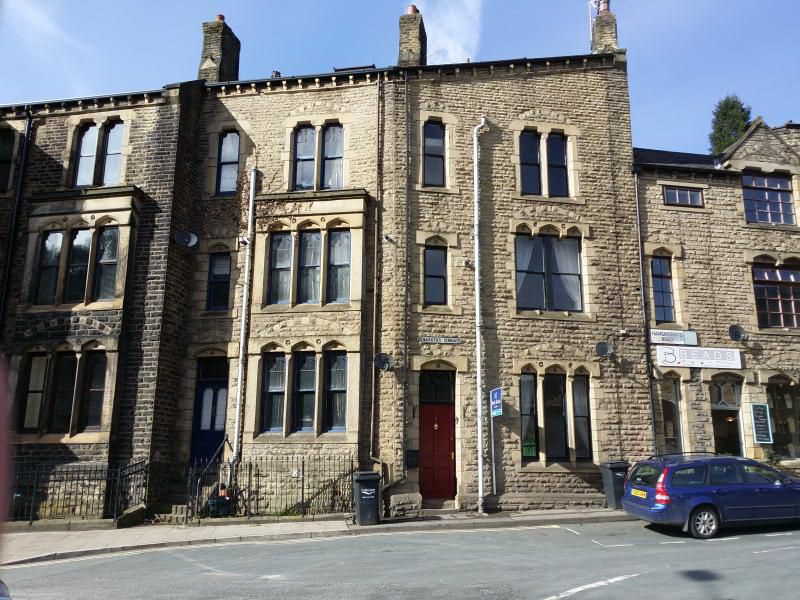
The houses of Royd Terrace in which Abraham had lived were not built until 1848-1852 and all but one house retain their original glazing
My photo of Royd Terrace
A friend of mine lived in the only one to have double glazing installed. On his marriage, in 1881 at Heptonstall church, (where I am now on the organists’ rota) to Mary Hannah Thomas, daughter of Thomas Thomas (!) a coal merchant, the couple moved to Barker’s Terrace. Both Abraham and Mary signed their own names and Thomas Thomas signed as witness.
My photo of Barker’s Terrace
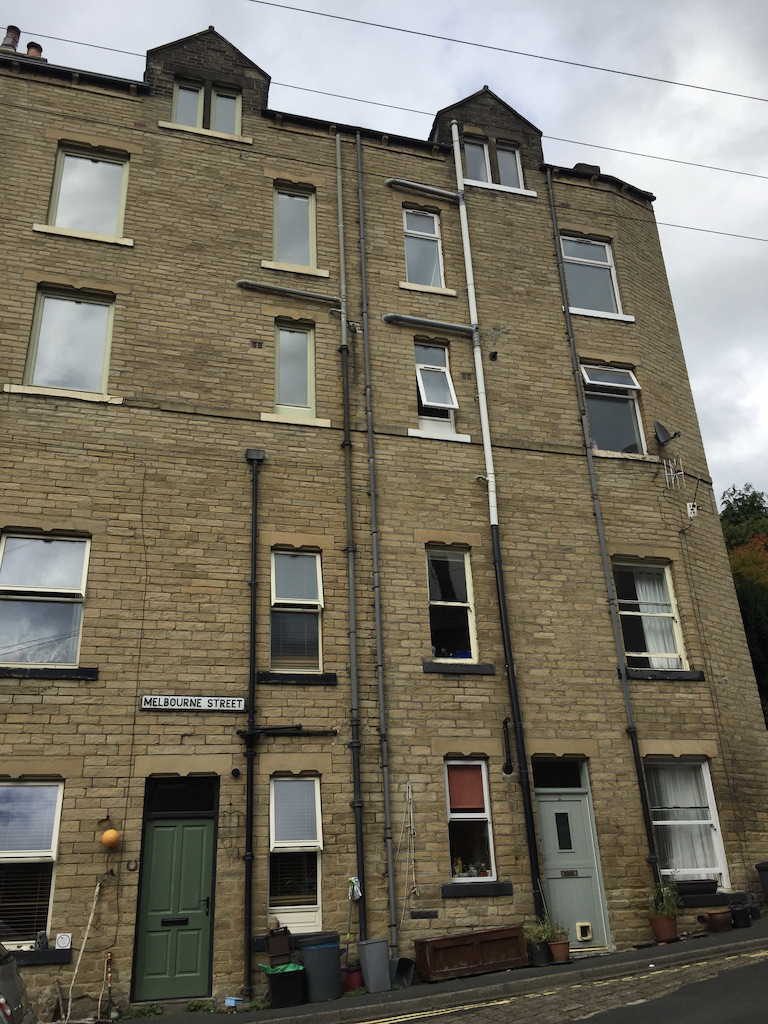
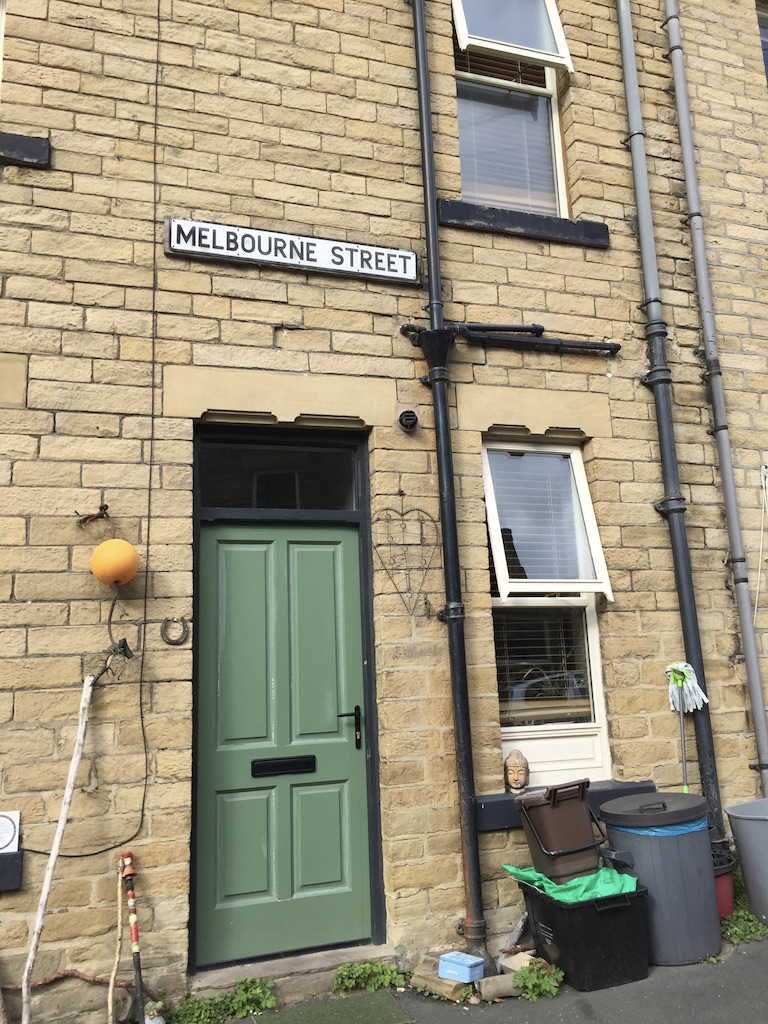
Abraham was a commercial clerk in a fustian warehouse. Three months after their wedding their first of seven children was born, a daughter, Beatrice Louise at 13 Melbourne Street.
13 Melbourne Street
13 Melbourne Street
In White’s 1887 Directory many Mosses are recorded:
Moss Abraham (Bros) h in Brunswick Terrace
Moss Bros. fustian manufacturers and cutters, Brunswick Works
Moss( G. F & C. W) h Bridge Lanes
Moss Frederick Hague (Bros) h Brunswick St
Moss George Frederick (G.F & C.W) h Bridge Lanes
Moss James (Bros) h Pleasant Villas
Moss Mortimer (bros) h Brunswick House
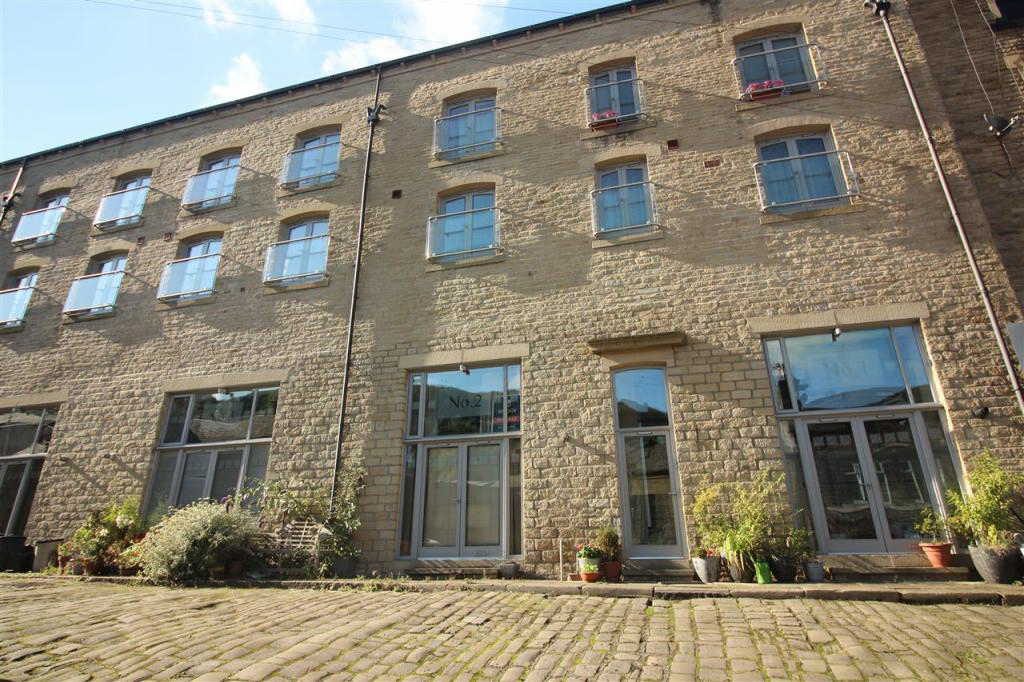
The fustian factory on Brunswick street – now apartments
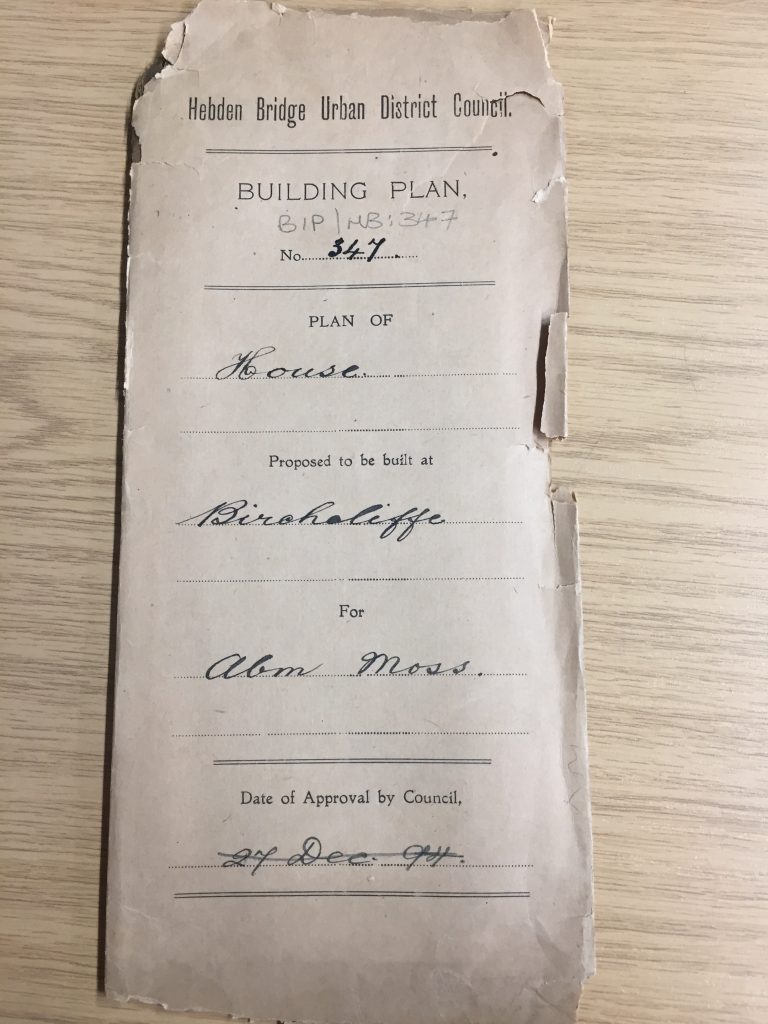
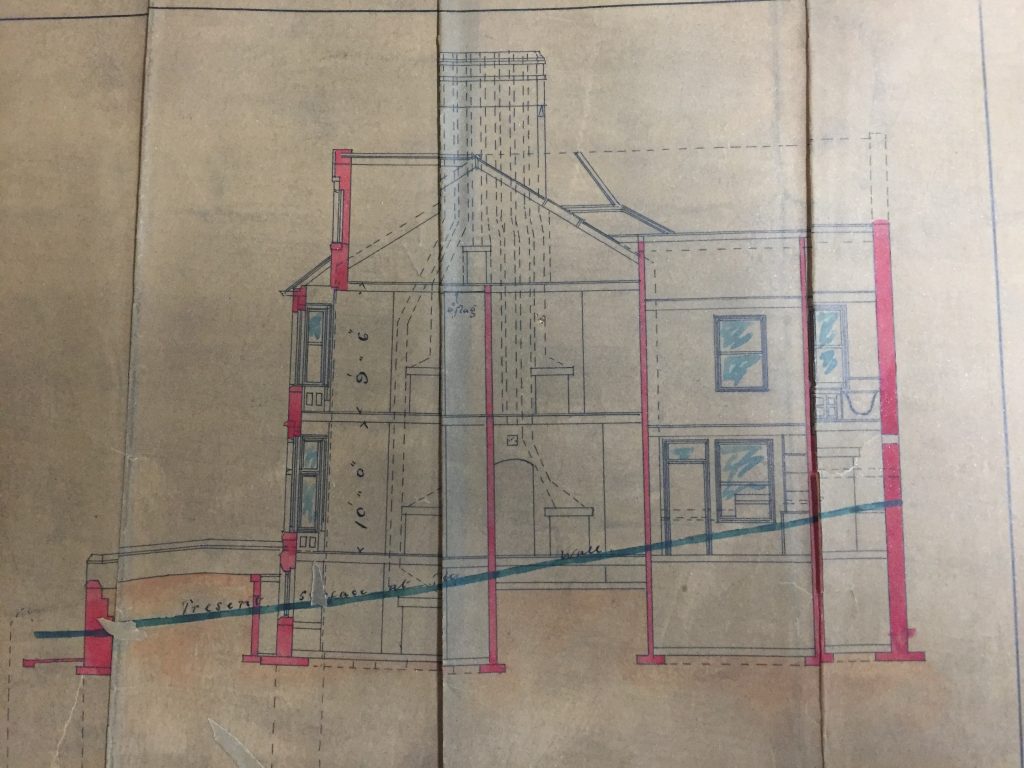
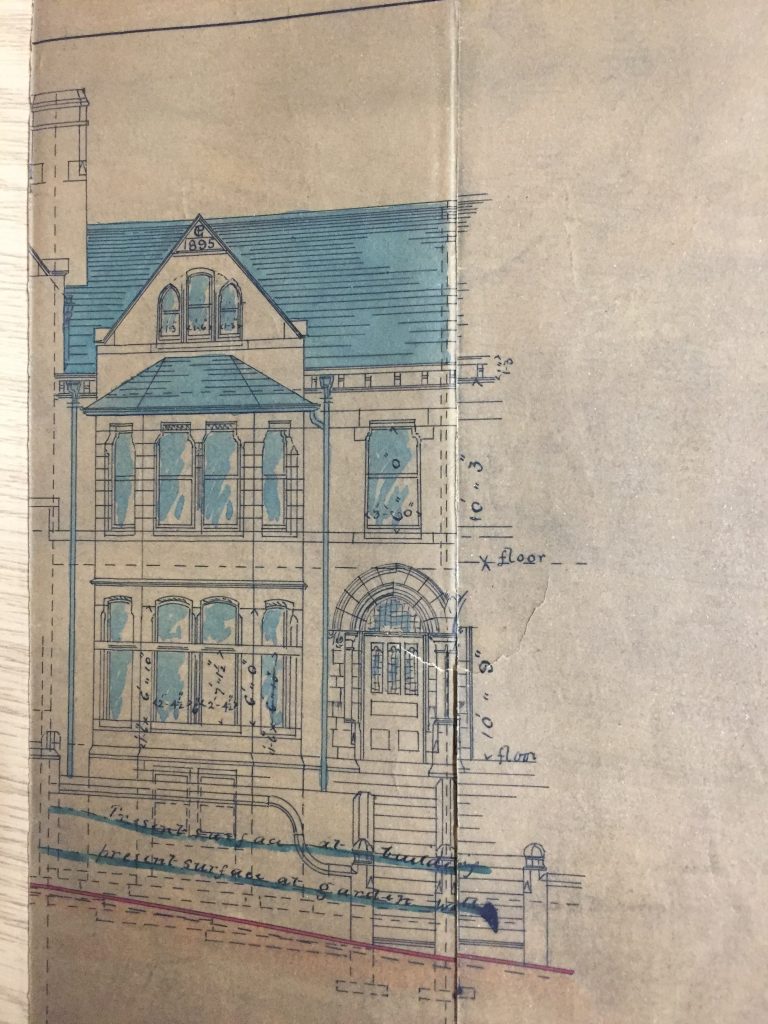
By the 1901 census Abraham is listed as a cotton fustian manufacturer, an employer, and later that year a daughter, Phyllis Margaret was born, seven years after the last (living) child. The 1911 mentions that one child has already died. He is now living on Snob Row, in Brooklyn, where I’d photographed the sign on the gate. The house had 9 rooms and they had a live-in general servant. What a difference from 2 High Street. I was able to view the plans for the house at West Yorkshire Archives though each leaf fell apart in my hands as I opened it. It would appear that the plans were drawn up by John Sutcliffe, architect, on December 20, 1894 but the approval date of December 27, 1894 has been crossed out. This was the same architect who drew up the plans from Ezra Butterworth five years earlier. But what an extravagant house it was – especially compare to the houses Abraham had lived in before.
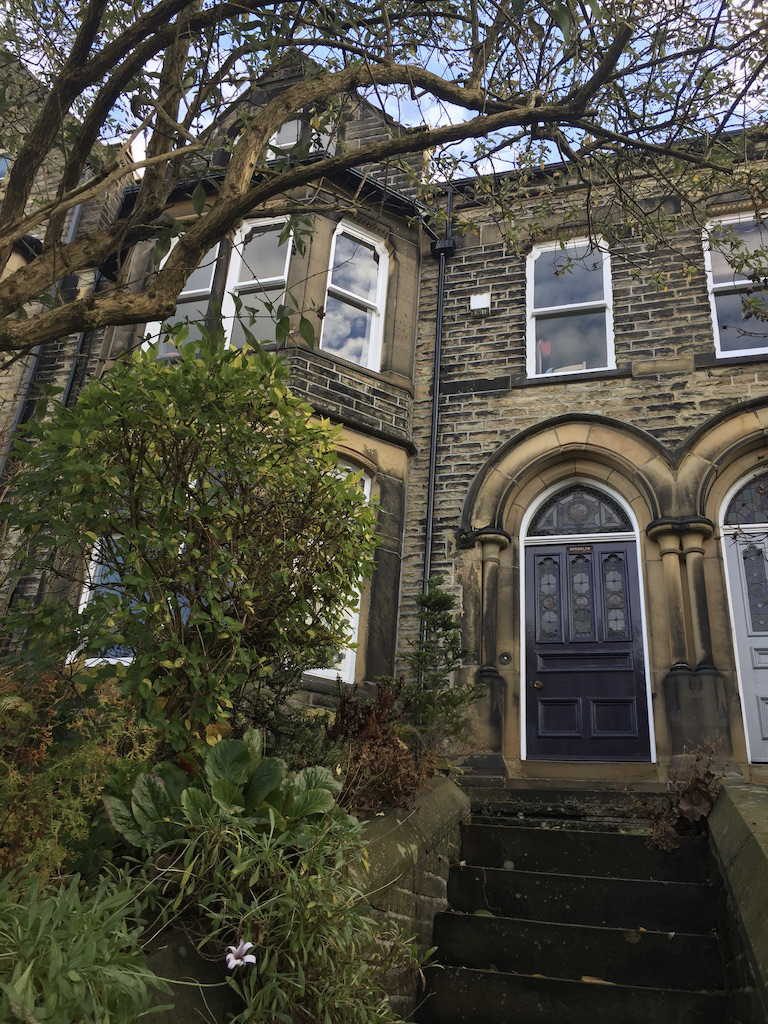
The previous level of the land, marked by the blue line, is clearly visible. The steps are marked on the architect’s drawing of the front elevationBrooklyn today with its fatal steps
However, sadness and tragedy were just around the corner for the family. Phyllis died, aged 13 and three years later Abraham himself died. Imagine my horror when I read in a local newspaper that he had died as a result of falling down those very steps. I do wonder, from a morbid sense of curiosity, if the people who put the notice on the steps know of Abraham’s accident.
FATAL FALL AT HEBDEN BRIDGE. SAD END OF A WELL-KNOWN We very much regret to have to announce the death of Mr. Abraham Moss, Brooklyn, Hebden Bridge, and especially so considering the melancholy circumstances under which happened. The gentleman on Wednesday evening was found laid in an unconscious condition at the foot of the steps leading to his own house, with a deep gash on the side of his head, and from this injury he died at two o’clock yesterday morning without regaining consciousness. So far as we can gather from particulars collected from various sources the circumstances are these: Mr. Moss had been down in the town and parted from Mr. A. Moore at Top o’ th’ Hill about ten o’clock on his way home. In the course of half an hour or so, Mr. T. Fenton Greenwood was on his way home to Eiffel Street, and when he got opposite to the gate the residence Mr. Moss he heard some deep breathing, but as he had no means of making a light and the night being very dark, he could not make out any object. Mr. Ernest Whiteoak, Eiffel St., came up almost immediately afterwards, and struck match and the light revealed Mr. Moss laid at the bottom of a flight of dozen steps, with his head resting in a large pool blood and perfectly unconscious. On the right side of his head there was a large wound from which the blood was issuing. Mrs. Moss was acquainted with the fact and her husband was carried to the house and Dr. Sykes summoned, and that gentleman found that Mr. Moss was suffering from fractured skull. Whether he had fallen from the top of the steps or not does not appear clear, but the sloping asphalt from the top of the steps was very slippery. Judging from the position the body it would appear that Mr. Moss had fallen backward and his head had either struck the wall or the steps in his fall. The facts have been reported to the Coroner. The news of the sad occurrence created quite sensation in the town yesterday morning. * Mr. Moss was well known in Hebden Bridge and district. He was the younger son the late Mr, Haigh Moss, and many years was associated with his brothers in the fustian manufacturing, dyeing and finishing business at Brunswick Street, Lee Mill and Bridge Boyd, up to few years ago, when he retired, and since then he has not followed any occupation. He was one the directors of the English Fustian Association up to the time of his death. For a good many years he had been one of the local representatives on the Todmorden Board of Guardians. He was first elected in 1898, and remained member up to 1910. Three years later he was again elected, and had been a Guardian ever since. He took great interest the affairs of that body, and for a term was its chairman. For many years he was a very active member of the Hebden Bridge Commercial Association. He was an enthusiastic member the local Angling Club. Though he associated himself with the Constitutional Club he did not take any part in the aggressive work of the Conservative party. Free Masonry claimed a considerable portion of his time, he having filled offices in the Prince Frederick Lodge. He was one of the band of young men who received a considerable portion of their education the classes held in connection with the defunct Hebden Bridge Mechanics’ Institute. He took interest in electricity, and according to his own story, he along with the late Mr. B. Blackburn installed the first telephone in Hebden Bridge, connecting the house of one of his brothers to the firm’s premises. He was closely associated with the Particular Baptist Church, and was good supporter of that institution. His nature was kindly and sympathetic and he was ever ready to give financial assistance when occasion demanded it, and in this way he has displayed a liberal generosity. Mr. Moss, who was 67 years of age, leaves widow and five children. Two his sons are serving in the army, Walter in France and Reginald in India. The inquest will he held to-morrow afternoon.
When he died he left just short of £40,000 pounds to his wife. This was in 1917 and many of the other people on that page of the probate records had just a few hundred pounds to their name. He was initiated into the Prince Frederick Free Masons Lodge on March 3, 1890 along with Richard Redman, clothier from Pleasant Villas, and James Moss, fustian manufacturer, also from Pleasant Villas.
From The Hebden Bridge Times, January 30, 2006
WHEN the history of Fustianopolis – alias Hebden Bridge – comes to be written, it will be recorded that it died of apathy. I have now been waiting in vain for a month for somebody hereabouts to protest about the East Anglian train operator, One, banning cab drivers from wearing corduroy.
Under new licence conditions, cabbies at Lowestoft and Great Yarmouth stations must wear black trousers and black shoes with a collared or polo shirt. For women the regulations require a black skirt and blouse with a collar. No corduroy, not even black corduroy.
The company says: “Cords were included in the list of unacceptable clothing as they can look quite scruffy when they get faded. When the guidelines were being clarified, it was noticed that several drivers were wearing light coloured cords which had frayed and looked quite nasty at the knees”.
This is a bit lame. Are they objecting to corduroy or to fraying corduroy? If the latter, then they could simply have prescribed smart corduroy instead of banning it outright.
This is – or should be – of serious concern to Hebden Bridge. Nowhere has more corduroy been woven per head of population than in this town. My parents and several aunts wove miles of it on Hangingroyd at the CWS and Ashworth’s below where Foster Lane chapel once stood. My father went deaf in the service of corduroy and my aunts emerged from kissing shuttles in the CWS with a halo of cotton fuzz collected in their hair.
Corduroy was the life’s work of so many of my parents’ generation, and to think it has come to this: banned by the transport industry for being scruffy. Of course, anything can look scruffy if it is worn long enough. But that is no reason to ban corduroy that retains its rib (with musical consequences when you walk) and its sheen. Perhaps the problem is that it takes long periods of hard duty to wear thin.
Corduroy has, in fact, gone up in the world since it was the uniform of the academic, the Leftie intelligentsia, if that is not a contradiction in terms, and the wild and woolly end of the sandal-shod Liberal Democrats. It has, indeed, been on a long upward social march since it clothed the navvy and hard working man and had the likes of George Orwell, author of 1984, the Road to Wigan Pier etc, dressing, according to Malcolm Muggeridge, in the manner of the class into which he wished he had been born.
The fact that I have three pairs of corduroy trousers – the latest in a long line going back to my childhood – is no guide to the fabric’s social standing. I believe in supporting home industries and regard jeans, with their marked tendency for the backside to sag alarmingly, as thoroughly sloppy.
Which brings me back to the shameful apathy of Hebden Bridge in the face of East Anglian provocation. Corduroy is not some foreign-produced relic of Hebden Bridge’s once central position in the fustian trade. It is part of the 1m metres – otherwise 621,504 yards or 353 miles – of cloth that Brisbane Moss weaves, dyes and finishes every year at Bridgeroyd Works, Eastwood.
Hang it all, corduroy is part of our heritage. Since the middle of the 19thC, Moss Brothers – now Brisbane Moss – has been producing it along with moleskins. This company became part of the English Fustian Manufacturing Co when the local trade re-organised to meet the competition from another amalgamation of clothing and dyeing companies called the English Velvet Cord Dyeing Company.
Moss Brothers Brunswick Mill in Hebden Bridge may now be a Co-op superstore. But Bridgeroyd Works remain our link with the Industrial Revolution. And I for one do not intend to allow some obscure railway company on the Broads to disparage its Pennine products. Wear corduroy with pride – and in protest.
Just to see the contrast between the home in which Abraham was born and the one where he died shows the strength of character and determination of the man.
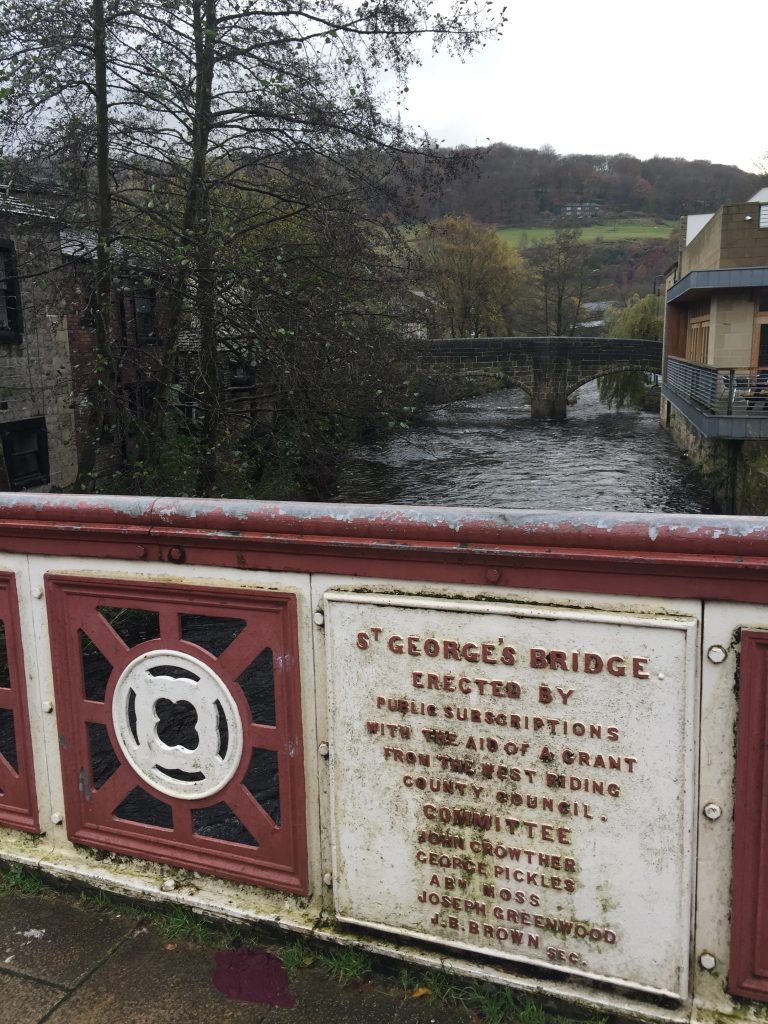
I pass this reference to Abraham Moss almost everyday. The bridge spans Hebden water and was constructed in 1892 and is Grade ll listed
UPDATE
I ws contacted by several people who had lived at Brooklyn and the current residents offered to show me round. So in December, my daughter Rachel who was visiting me from California, spent a wonderful couple of hours inside Abraham’s former home. It was a magical experience to sit in the same room and look out from the window overlooking the town, just as Abraham and his family would have done. Many thanks.
Surprisingly it wasn’t raining when I looked out of the window this morning. It even looked a little less gloomy than I was expecting so I wanted to take advantage of this ‘fine weather.’ I spent more than an hour planning my route – the area of steep hillside below Winters. I’d discovered more ancestors living in this area but the various maps I had seemed to have conflicting ideas about what constitutes a decent sized path. At this time of year the very steep paths are coated in slippery leaves. But even more dangerous than these are the steep cobbles of ancient roads whose moss ridden stones are a veritable nightmare, especially heading down the hillsides.
Built into the hillside
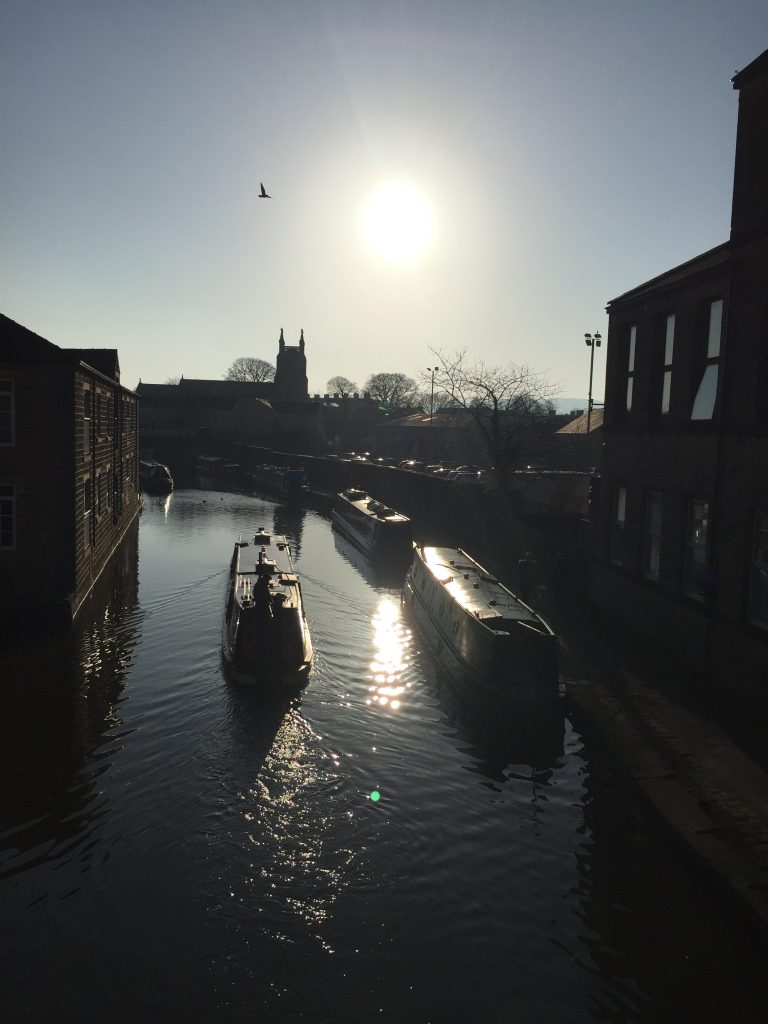
I walked along the canal to Stubbings Square where one of my ancestors lived. Though I’d passed the entrance to this little square many times I’d never actually gone in to the ‘square’ so here was my opportunity. Rather pretty old stone buildings.
Stubbings Square
Then on to Oakville Road which led up into the hills. As I turned a corner in the road I saw a train heading directly towards me which scared me for a moment. There was actually a wall between me and it, though if my arms had have been a tad longer I’m sure I could have touched it. I was to take the paved Turret Royd Road, (where another ancetsor had lived at #4) pass the last building and then continue on a footpath. Hmm – no sign of a path past the last house so I had to retrace my steps and take the lower road instead.
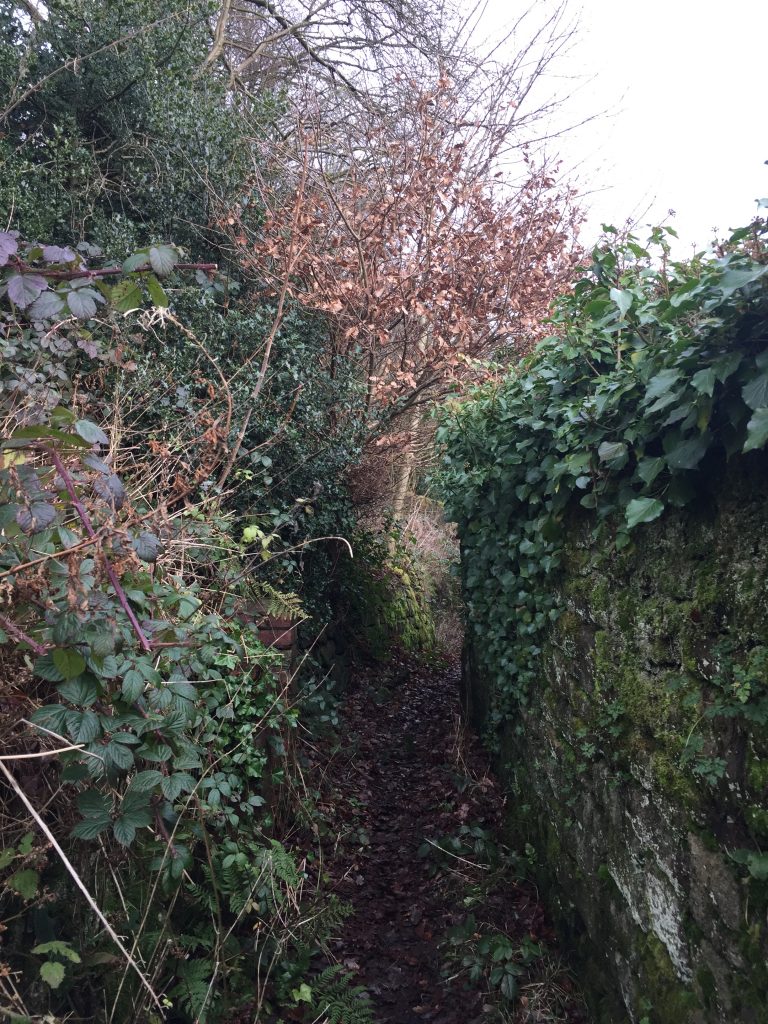
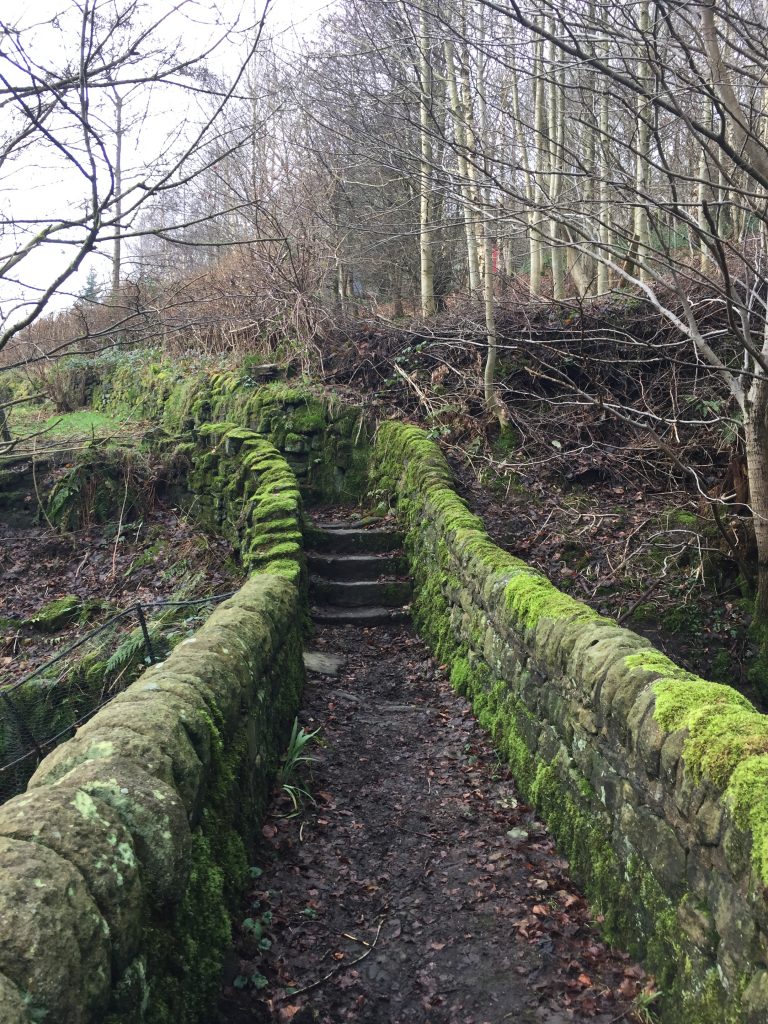
My path was narrow . . .
. . . .and steep
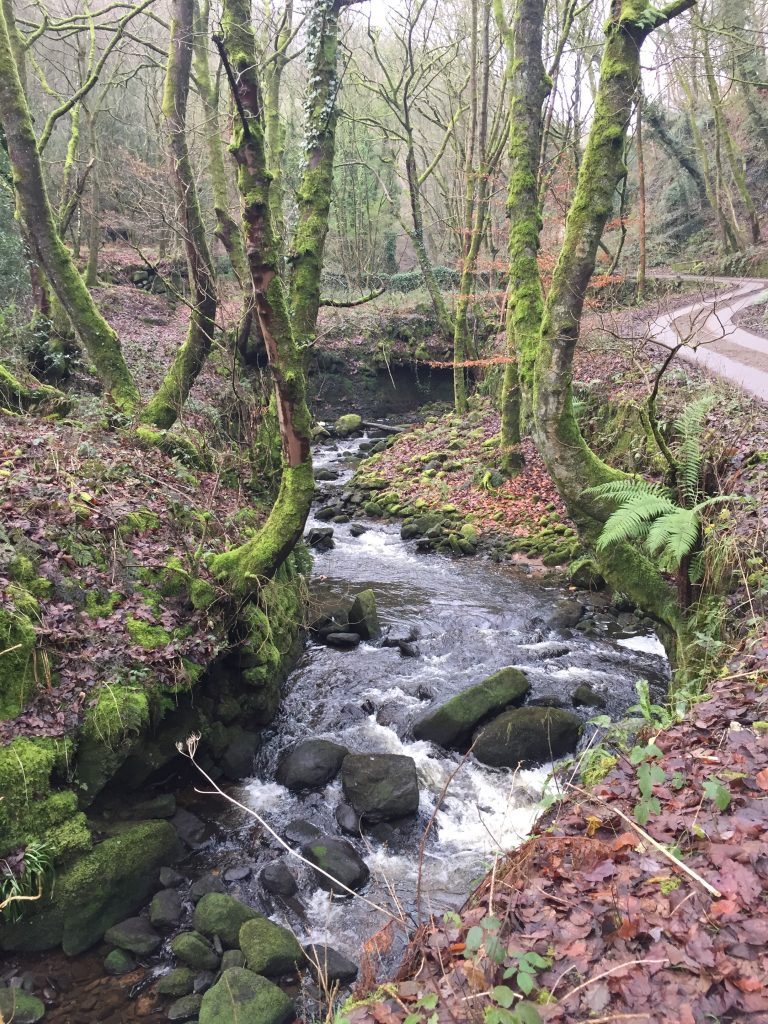
This eventually turned into a very, very narrow track, part path, part stream. It led past old buildings towards the main road and so I turned right over a little bridge and headed upwards again. Scattered cottages and ‘halls’ edged the path but many of them didn’t appear to have names. One fine building was built directly into the hillside, being barely 6 ft high at the back and 3 stories high at the front.
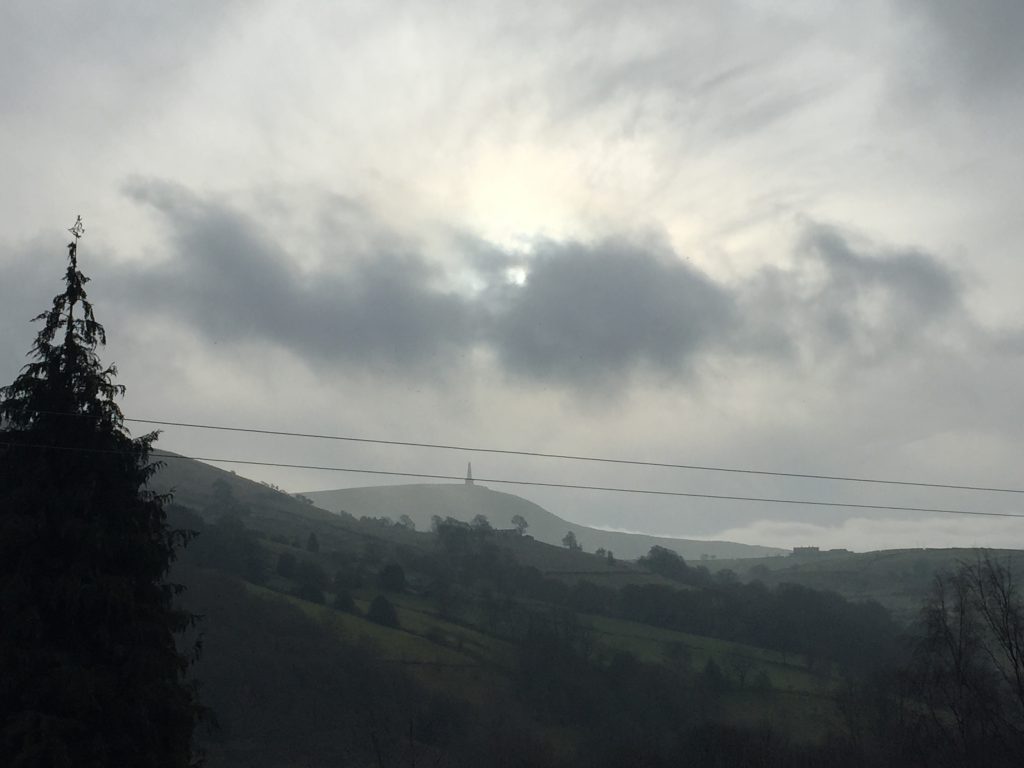
View across the valley to Stoodley Pike
This hillside was directly opposite Stoodley Pike and the sun was trying desperately to find its way between heavy clouds. It was quite pictureque. Eventually I came across a couple heading towards me. “You seem to know where you are going” I ventured as we drew level outside Higher Underbank farm. “Yes, we live here,” came the reply. I asked for directions back down to the valley on a road that wouldn’t be too steep and slippery. “Ah, the best way would be to go through our garden, through the gate, turn right, meet a cart road and go past the mill and turn left.”
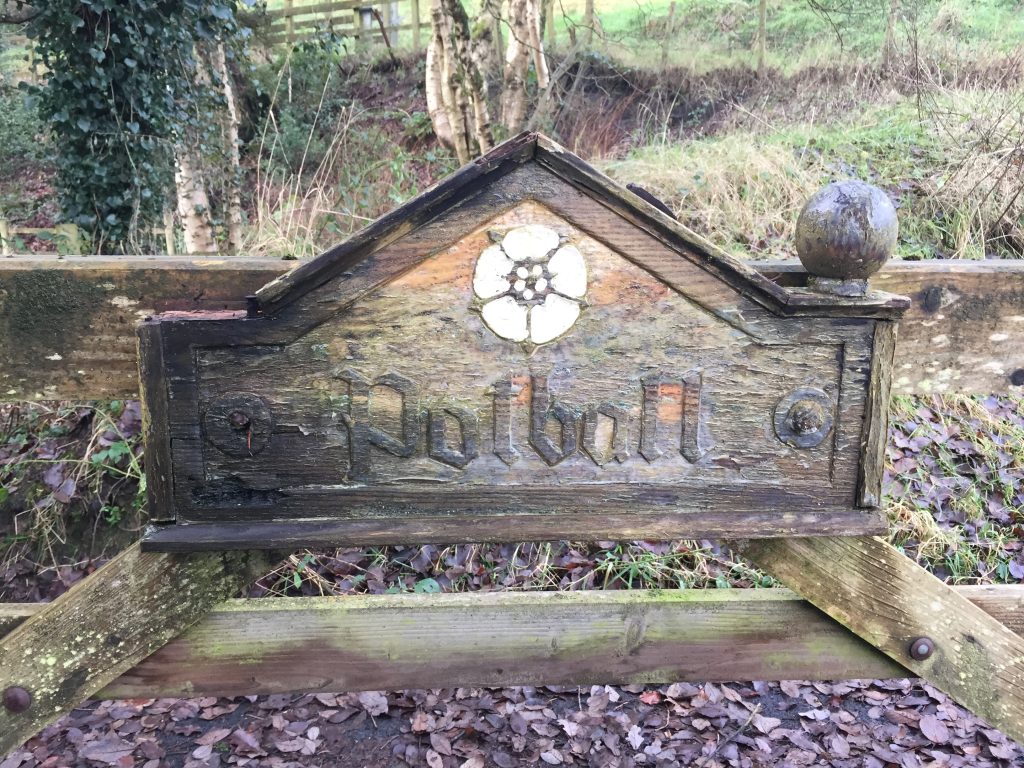
Potball
Yes, really!
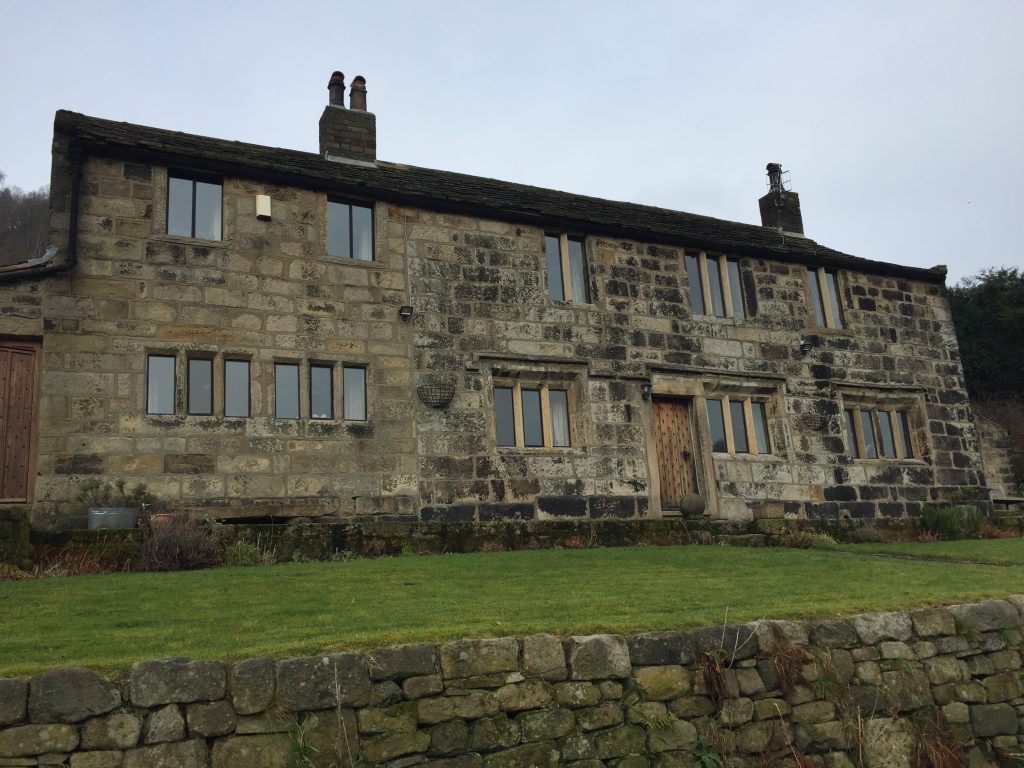
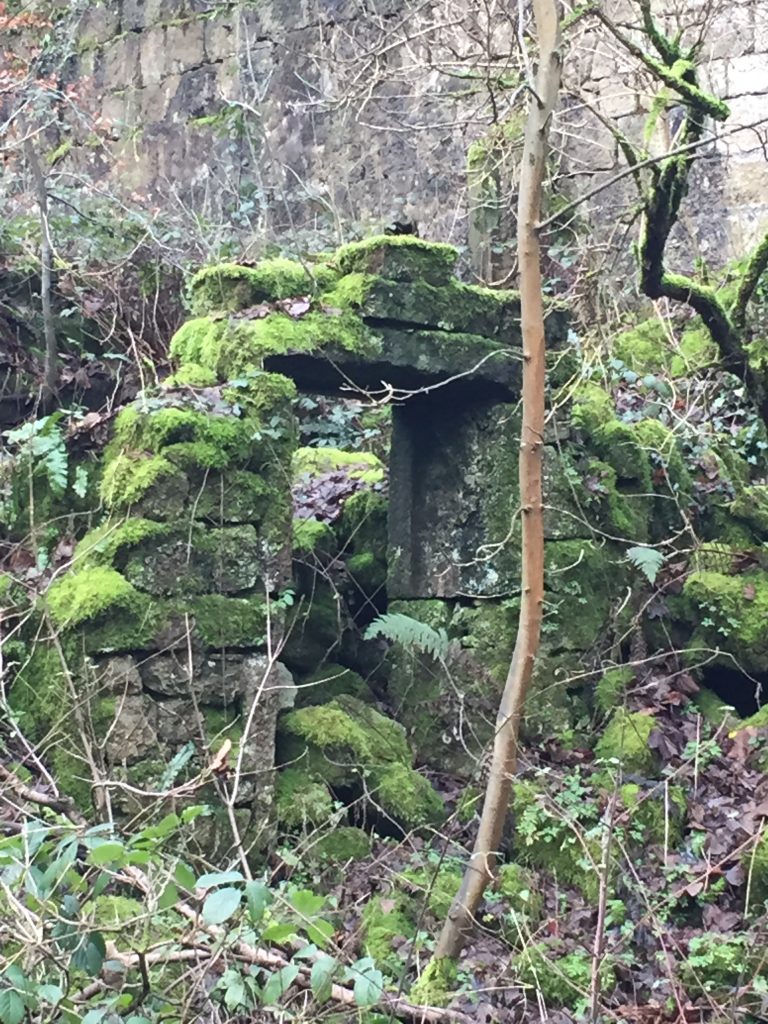
So off I went. I was very grateful for the short cut through their garden which eliminated some of the steeper, overgrown paths. I soon came to Potball. How’s that for a name? I had seen the name on my map before I’d left home. It turned out to be an imposing building directly overlooking the Calder Valley with an uninterrupted view across to Stoodley Pike. Then down past the ruins of Jumble Hole Mill. I think I’ve only been here once before and that was on a hike in the summer before I moved to Hebden Bridge. The ivy and moss soften the jagged outlines of ruined walls and broken pillars turning everything into elfin territory where everything is a brilliant vibrant green.
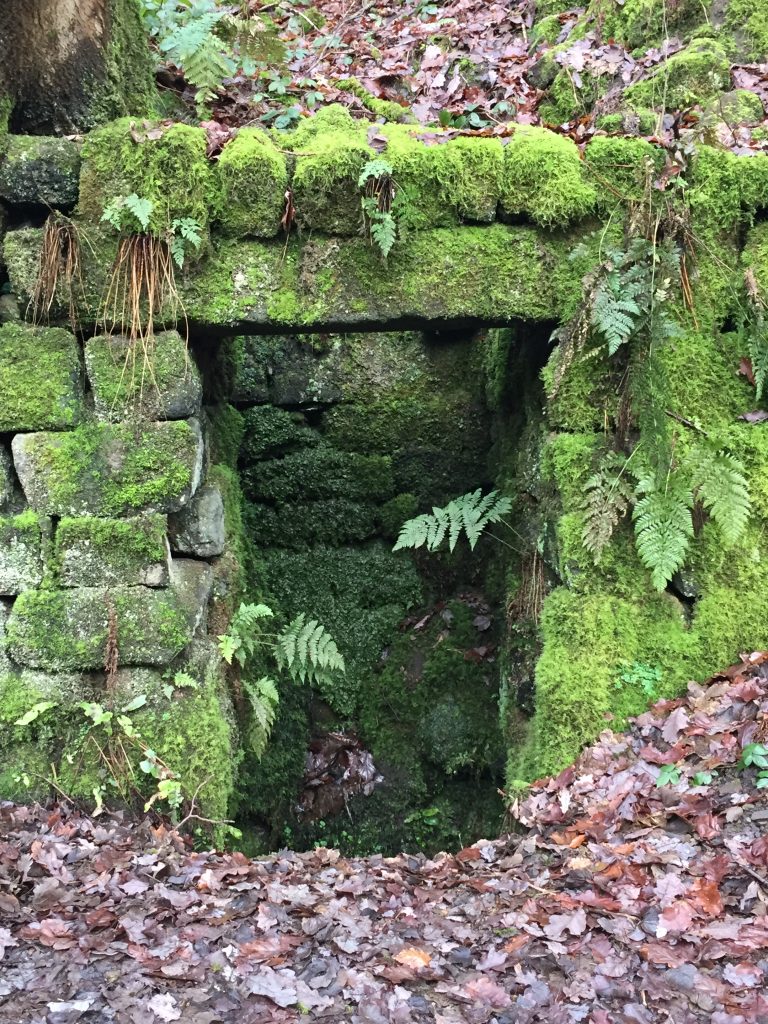
Ruins of Jumble Hole Mill Fairy glenThe power for the mill
Soon I came to the railway tunnel and, on going under it found myself on the main road.
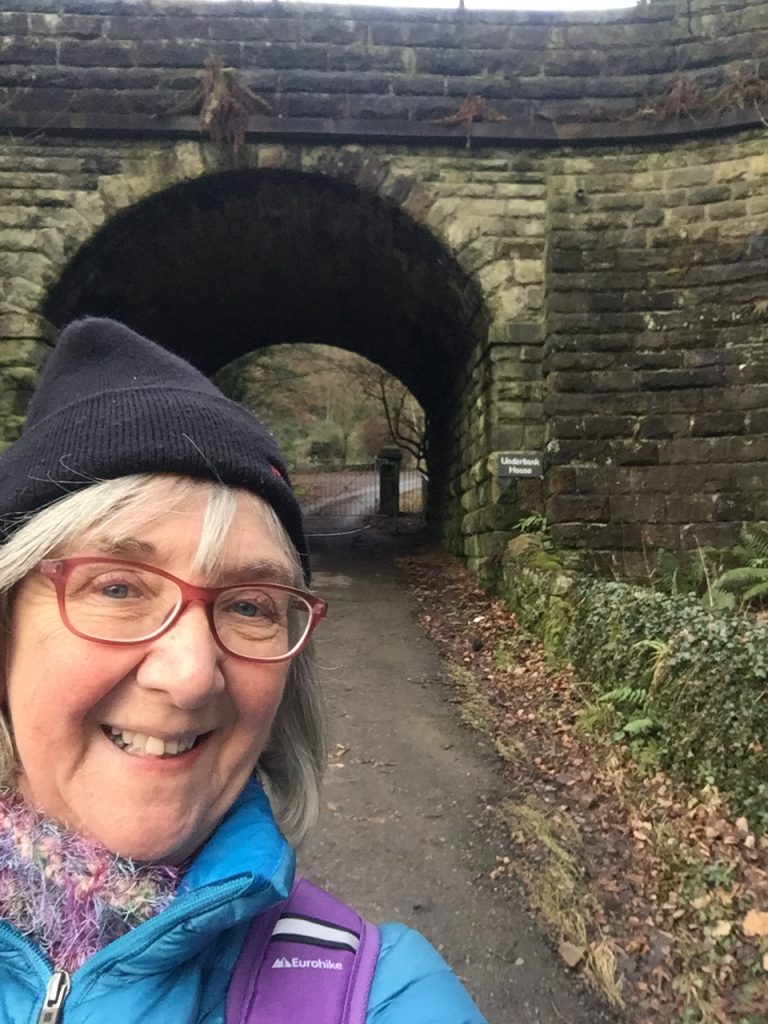
A little father on another tunnel was signposted Underbank House and I took a little detour to see this imposing mansion with its wrought iron gates, alarm system, cctv cameras – and trampoline! I don’t think John Gibson would have lived there in 1861. He was a plate layer for the railway – the same job as Ezra Butterworth.
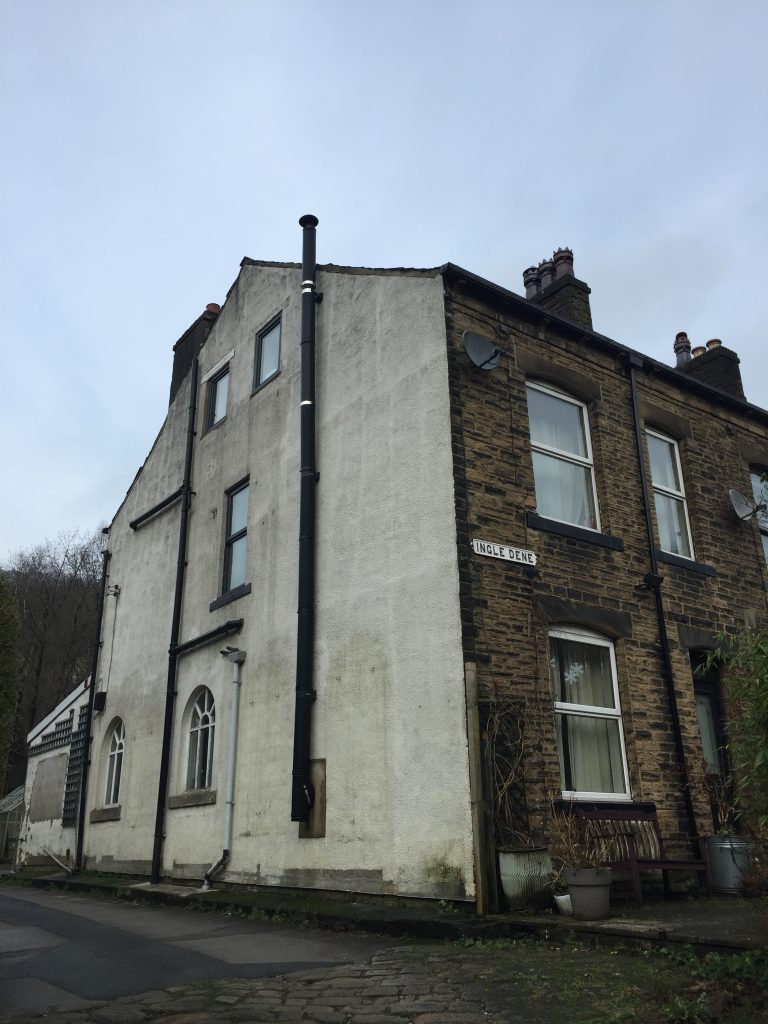
It was very noisy walking along the main road back towards Hebden but I suddenly saw above me on the left three terraces and I could just make out through the trees the sign Ingle dene on the first group. Each house had a steep flight of steps going up to the front door and I went up one of those to get a better view.
Ingle Dene
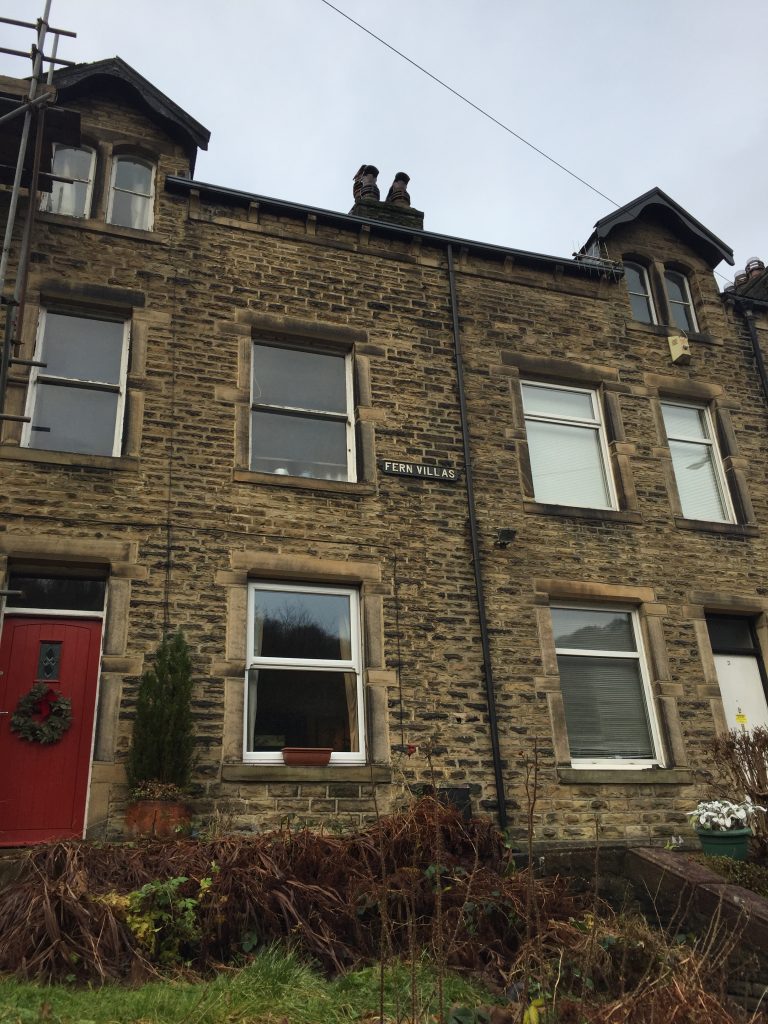
Fern Villas
The next block was Ivy Bank, and the last block was Fern Villas but that only consisted of two houses. A man was just leaving, being taken for a walk by his dog, and I asked him about a third house. He believed that one had been demolished, and, sure enough a grassy area to the right of the terrace suggested that he was correct.









Recent Comments