Emily Moss
I’ve now got just over 4000 ancestors in just one branch of my family tree – the Hebden Bridge/Heptonstall branch originating primarily with James Wrigley of Lily Hall. When people hear that I’m interested in my ancestry their first question is usually ‘How far back have you got?’ And I explain that I’m not really interested in dates and names. My interest is in finding out about the lives of people that I am somehow related to, however distantly. So choosing which names to pursue is never an easy task and I sometimes find just the selection process overwhelming.
In early 2024 I purchased a book written by Vaughan Leslie about the history of Hebden Bridge Little Theatre. Vaughan had been a member of the Little Theatre choir when I was the accompanist and occasional director and I knew that one of my ancestors, Edward Binny Gibson, had been a founding member of the Little Theatre so I was eager to look through the new book. What I was surprised to find was that many of the people in the photos had names that I recognised as being in my family tree. So this year when the nights grew longer, the weather colder, and the opportunities for outdoor activities had come to a seasonal close I spent a couple of evenings reading the book and a name that stood out was that of Emily Moss. I’d done a lot of work on various branches of the Moss family – one branch who became textile mill owners and one branch who operated several schools in the area. In fact the street adjacent to where I live is called Moss Lane because one of the schools operated by the Moss family was located at the top of the street. Emily was my grandma’s name and this was passed down to one of my daughters so off I set to find out about the life of Miss Emily Moss, knowing nothing about her other that she appeared in several productions at The Little Theatre.
Emily’s parents were George Frederick Moss and Hannah, nee Whittaker. George was 31 when he married Hannah who was 24, so George was unusually old for a first marriage and he was 44 when Emily was born in 1897. She was baptised at Heptonstall church. Emily, my own grandma was born in 1896 so that gives me some context. Emily Moss was the fifth child out of six, the last being the only boy. Nine children had been born but three had already died. In 1891 the family were living at 15 Market Street in the centre of Hebden Bridge and George was a stationer and printer. That shop is now ‘Beer’ and my daughter and I went to the pub quiz there last Christmas, little knowing of our connection with the place. We won the booby prize!
By 1901 the family had moved to Albert Street, 4 doors away from The Albert pub which was used extensively for filming Riot Women TV series last year. It’s also the pub where my creative writing group meets fortnightly.
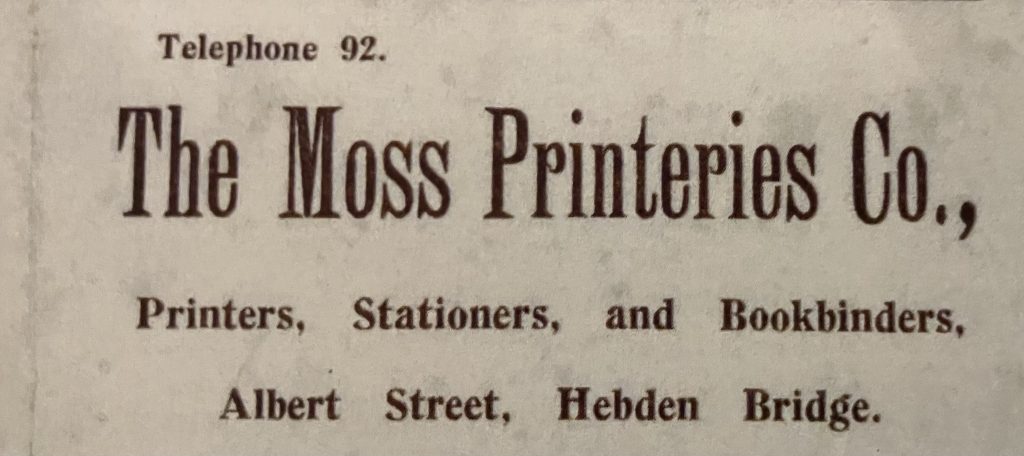
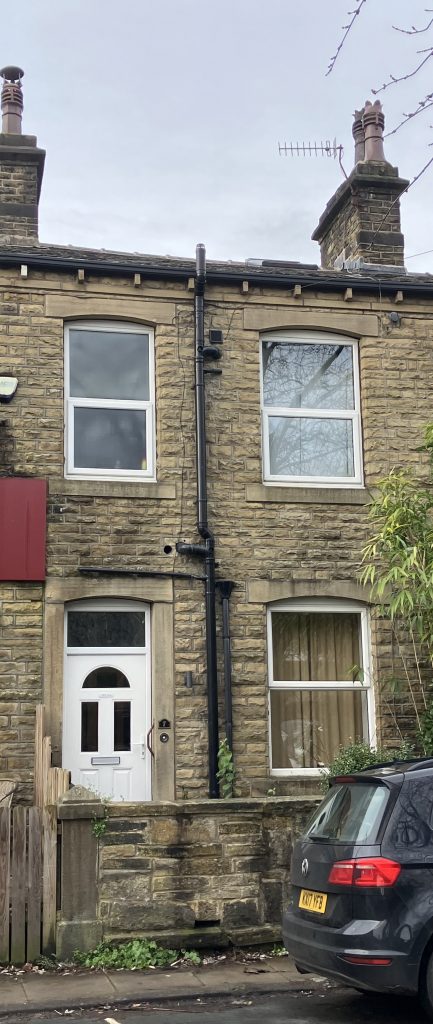
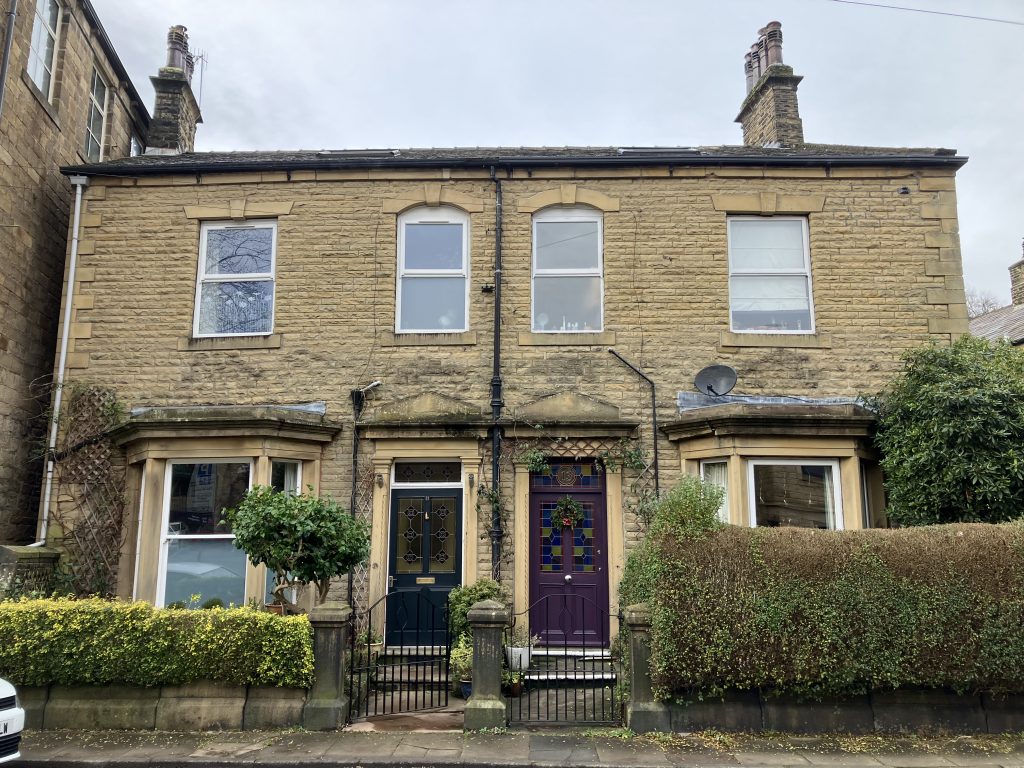
I wonder if George frequented that particular hostelry since it was virtually on his doorstep. George is listed as a letterpress stationer and printer and Emily’s sisters Mabel, 14 and Dora, 12 are tailors and fustian machinists. By 1911 the family have moved to number 7 Hangingroyd Lane. It’s situated in a terraced row of small cottages which I presumed were Victorian.
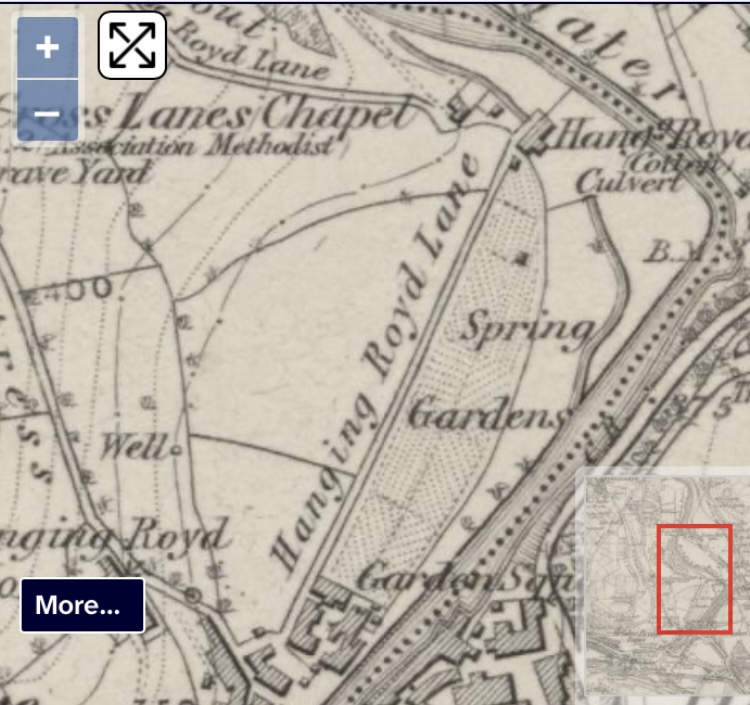
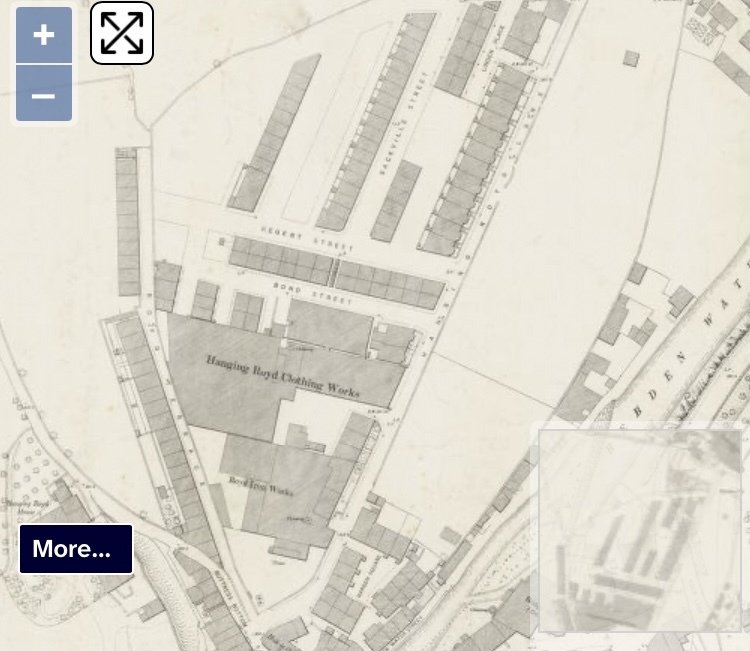
In the map of 1850 there are no houses along Hangingroyd Lane, just Hangingroyd Cotton Mill on whose site my own house now stands, but by 1888 there are 3 sets of homes, one of 6 cottages adjacent to Royd Iron Works, then the Hangingroyd Clothing works, then two semi detached houses. #7, where the Moss family were living is in the first group of 6 houses, named Royd Villas. This street meets Moss Lane and is the street I walk along each day to reach the centre of Hebden Bridge, the shops, library, little theatre, cinema, buses and trains. Emily’s older sister Dora, now 22, was a teacher in an elementary school so perhaps this was the teaching side of the Moss family. Indeed, as it turned out I discovered that Emily’s grand uncle had been Joseph Haigh Moss 1791-1861 who had founded the Moss school dynasty. His story can be found here: https://blog.hmcreativelady.com/2020/04/13/joseph-haigh-moss-1791-1861/
Edwin Moss, who also ran a private school in Walsden was Emily’s first cousin twice removed. In 1909 Emily was attending Stubbings infants School – also much used as a location in Riot Women – and she was awarded a scholarship. By 1916 the family were living at Royd Villas – which, perhaps, was a posher name given to the row of houses in which 7 Hangingroyd Lane was situated. Four students each year were allocated as teachers in various elementary schools and Emily was assigned this role at Stubbings school which she had attended. Stubbings school is situated on the very, very steep hill above Hebden towards Birchcliffe and I always feel for the parents, and often grandparents who have to climb the hill to drop off and pick up their young family members.
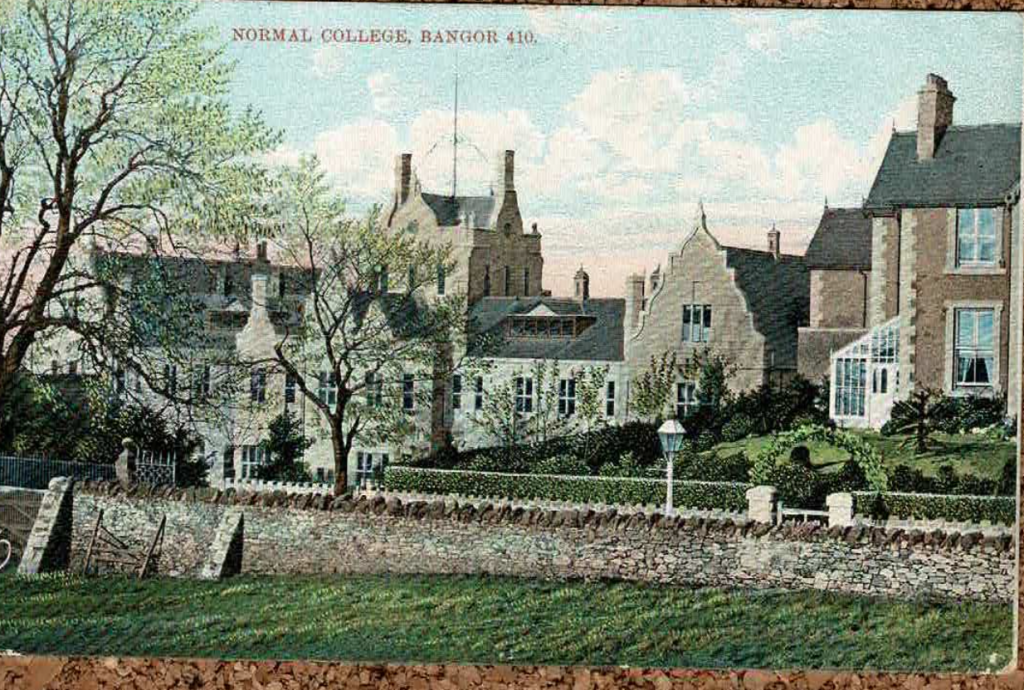
Emily trained at Bangor College and served as a certified assistant at Bradford Memorial School in Manchester – where the playground was on the roof! By 1921 Mabel, Dora and Emily have moved to 13 Hangingroyd Lane and on the day the census was taken the parents and other daughters are visitors at Ada Mercer’s home in Morecambe. Whether this was just a vacation it’s not possible to say. Mabel is now a fustian machinist at Bridge Mill where my children and grandaughter have visited. Dora is an elementary school teacher at Cragg Vale school. I went past this building just yesterday -very similar to Stubbings being set up on a hillside. It had opened in 1887 but closed permanently in 2017. When it closed it had an average of less than 10 students per year and it just wasn’t feasible to keep it open. By 1920 Emily was now 23 and an elementary school teacher at Eastwood school. I knew that Eastwood is an area between Hebden Bridge and Todmorden and that at one time there had been a railway station there. From the wonderfully informative Charlestown history site I discovered “the earliest reference for Eastwood we have found is in 1286 when it was called Estwoode. The name was almost certainly taken from the Eastwoode family who were local landowners acitive from the 13th to 17th centuries.
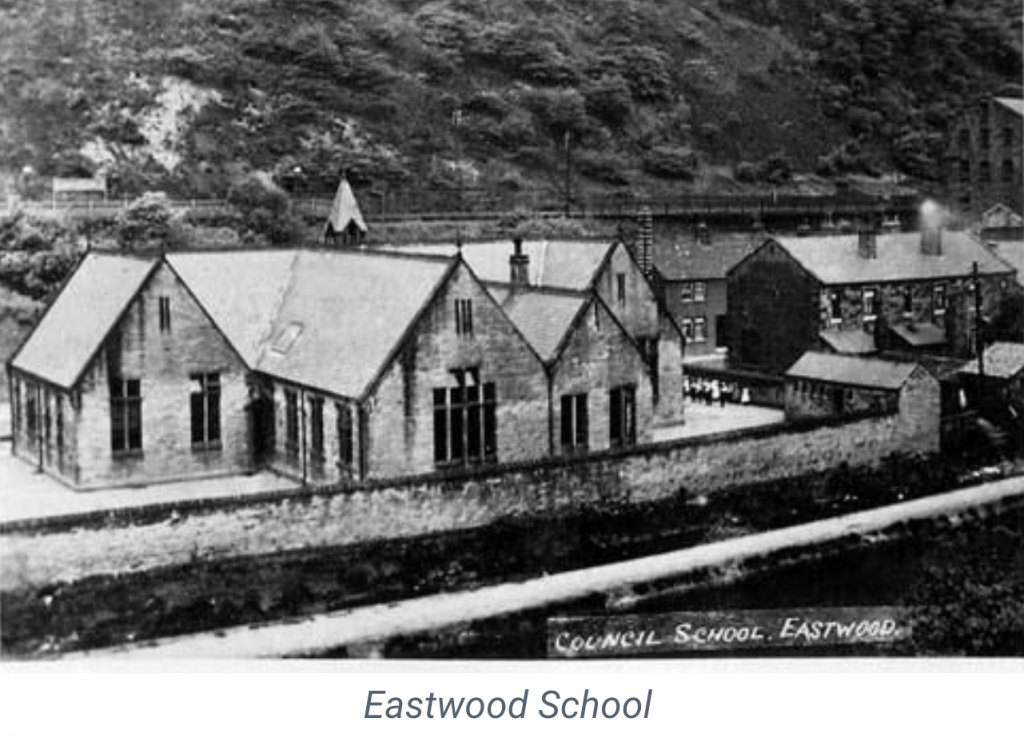
The older part of Eastwood (now known as Higher Eastwood) is on the North Hillside. When industry and people moved from the tops, the dwellings in the valley were referred to as Bottoms. Eastwood is the present name used for Bottoms. The school was located opposite the station and had at its peak around 60 students divided into 4 classes served by two teachers. It had been established around 1875 and before that children could attend the dame school for which they were charged one penny per week making it unaffordable for many families.”
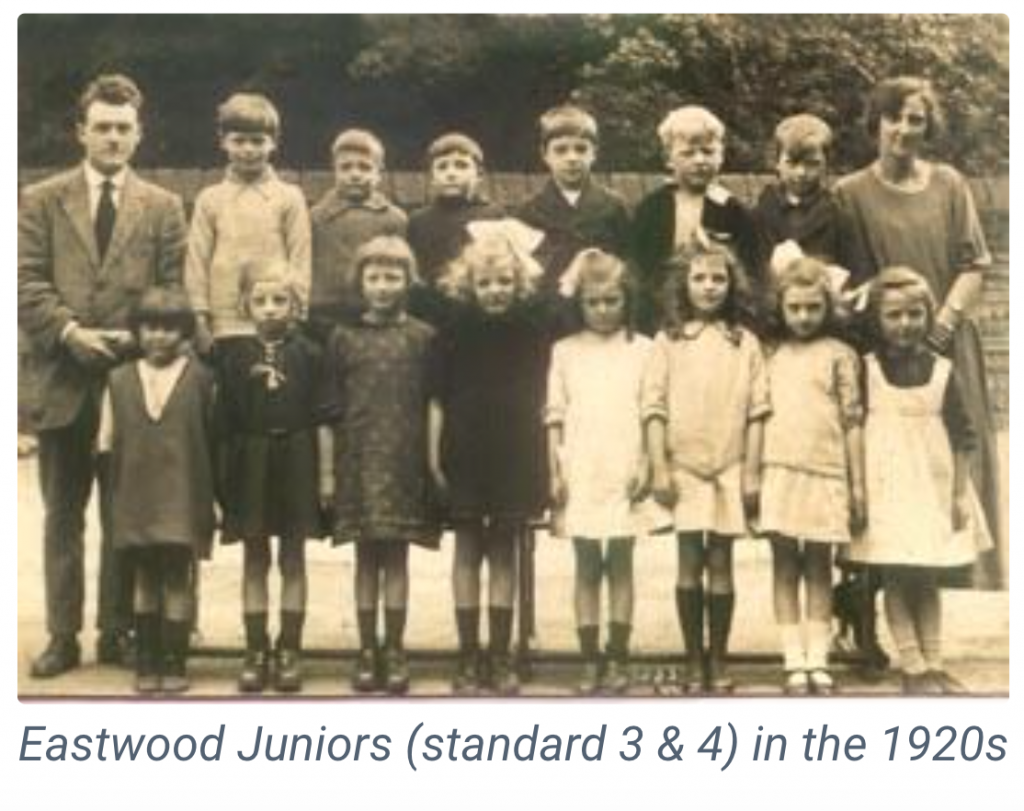
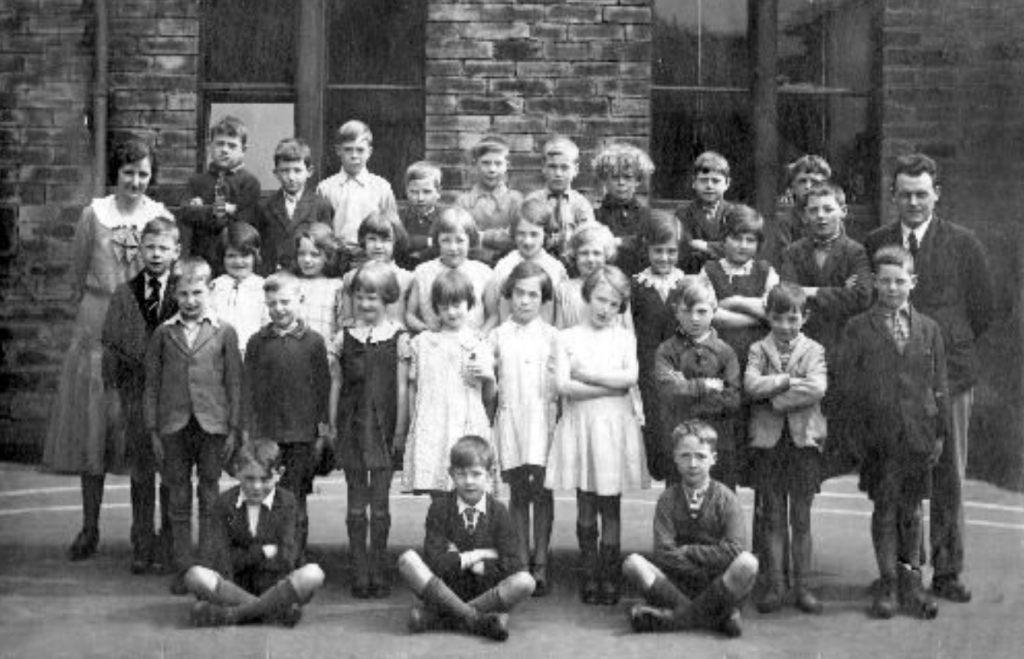
“There was a system of pupils who had passed the standard exams to teach the younger children,” writes Mrs Suffolk (nee Cockroft) who attended the school in the 1920s at the time that Emily was teaching there. “Children (boys and girls) were taught to knit and sew, but they also learnt to write, read and figure.” And then, surprise, surprise I found a reference to Emily herself, telling me more about her family too. *Miss Moss’s father owned a sweet shop on Market Street, Hebden Bridge and was well remembered for bringing in chocolate eggs for every child each Easter. Franklin Greenwood and Miss Emily Moss taught in the senior school from 1919 to 1946. Miss Greenwood taught ‘the babies’ from about 1919. There was even a photo of Emily and the children. Here she is on the far right of the photo.
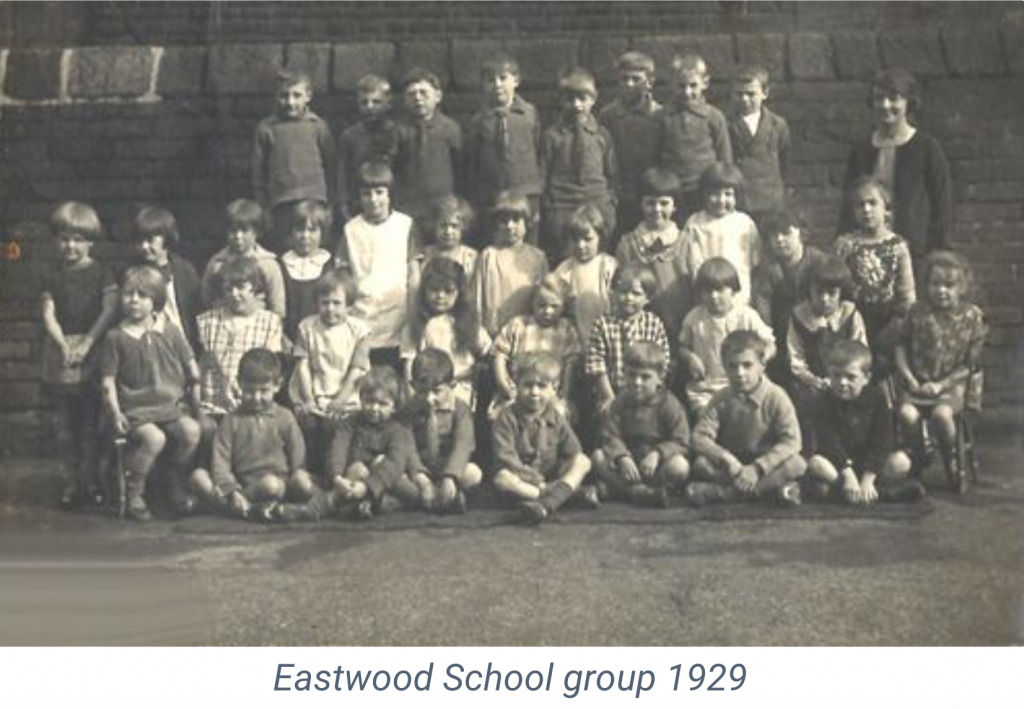
Life at the school was eventful being frequently affected by the river bursting its banks, flooding the boiler and providing another day off. Another comment written by a former student attending the school in the 1920s gives us a little glimpse into what life was like at the school. “In about 1920 there was a very strict master called Mr Johnny Briggs. Woe betide any boy whose clogs were not polished til he could see his face in them. All the girls and boys wore clogs which were supplied by George Henry at the clogging hut by the post office.” The school closed in 1945 and was subsequently demolished though apparently the gate posts are still there.
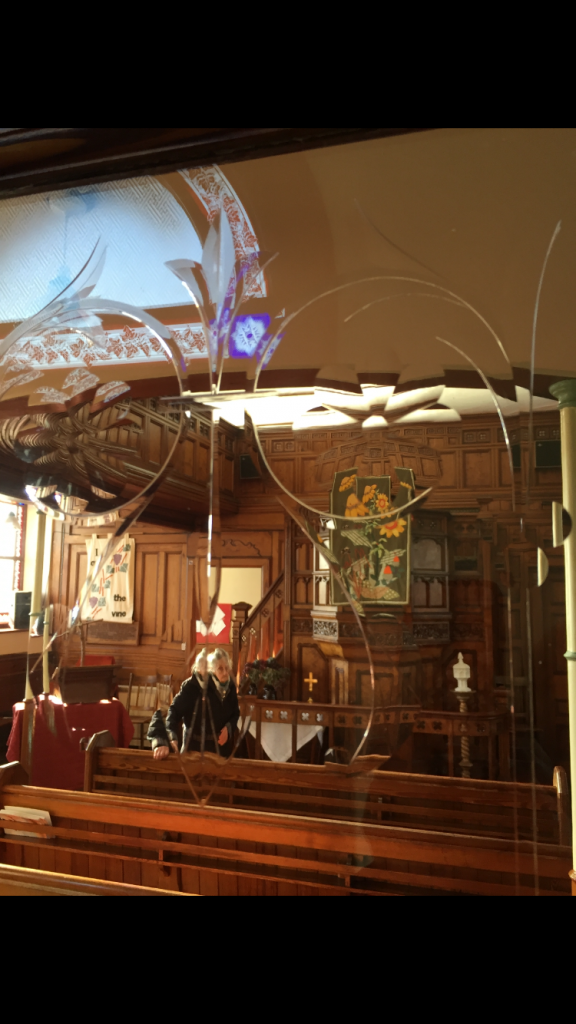
Emily’s father’s sweet shop was the source of a circuitous personal connection I have with Emily. When I first moved to Hebden Bridge in the course of my research I took a trip to Blackshawhead Chapel where one of my ancestors is commemorated on the war memorial there. During my visit on one of the church open days I was shown around by Mrs Dorothy Sutcliffe.
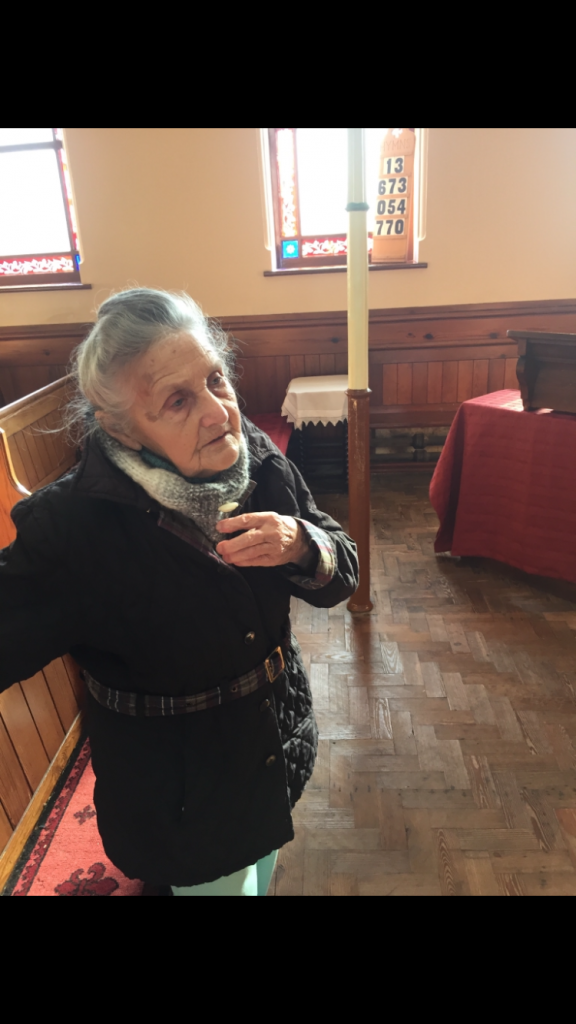
Dorothy died in November 2025 aged 93 and in Vaughan Leslie’s book on the theatre’s history I found an interview that she’d done in 2022. “ Dorothy Sutcliffe moved to Hebden Bridge to stay with her step brother. It didn’t take long before she found work in a bakery on Market Street owned by the Moss sisters and it was Emily Moss who introduced her to the little theatre. One day Emily offered her a sealed envelope with money in it, which is the way patrons paid for their seats, and asked Dorothy if she wanted to go. Dorothy had been keen on acting and drama at school and was thrilled to accept this invitation. Very soon Dorothy was attending rehearsals regularly, to prompt, and help with props. Then she graduated to acting and directing. Thus began a 40 year association with the LT which she describes as ‘the love of her life.”
However, it was while Emily was teaching at Eastwood school that a tragedy befell the family. Her elder sister, Mabel, with whom Emily lived at #13 Hangingroyd Lane was killed in a motor accident on June 11, 1926. Three cars were on an outing to the seaside town of Morecambe – my grandma’s favourite seaside town. The party was travelling in three motor cars. The driver of the car in which Mabel, Dora and Emily were travelling was Frank Greenwood who lived next door to Emily at #11. These were the semi detached homes seen in the second map.
The party had stopped and had dinner at Clapham Moor and set off again around 2pm. They’d only been travelling for five minutes when the middle car in which Emily was travelling overturned and Emily was thrown out of the back seat as the car overturned. When Emily picked herself up she saw that the car was pinning down Mabel but Mr Greenwood had been able to get out. The other cars stopped and managed to right the car but Mabel had sustained many injuries and died in hospital a few days later. Dora was also travelling in the back seat so must have been severely traumatised.
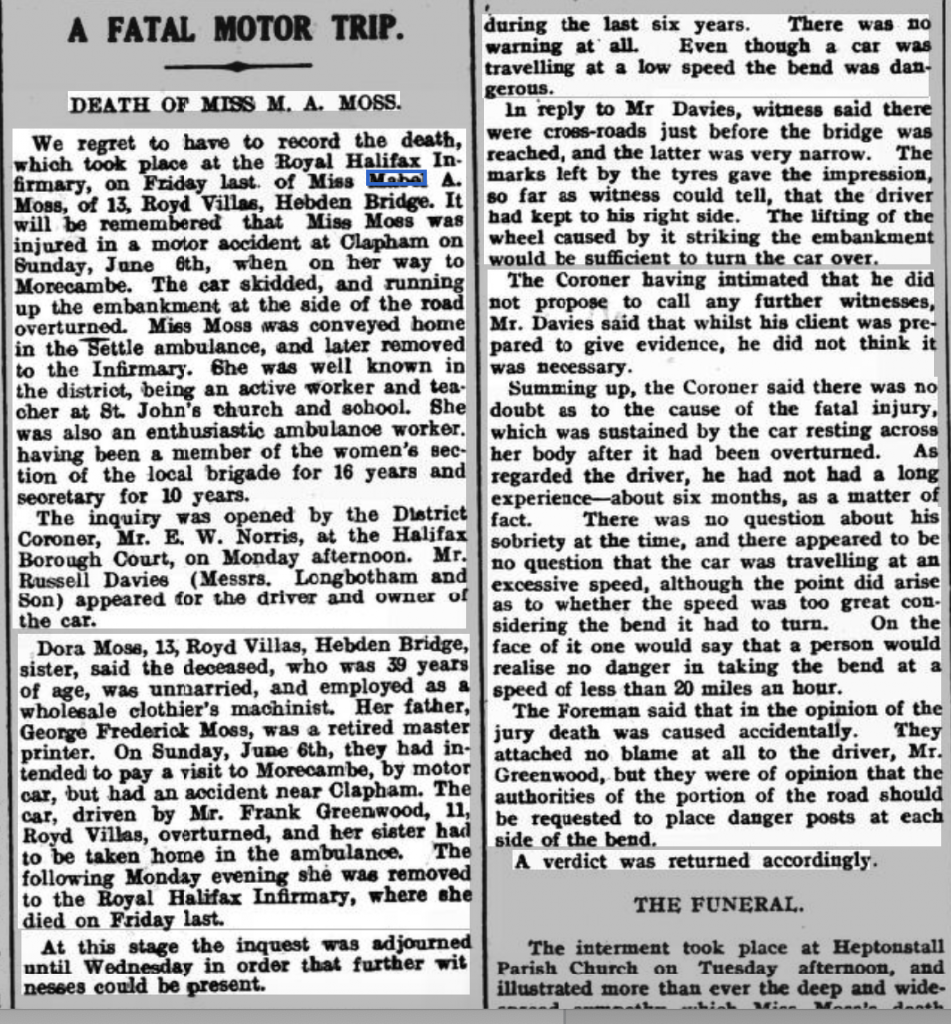
Then I find something else that I hadn’t anticipated:
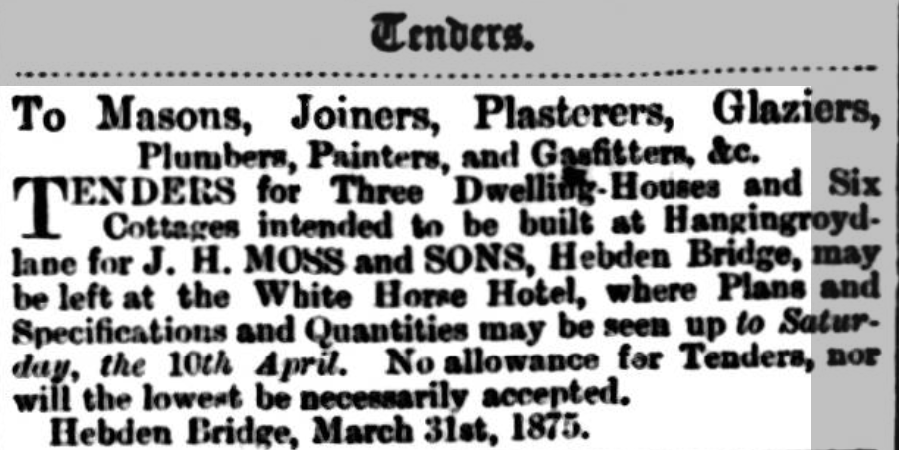
So it would appear that J. H Moss had those houses built. J. H Moss was Emily’s grandfather who had started the Moss teaching dynasty by operating a school from 1817 close to the Shoulder of Mutton in the centre of town.
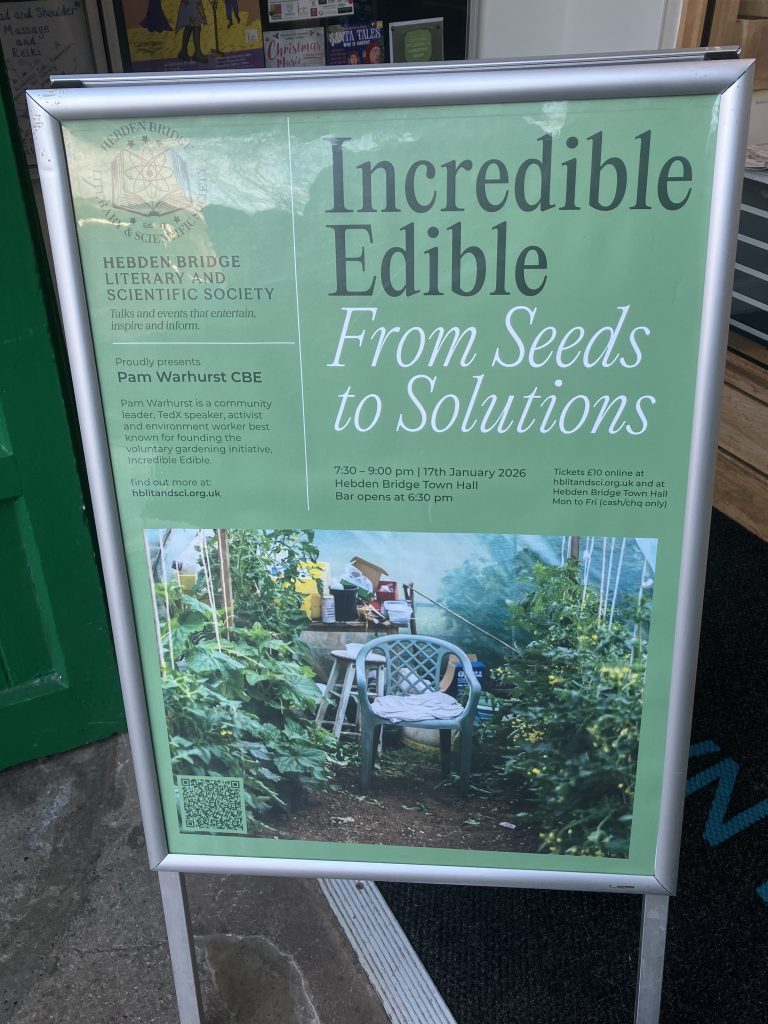
The next time I find Emily mentioned in the newspaper is 6 years later when she is the secretary of Hebden Bridge Literary and Scientific society. The society had been founded in 1905 by William Powell, a noted botanist. Although its initial focus was on nature William writes “while interest in literary studies was deeply felt among the early members there was not the opportunity for action which the cloughs and the moors provided for natural history students.” Sections for drama, local history and photography were subsequently added as were astronomy and Esperanto. The society still survives and I frequently attend their meetings. Here’s the poster for their next meeting to be held at the town hall.
In 1935 Emily took part in a costume pageant put on by the Lit and Sci society with scenes from 18 plays showing costumes of different periods over 2000 years.
She was still living at Royd Villas when she was appointed headmistress at Todmorden National School in 1932.The National School was the first in Todmorden to be built under the Government’s National Schools Scheme. The corner stone was laid in 1844.
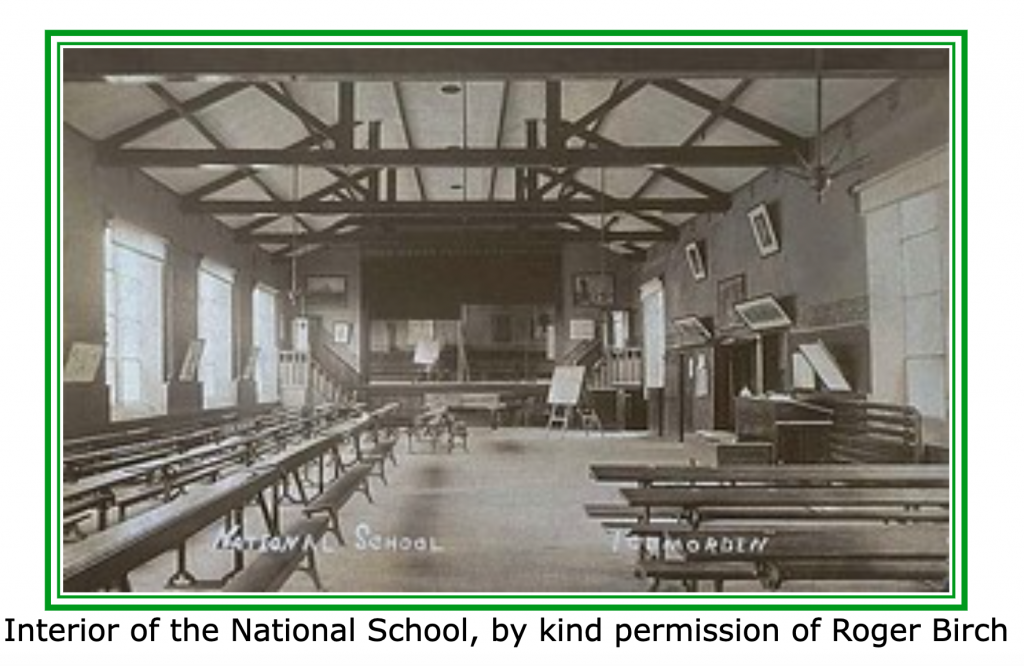
Due to the Factory Act of 1844 and to accommodate the greatly increased number of children now obliged to attend school for at least 3 hours a day, this was one of three National Schools (Church of England) established in Todmorden. I must have passed the school many many time, situated as it is just between Christ Church and Centre vale park but I went to see it yesterday knowing of my family connection to it now.
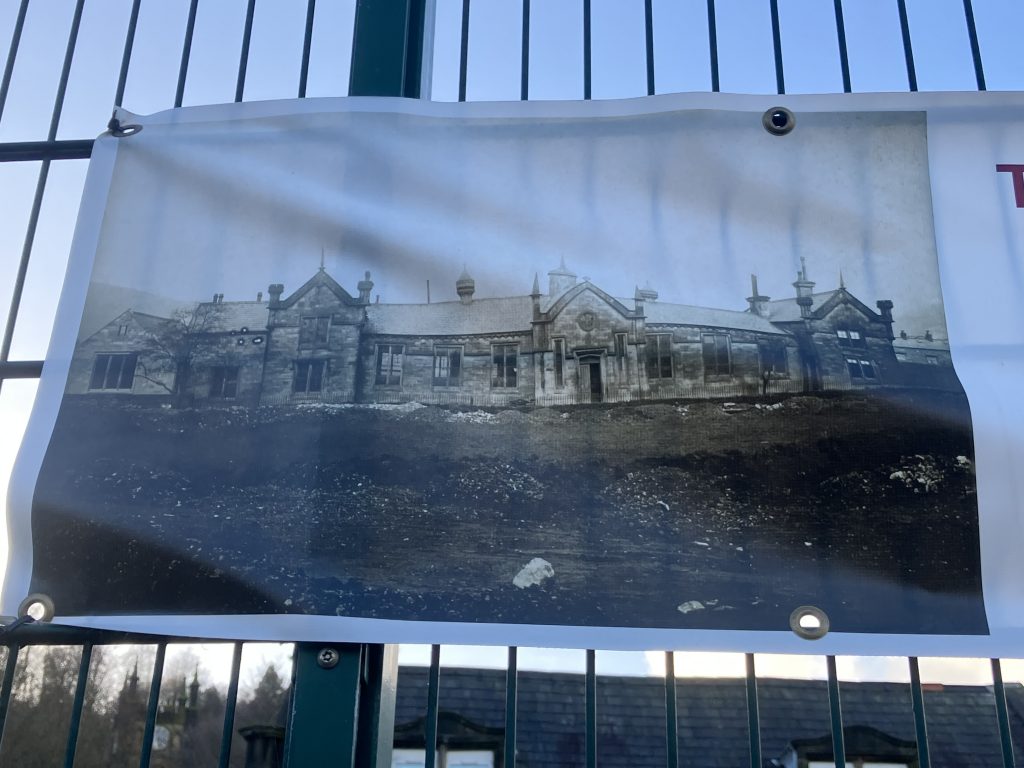
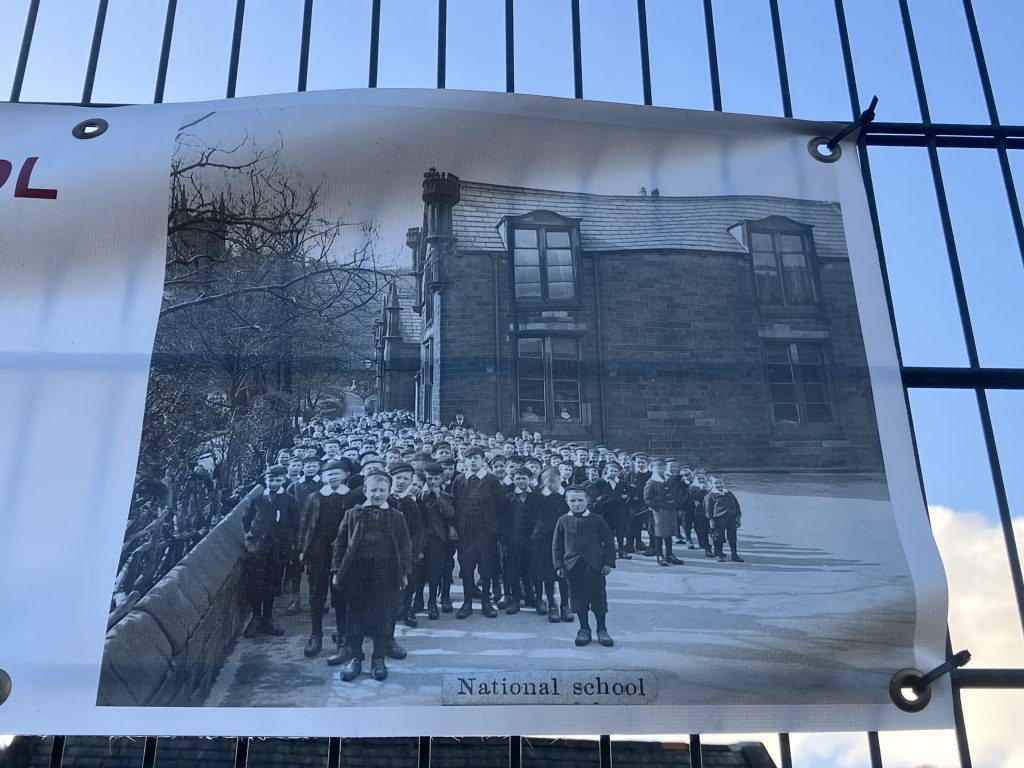
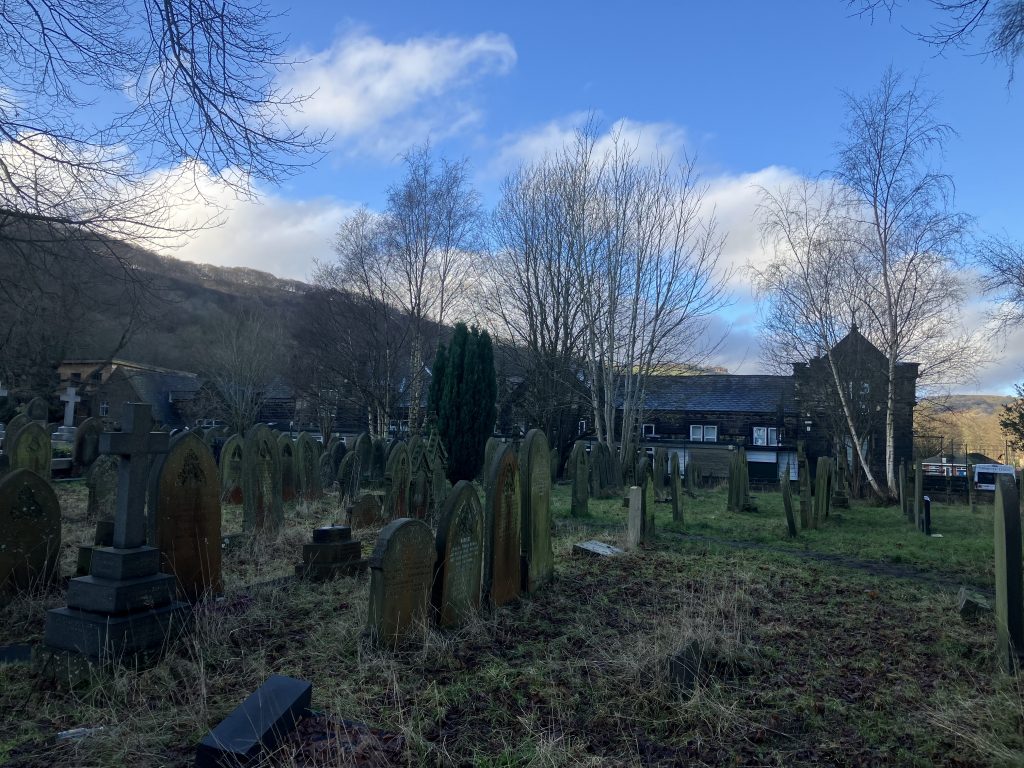
It’ s not surprising that I hadn’t really noticed it before because although it’s a very long building it is situated at right angles to the main road, thus looking out onto the graveyard of Christ Church – rather a gloomy prospect for the children attending lessons there.
The year following her appointment as headmistress of Todmorden National School in 1933 she was appointed headmistress of Walsden school.
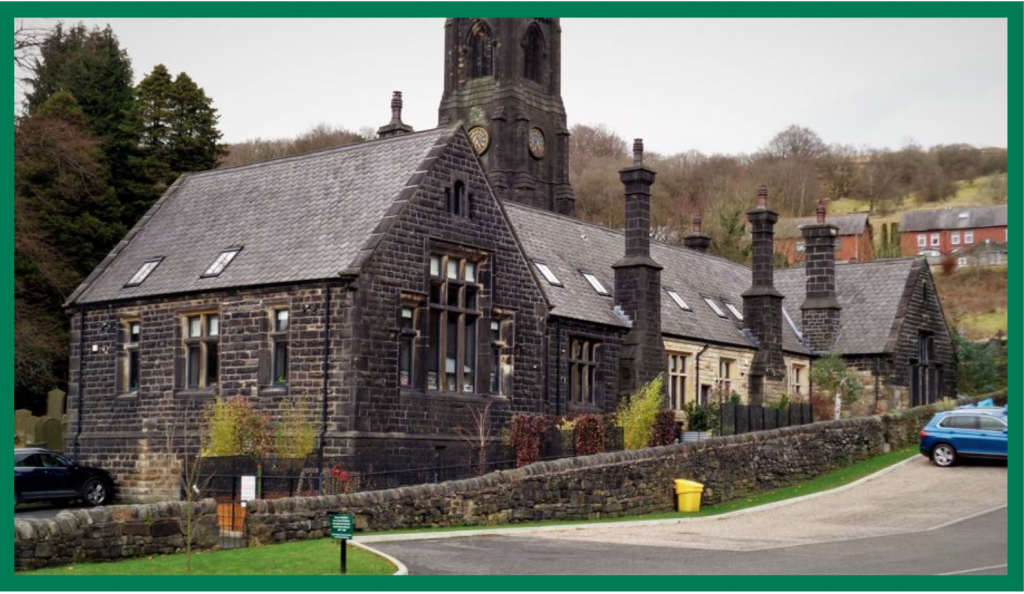
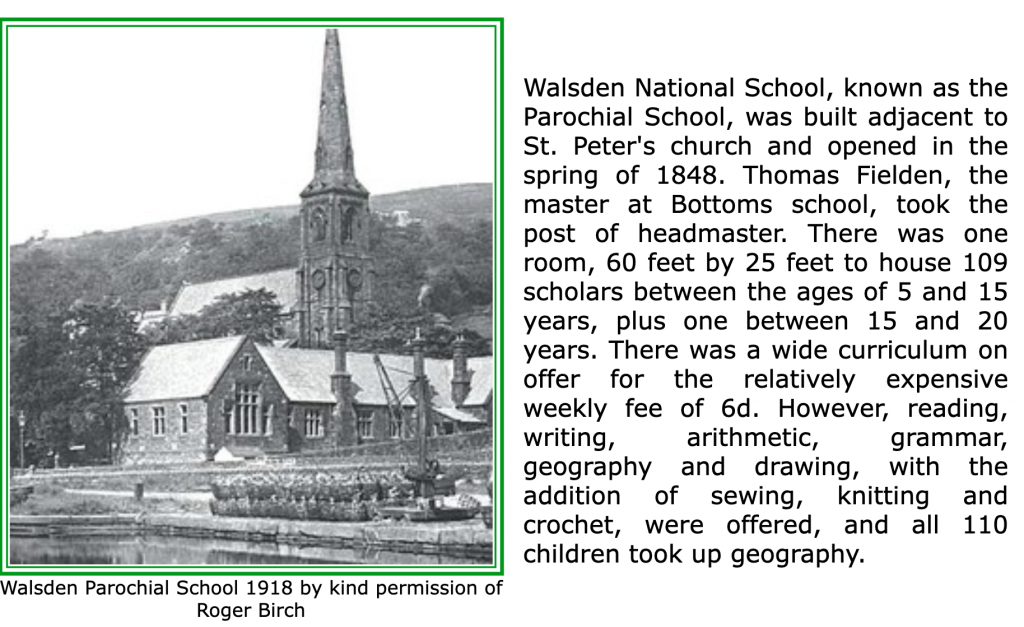
“Walsden National School, known as the Parochial School, was built adjacent to St. Peter’s church and opened in the spring of 1848. Thomas Fielden, the master at Bottoms school, took the post of headmaster. There was one room, 60 feet by 25 feet to house 109 scholars between the ages of 5 and 15 years, plus one between 15 and 20 years. There was a wide curriculum on offer for the relatively expensive weekly fee of 6d. However, reading, writing, arithmetic, grammar, geography and drawing, with the addition of sewing, knitting and crochet, were offered, and all 110 children took up geography.” She was also a Sunday school teacher there and president of the Todmorden branch of the National Union of Teachers. In 1943 she produced the school nativity play, ‘Christmastide’ in Walsden parish church schoolroom – highly appropriate since I’m writing this over Christmastide. In the same year she played the part of a jealous mother in the Hebden Bridge Little Theatre production of ‘Yellow Sands.’
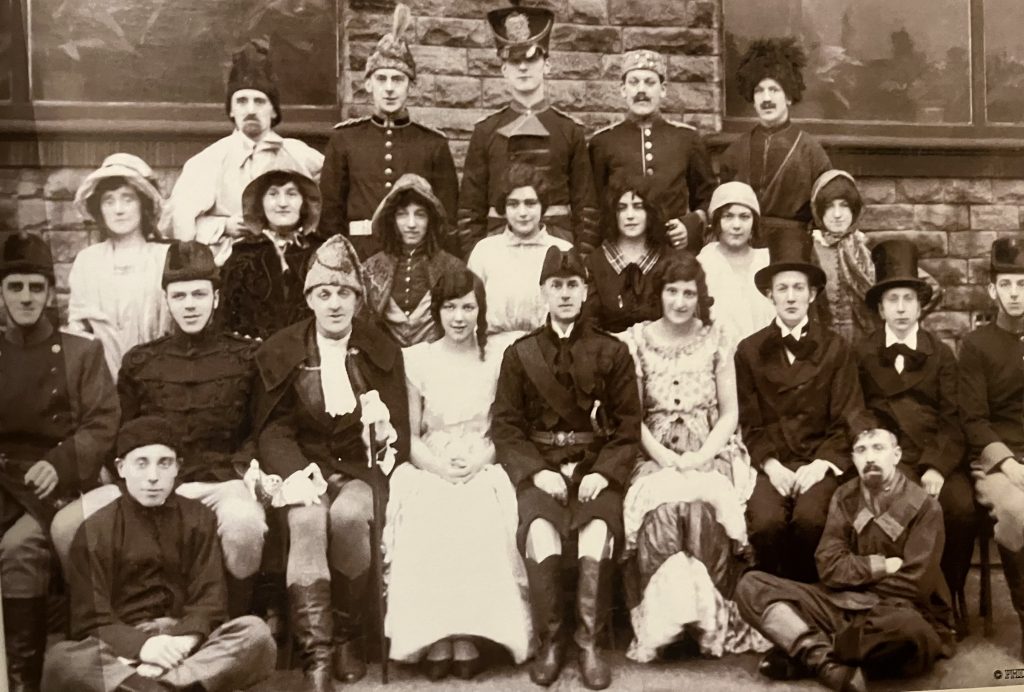
The review mentions how tough it had been to cast the characters because of the call ups in the district for World War ll – hard for me to imagine.
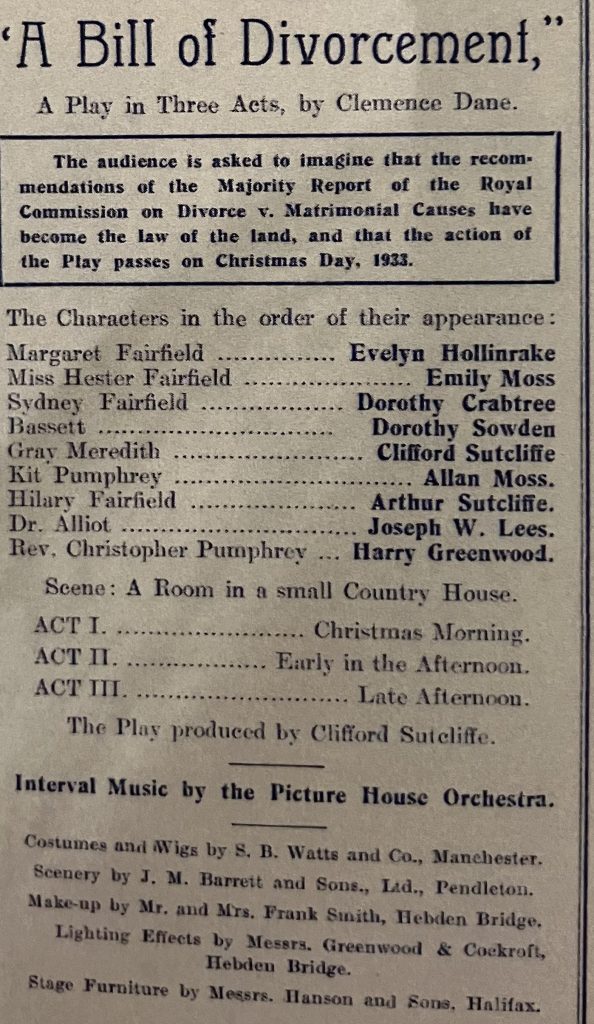
In 1957, after 25 years at Walsden School Emily retired. At the time she was living at 35 Caldene Avenue in Mytholmroyd, a house that I need to take a look at next time I’m on a walk along that street. She was still living in Mytholmroyd in 1974 when she was involved in the celebrations for Hebden Bridge Little Theatre’s 50th season. She was one of the four surviving members of the theatre’s first play.
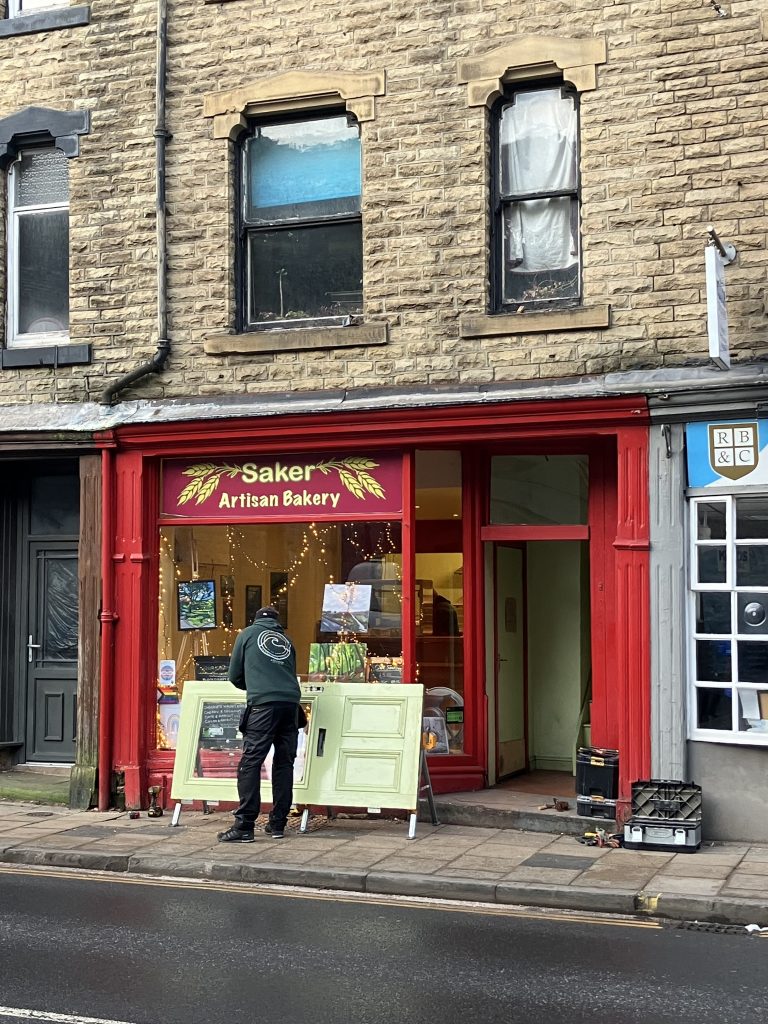
On the census of 1939 the three sisters are living at 30 Market Street. Dora is a teacher, Winifred is a shopkeeper and Emily’s profession is given as confectioner and cake maker.
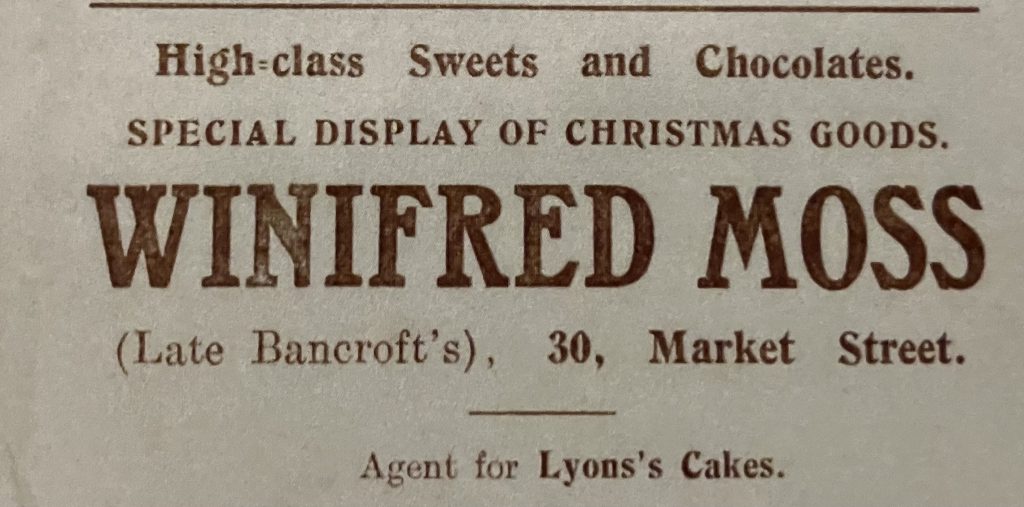
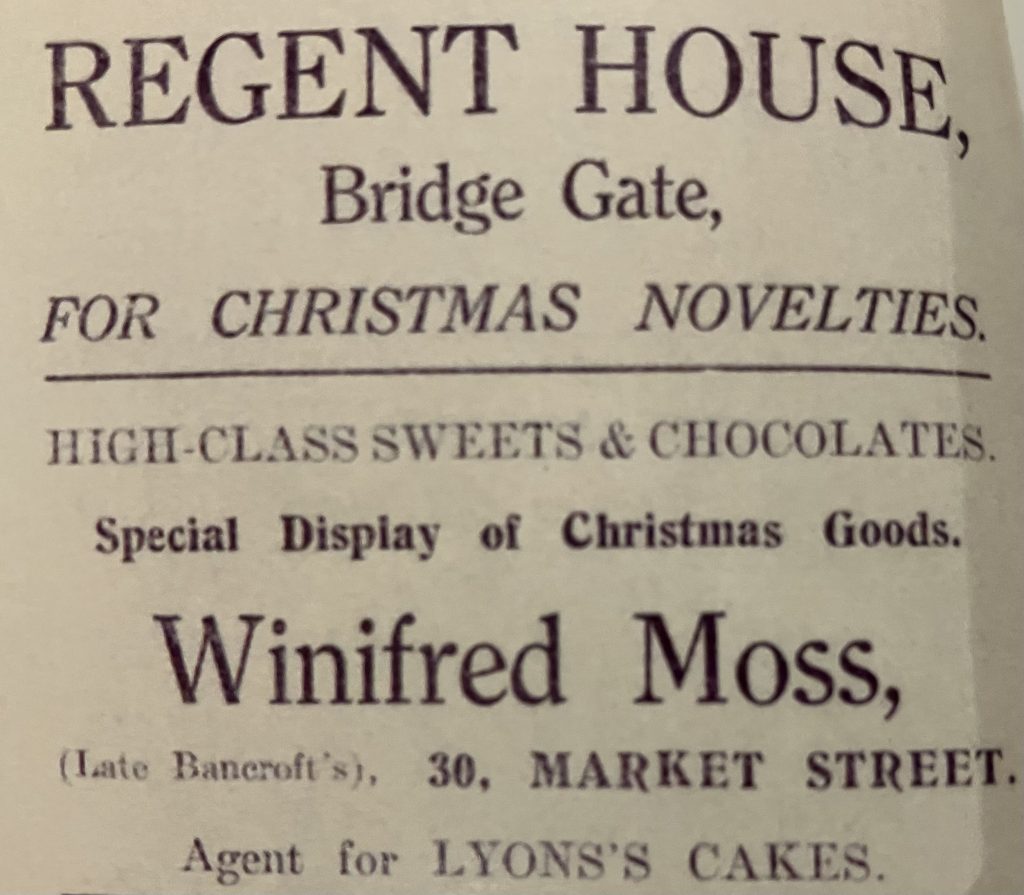
Something must be wrong since I’m sure that Emily was the headmistress of Walsden School in 1939. Perhaps the sisters have got mixed up in the census.
Emily died at the age of 89 in 1986. The Halifax Evening Courier posted the following, ” The family of the late Emily Moss wish to thank all relatives, friends and neighbours for the kind expressions of sympathy received during their recent bereavement; a special thank you to Emily’s family doctor and to her Social Services home help, for all their help and care.”
Leave a Reply