Cover: needle felt, cut felt, embroidery view of my home on Crown street, Hebden Bridge in Spring time. Cross stitch lettering and crown logo.
Fabric with butterflies, dragon flies, and my own spirit animal – a ladybird – purchased at the fabric store next to Hebden Bridge outdoor market. I embroidered the insects while sitting in the pews at St Thomas church, Heptonstall, clothed in 18th century costume as I awaited my calls for being an extra in the upcoming BBC TV series, The Gallows Pole. Several members of the cast came to admire my creation.
While at Sheffield University Colin and I found summer employment at the Wilson Arms in Threshfield in the Yorkshire Dales me as a chamber maid, and him washing dishes. I revisited the place with my Bolton School friend Judith in July 2016 and this design comes from a photo she took of me pointing at the sign. The building is now a nursing home. During the pandemic I lost a couple of earrings with taking my mask on and off several times each time I left my apartment. One of the earrings I was devastated to loose was one that Sarah gave me many years ago with leaves, dragonfly and flowers. I lost it on a trip to Sowerby Bridge to see my friend Viv. The turquoise leaves come from a bracelet that broke.
Hock Farm, Est. 1841 is a place that I visited during my research into finding the first piano that ever made it to California. John Sutter’s Hock Farm was the first large-scale agricultural settlement in Northern California, composed of grain, cattle, orchards and vineyards. I visited there with Emmett on December 29, 2014. I’m wearing my Monterey Bay jacket which I still have. The yarn flowers are made from some interesting yarn I found at a stall in Todmorden market.
On Edge Lane in Colden, Calderdale, there are some outhouses on the opposite side of the street to the houses. I took a photo of my shadow on one of the toilet doors.
On March 20, 2020 I walked along the canal from Sowerby Bridge to Copley Village. The old church door had some amazing decorative ironwork which I recreated in felt. The lettering is in cross stitch. I enjoyed designing the embroidery of St Thomas’s Heptonstall where so many of my ancestors were baptised, married and buried. Sometimes I am called upon to play the organ there for services. The grotesque on the old church in Heptonstall is needle felted from a photo I took when Angelika was visiting from Germany on August 9, 2018.
This a needle felted depiction of a snowy bus ride to Burnley along Cliviger Gorge on January 4, 2021. I added a few pieces of black net for the trees and embroidered the fences. It’s an hour’s ride to Burnley on the bus. I got off at the bus station, purchased a cup of tea to take away and got the next bus back ten minutes later!
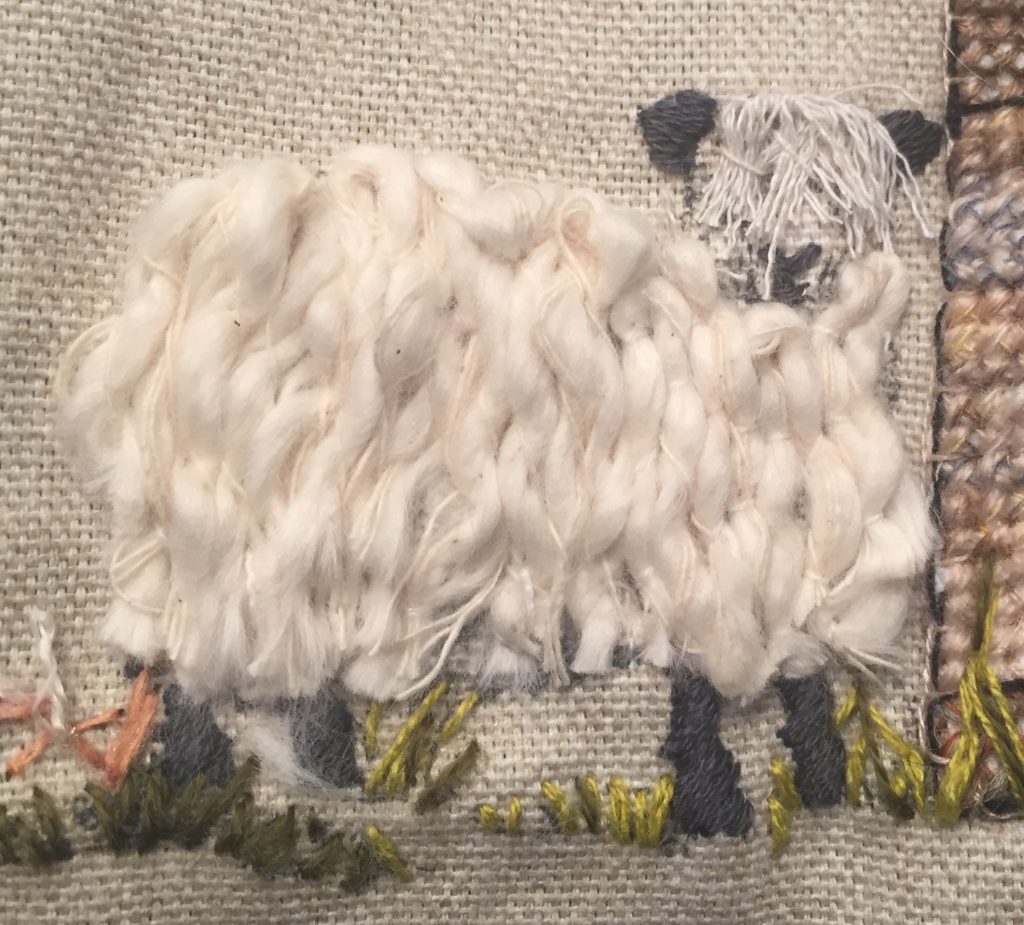
Two continents. In April 2015 I stayed for 5 days by myself in a haunted former hospital in Virginia City, Nevada. When I say ‘by myself’ I was the only one in the entire building – no reception, kitchen, cleaners! I explored the semi ghost town, visited all the outlying districts including the abandoned silver miner’s cabin depicted here in cross stitch. I used rusted iron nails to distress the fabric in my title. The sheep fabric was purchased in Hebden Bridge using some wonderful sheep’s wool that Anna had sent to me. The cross stitched doorway is part of my ‘doors’ theme and is a local doorway on the Rochdale canal.
I recently discovered that I am related by marriage to the Hoyle family, textile manufacturers who originally came from Bacup in Rossendale but who built a textile mill at Old Town, a small community situated on the hill above Hebden Bridge. They exported all over the world and one of their buildings is now the high end Malmaison hotel in Manchester. I was fascinated to find this piece of fabric advertised for sale online, complete with the Joshua Hoyle logo.
Another page of 2 continents. Soon after I moved to Santa Cruz, California Dale, a friend and stained glass artist created a piece of stained glass for the fanlight in my front door. I have recreated it in cross stitch. The ‘face’ is a work of street art in Ancoats, Manchester – an area that had undergone amazing gentrification from the dreadful slums lived in by the textile factory workers – my Gledhill ancestors being part of them. In May 2019 I took a guided tour of the area with Manchester guide extraordinaire Jonathan Schofield. One of the churches has been restored and my piano group now performs at Halle St Michael’s monthly. The soldier looking from a window is another piece of street art in Rochdale that I saw in October 2019 on Smith Street. Memories of my trip to Paris with Anna just before lockdown in January 2020. The interlocking hands were based on a piece of painted street art at the gable end of a building in Paris. The snippets from Parisienne postcards are from a book of paper I purchased during lockdown. The Haute florist ribbon was wrapped around a bouquet my daughters sent me for Christmas.
I experimented with machine stitching on a paper door. I was sceptical about this venture but it worked surprisingly well. A doorway of an abandoned mill.
A canalside door to a ruined warehouse on the Rochdale canal in Luddendenfoot. The leaves are made from the wrapping paper of a bouquet I received from my daughters. I made the arch from a cardboard wrapper of a cup of coffee. The door is cross stitched and the background is a quilted panel.
I visited The Royal Hall in Harrogate in 2015 when I was staying with my school friend Judith. I took a photo of the stained glass in the entrance door from the inside, hence the back to front writing. The leaves are made from cut out felt. The lace doily was purchased in an antique shop. I added embroidery to the floral background fabric A photograph of my mum from the late 1960s, taken on a day trip but I don’t know where the church is – probably either Lancashire or Yorkshire. I used fragments of a rubber mat to add texture. I experimented with the various settings on my sewing machine creating a criss crossed roof. A broken necklace that I’ve had for years was added but I can’t recall where it came from.
A tribute to my holiday in Germany in August 2019 to see Angelika and her father, who lived in Dettelbach, who has since died. This wonderful piece of life size street art was painted on a garage door on Luipold-Bauman Strasse in the town. I cross stitched the car and added some gold paper for the wall. The background is a cotton patchwork.
I discovered that I could computer generate my own QR code based on my name. QR codes became a feature of life in the pandemic – from checking in at bars to ordering food, so this QR code is my name! A ruined doorway, probably from photo on one of my desert ghost town trips is bordered by selvedges of various fabrics featuring the words ‘distressed’ and ‘abandoned.’ The date 13.3.2022 was the date I completed this, my third fabric book.
This design is based on a piece of street art painted on a garage door in Ancoats, Manchester. I embellished the cross stitch with various beads and sequins. The background on this and on page 14 is made from an expensive cotton fabric with a combination of music notation and bricks.
The closeup of a door panel in Mdina, Malta from my trip there in 2018. It is needle felted. The horizontal face is a sculpture that I could see from my room in Kendal youth hostel where a stay for 5 days in September 2019.
A hand crocheted mat purchased from an antique shop and embellished with beads.
Yesterday I received the delivery of a stone. It measures 14″ x 28″, is 2″ thick and weighs a ton. Well, maybe not quite a ton, but I certainly can’t move it, let alone pick it up, but the stone mason who delivered it managed to carry it up the stairs and plant it against the wall in my music room.
My music room has a new resident
So, what’s the story? Well, it all began on rainy November day last year, November 2nd to be precise. I was out for a walk trying to pick a time between the showers, and find a path that wouldn’t be knee deep in mud, so I walked along the towpath and along Mayroyd road towards the railway station. On the approach to the bridge over the River Calder a pile of large blackened stones had been gathered supporting a big red sign- Road Closed: use Palace House Road.
The top stone as I discovered it
Ah, I thought, there must be a safety issue preventing vehicles from using the bridge. But then I noticed that the top most stone had some writing carved into its upper surface: ‘This memorial stone was laid by Joshua Hoyle, Esq, Moorlands, Bacup, June 14th 1890.’ That’s interesting, I thought.
The inscription caught my eye
I have a Joshua Hoyle in my family tree, who also issued from Bacup, a small town in Rossendale, 10 miles from where I was standing in Hebden Bridge. I wonder if it could possibly be the same person. Close to the bridge is Whittaker’s stone mason’s workshop so I poked my head into the door and was soon chatting with Richard Whittaker. His father and grandfather had owned the business and he recalled that they worked on a demolition job in Bacup! but he had no idea how or when the stone had made its way from Bacup to Mayroyd Bridge but he told me that the stone could be cut down in size, made much thinner and he would even deliver it to my apartment. I told him that I’d have to do more ancestry research to see if this Joshua was ‘my’ Joshua. The upshot was its delivery yesterday, but the story even involved many many hours of research, and I felt as if I was getting more and more mired into the mud. The primary problem being that there were two Joshua Hoyles who lived almost next door to each other in Bacup and they were both owners of textile manufacturing companies! The story does have its own royal ending because there’s a connection with Camilla Parker-Bowles, yes – Mrs Prince Charles – who I saw at an event in the Piece Hall in Halifax in 2018.
Moorlands Interior views of Moorlands – courtesy of Joshua’s grand daughter
As I set out to find my possible connection to Joshua Hoyle of Moorlands I was contacted by member of the Hoyle family through Ancestry.com. I asked if she knew anything about a Joshua Hoyle living at Moorlands. “Hello, regarding Moorlands, my Gt grandfather, Joshua Craven Hoyle sold the business in 1919 due to the damp weather in Lancs and he was recommended to move south. He moved to South Devon. On leaving he gave the house and gardens to the council. I guess it was them that decided that the house (a very unattractive monstrosity) was to be knocked down and the gardens made into the park.” She added “I happened to be in Bacup in the early 1980’s when they knocked down either India or Plantation mill and I picked up some bricks.” So she too, like me now, has a physical piece of the Hoyle’s empire.
Joshua – a painting in the possession of his grand daughter
So what was the Hoyle Empire? Joshua Hoyle and Sons was a firm of cotton spinners and manufacturers, originally founded by Joshua Hoyle in 1834 at Plantation Mill in Bacup. In 1854 his two youngest sons, Edward and Isaac, took over the family’s mills and its Manchester business respectively, Joshua dying in 1862. The company (motto: ‘no test like time’) gained a reputation for benevolent management and in 1873 its workers were given the opportunity to buy shares. In 1891 the firm had five mills operating 101,000 spindles and 3,000 looms. Brooksbottom Mill was then their principal production site with 61,560 spindles and 1,082 looms. In 1906 they moved the Manchester headquarters from Mosley Street to a new purpose-built steel-framed warehouse, National Heritage List for England (‘List’) entry 1271127.
Joshua in uniform
‘My’ Joshua Hoyle was the son of Edward and Frances Craven – hence the Craven name. By the age of 24 he was living with his cousin, William Hoyle, 26 in Ramsbottom, a small town dear to my family’s heart, and they are listed in the 1891 as cotton manufacturers. 2 years later he married Mary Beatrice Law Schofield at the parish church in Rawtenstall and the new family lived at Oak House in Bacup. With the death of his father in 1897 it seems that Joshua and Mary moved into Moorlands, Edward’s home. Edward’s will shows that he left 147,000 pounds to family members including Joshua. That’s around 16 million pounds in today’s money.
Edward Hoyle
Edward Hoyle (Joshua’s dad)
Edward and Frances at Joshua’s wedding
Wedding of Joshua and Mary Beatrice, 1893
Joshua with his daughter and grand daughter
During the first world war Joshua saw service in Egypt (embarked as Lt Col 9/9/1914 with the East Lancs Regiment) From Joshua’s grand daughter I learned that “in 1919 Joshua, his wife Mary Beatrice and my grand mother, Frances, moved down to South Devon – to Gnaton Hall, a house I knew well. It was sold in 1978ish, and became to family home of one of Lord Roborough’s sons. His son married Camilla Parker-Bowles daughter. They now live there. I guess Camilla would visit.”
Hawthorn House Hawthorn House is situated on the road to Bacup across the road from what most people will know as E Sutton & Son’s Riverside works. The house was built by Edward’s father, Joshua – senior – between 1844-1849, (not to be confused with Joshua Hoyle of Olive House). If the walls could talk the house could tell the tale of the building and demolition of India Mill.
Demolition of one of the mill chimneys in Bacup
Joshua the son of Abraham and Sarah Hoyle was born in 1796. In 1834, he went into business with John Maden at Midge Hole, building Throstle Mill two years later. By 1841 Joshua had built Plantation Mill living across the road from the mill until the completion of Hawthorn House. Joshua and his wife Elizabeth had four sons, James, John, Isaac and Edward (Moorlands House) and one daughter Alice. Joshua died at the house in 1859: India Mill wasn’t built until three years after his death. Both Edward and Isaac took a keen interest in the welfare of their employees and by 1873 the workforce held one-fourth of the concern as partnership shares.
The story of the Hoyle manufacturing empire is beyond the scope of this page in my blog. It’s a complex story and there is so much information that I find it overwhelming, but the Grace’s guide is a good place to start, with lots of posters advertising the business.
The former warehouse of Joshua Hoyle and Sons stood derelict for many years until it was converted and extended and opened as the Malmaison Hotel in 1998. [6]
Malmaison Hotel, Manchester – built as a warehouse for the Hoyle empire.
What building the stone that started off my research was actually commemorating is probably lost in the mists of time. For my own connection with the Hoyles see a former page in my blog: http://blog.hmcreativelady.com/2021/03/31/my-new-connection-with-old-town/
Many thanks to Ann for sharing the family photos.
Update: August 21, 2022
Entrance gate
At last the day arrived when I would visit the site of Moorlands and see if anything remained. It was mid afternoon when I took the bus to Todmorden and then the bus to Bacup. It had been raining until lunchtime and I’d given up my idea of hiking in the hills so, when the sun came out, I decided to visit Moorlands.
View of the playground in the park
An impressive gate heralded the entrance of Stubbylee and Moorlands park on the outskirts of Bacup. The park was well signposted with maps showing children’s playgrounds, rose gardens, woodland, cafe, duck pond and there were lots of people enjoying the open space on this Saturday afternoon. I came to a large building housing council offices and a citizen’s advice centre but the building looked much more impressive than its current function.
Stubbylee Hall
A lady and grandchild were sitting on a bench enjoying the view of the duckpond and i asked her if she knew anything about the origins of the building. She didn’t but suggested I asked at the cafe. The cafe was just closing for the day but the staff referred me to several information boards on the side of the old aviary and there I found what I was looking for.
The entire park has extensive plans including some working involving Moorlands.
I went in search of the sunken garden which was close by the now demolished house and by following a few little paths through the woodland I came across piles of used stone, some carved into formal shapes, looking very much as if they were from some elegant building, perhaps even parts of fireplaces.
Then I found a large retaining wall barely visible in the undergrowth. Returning to the information boards, sure enough, the stones are on the site of the original moorland house, and, what’s more, there are plans to ‘clear away some vegetation and expose areas of wall from the original hall that stood here – The Moorlands.’ Also ‘interpretation relating to the house,’ and ‘opportunities for archaeological digs.’ Perhaps they would be interested in the stone in my music room!
The sunken garden
In May 2023 I learned from someone who had read my blog about my connection with Moorlands that the lintels above the door frames and window frames on Moorlands Terrace had been made from the demolished hall.
2.FANNY GREENWOOD (This being chapter 2 of my ’13 Untimely Deaths’)
Willie Wrigley is
James and Mally’s great grandson
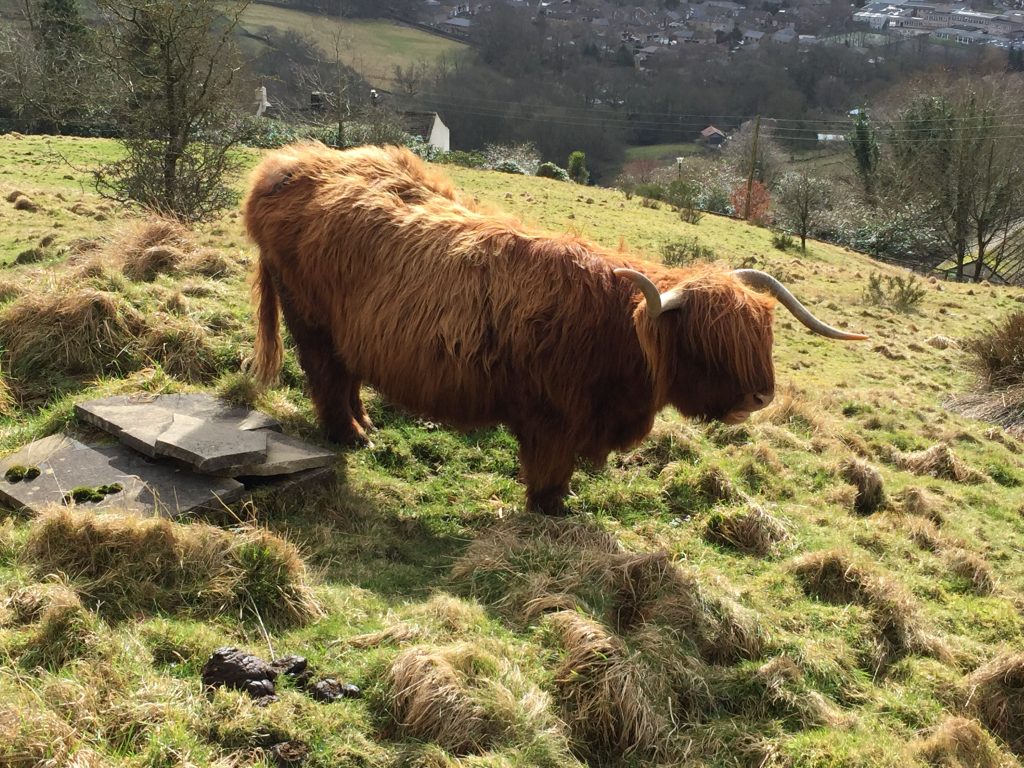
It was May, 2020. The country, indeed much of the world, was in lockdown – the Coronavirus pandemic. Yet here I stood on a remote hillside with a panoramic view of the Calder Valley. Atop Erringden Moor Stoodley Pike rose like an eagle commanding a view of its territory, but it’s a black eagle, no hint of gold on its ‘phallic spike.’ 1 The bleat of new born lambs filled the still air, a joyous sound now no longer obliterated by the overhead roars of planes on their flight to distant lands. A highland cow had introduced herself to me as I strolled along Burlees Lane, high above Hebden Bridge but her eyes warned me not to enter her field despite the public footpath sign.
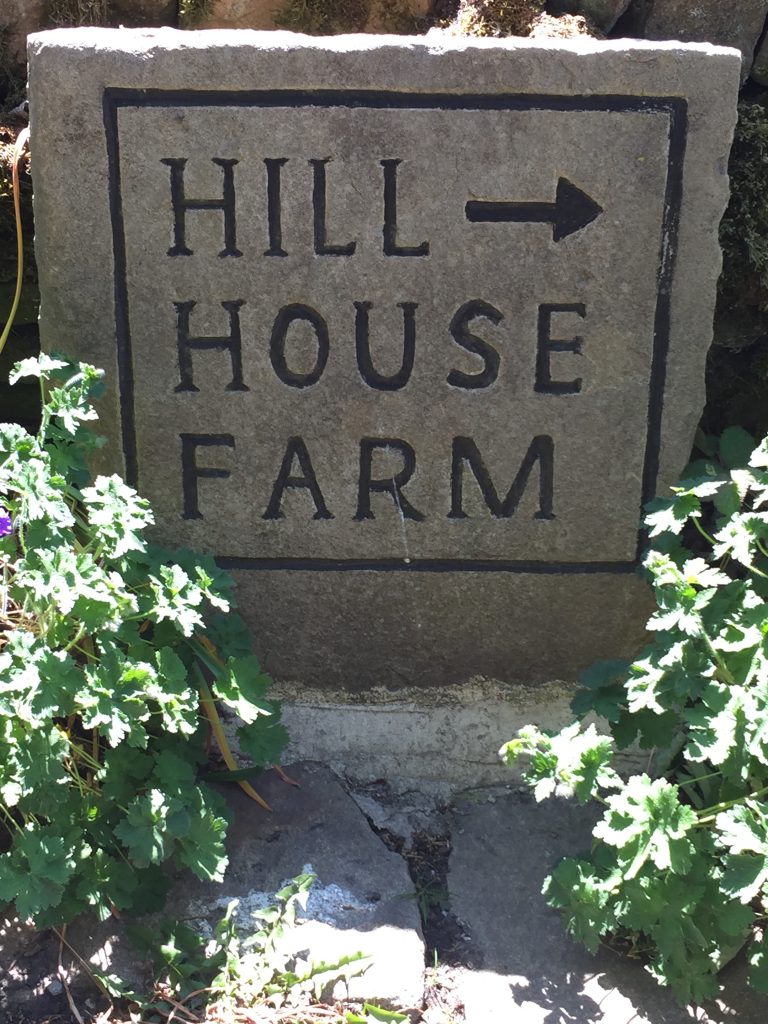
Above Hill House
It had been a steep climb up Wadsworth Lane, passing the housing estate of Dodd Naze on my left while to my right was open pasture but now I had a bird’s eye view of the Calder Valley and the small town of Mytholmroyd. Even though this town with its tongue twisting name is only 2 miles East of Hebden Bridge the valley here is much wider here with more expansive flat areas with scattered buildings , quite different from the tightly packed houses on top of each other, accessible by steep stone staircases.
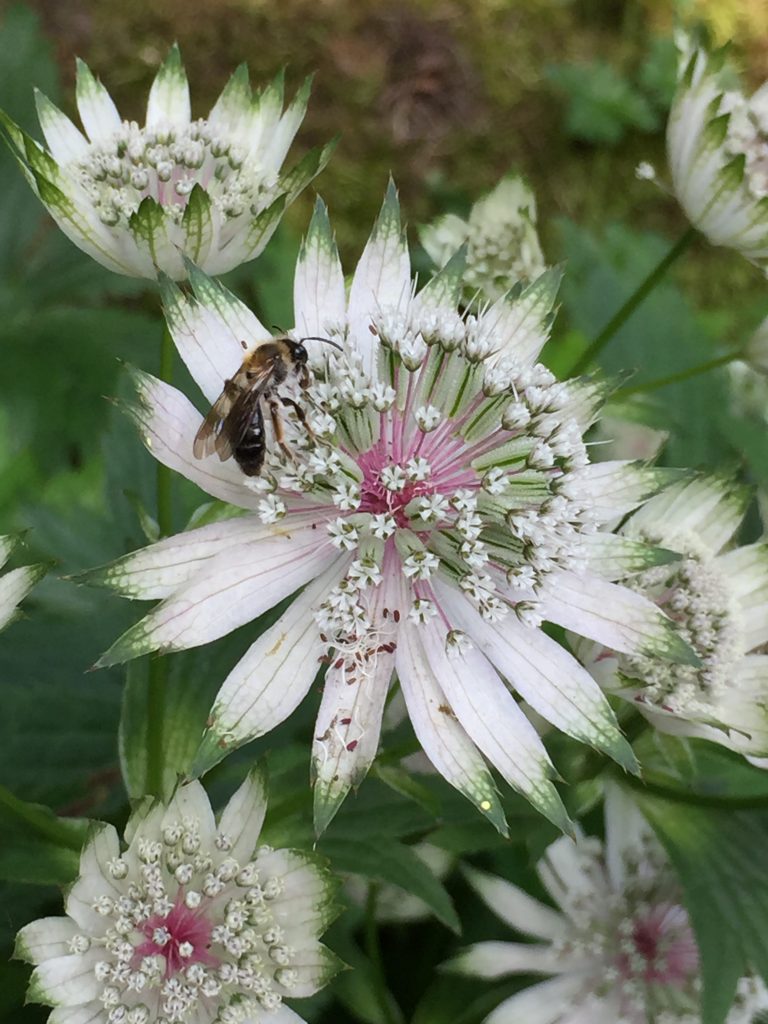
I was in search of Hill House, birthplace of one of my ancestors, Charlotte Greenwood. I turned off the main road onto a small unpaved lane, Raw Lane. Ancient cottages now mostly restored and exuding affluence, their windows overlooking a dramatic landscape are dotted along its length, seemingly at random, some with their front doors opening directly onto the lane and others set back. In places Raw Lane is tree lined and at this time of year the trees heavy with leaves bowed their boughs forming an arch above me for me to walk through onto centre stage. The scent of the white hawthorn flowers was everywhere, reminding me of the hawthorn tree close to my childhood bedroom window at Affetside, and the brilliant yellow gorse flowers vied with a field of vibrant yellow buttercups for the prize of best in show. Today the verges were ablaze with colour. Foxgloves stood tall, proudly displaying their pendulous bell-like blooms and as I became aware that my jacket perfectly matched their shade of purple-pink I assured the busy bees that I was bereft of pollen.
Yet I had walked along with path in Autumn when the fog was so dense I could hardly see the roadside verges, let alone the expanse of the Calder Valley. Winters up here can be treacherous with ice and snow in abundance, and even today bins of grit lined the path reminding me of those dark days of winter when the lane lives up to its name. With map in hand I picked out Hill House to my right, perched alone on top of a smooth sided grass-green hill, devoid of trees, and justifying its name 100%.
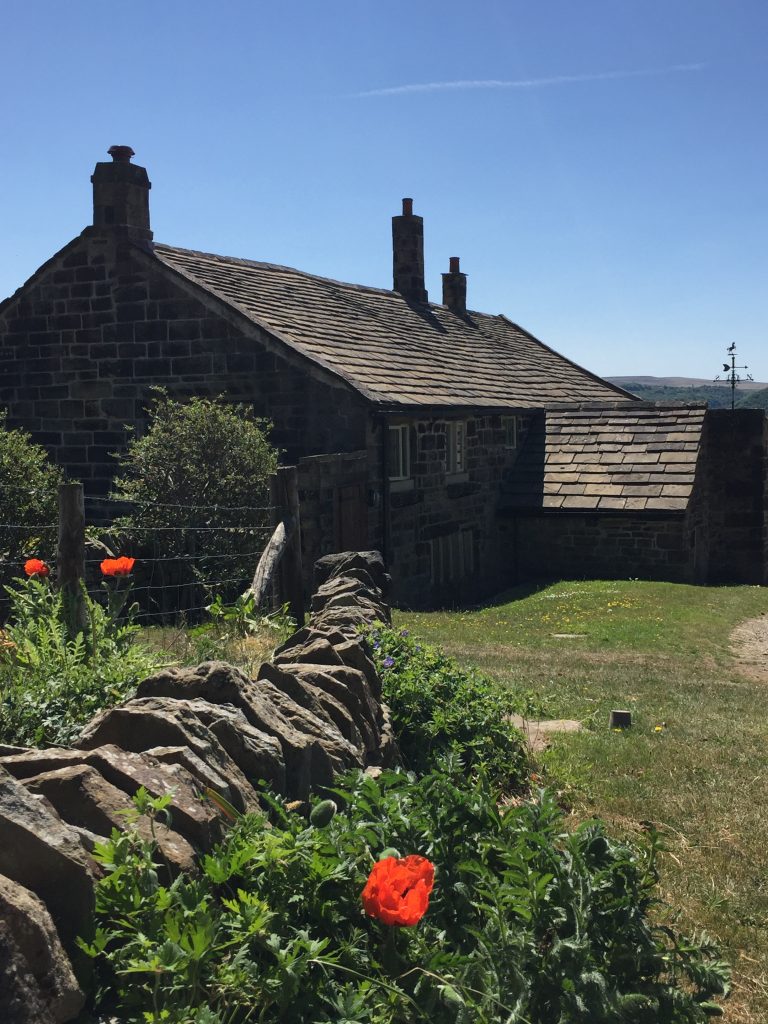
The track to Hill House
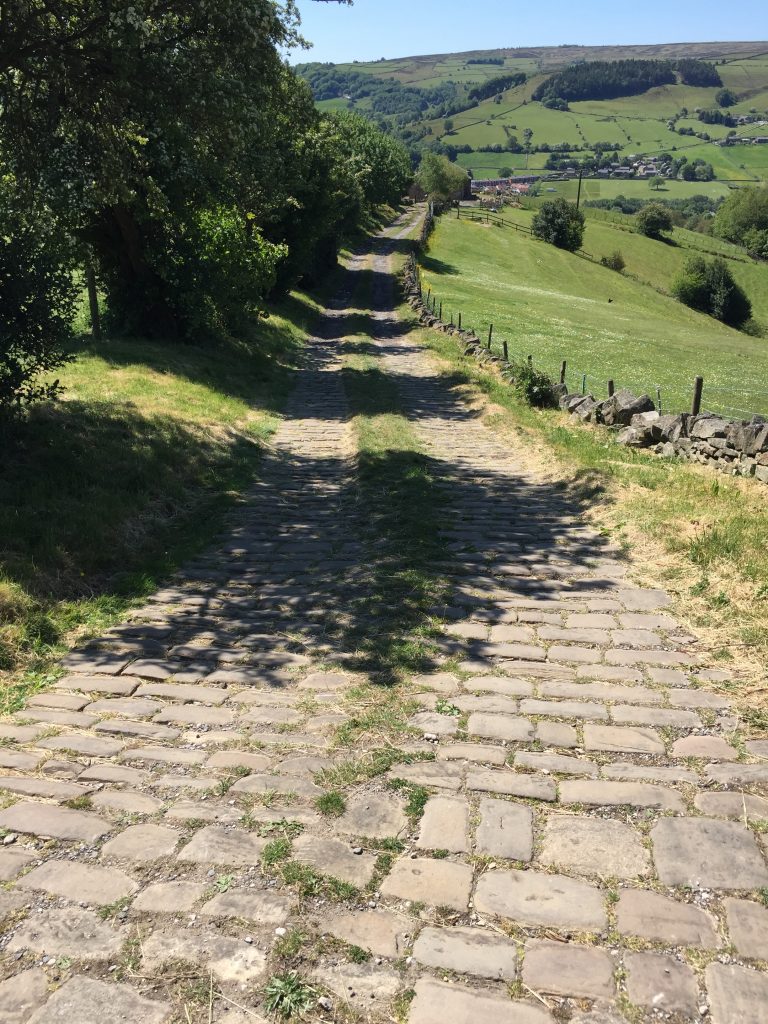
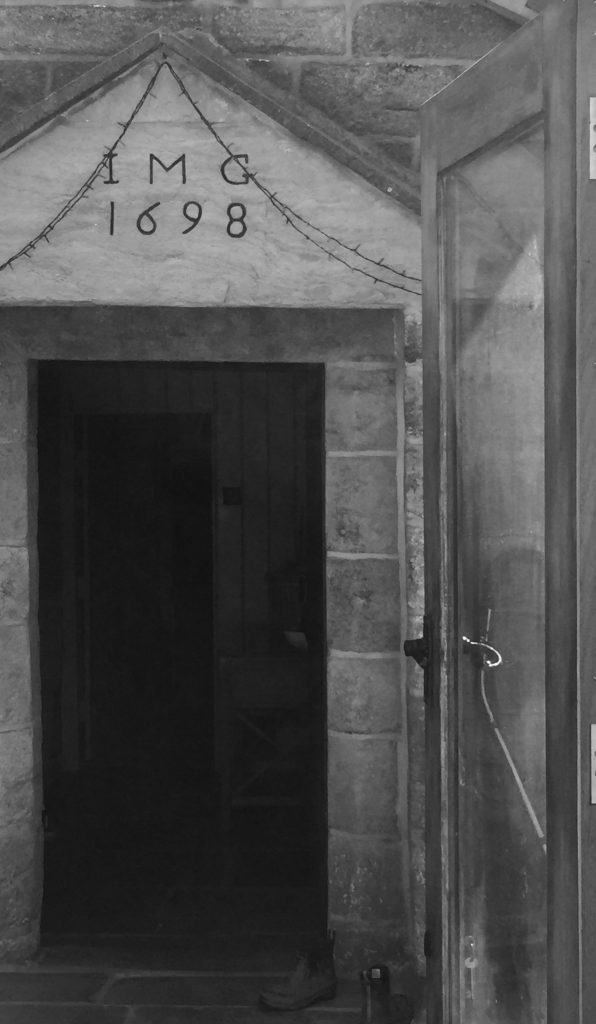
A man was gardening at Hill House Lane Top and I chatted to him, admiring the lovely view his house had before taking the poppy lined cobbled track down towards my destination passing a beautifully landscaped garden with an ornamental pond and just as I approached the ancient stone house with its large barn across the yard a woman came into view, the current owner. I explained my quest and she was interested enough to bring out to me a framed aerial photo of the property taken about thirty years ago. It brought back memories of a similar photograph of my home at Third Bungalow, Affetside, framed and sitting in pride of place on top of my piano for many years. It had been taken from a helicopter some time in the 1970s and the pilot had landed in our field. Back at Hill House the owner pointed out a date stone above the front porch of 1678 and the initials IMG but she assured me that the building was significantly older than the stone indicated and that this was the date commemorating a rebuild.
Date stone commemorating the rebuild
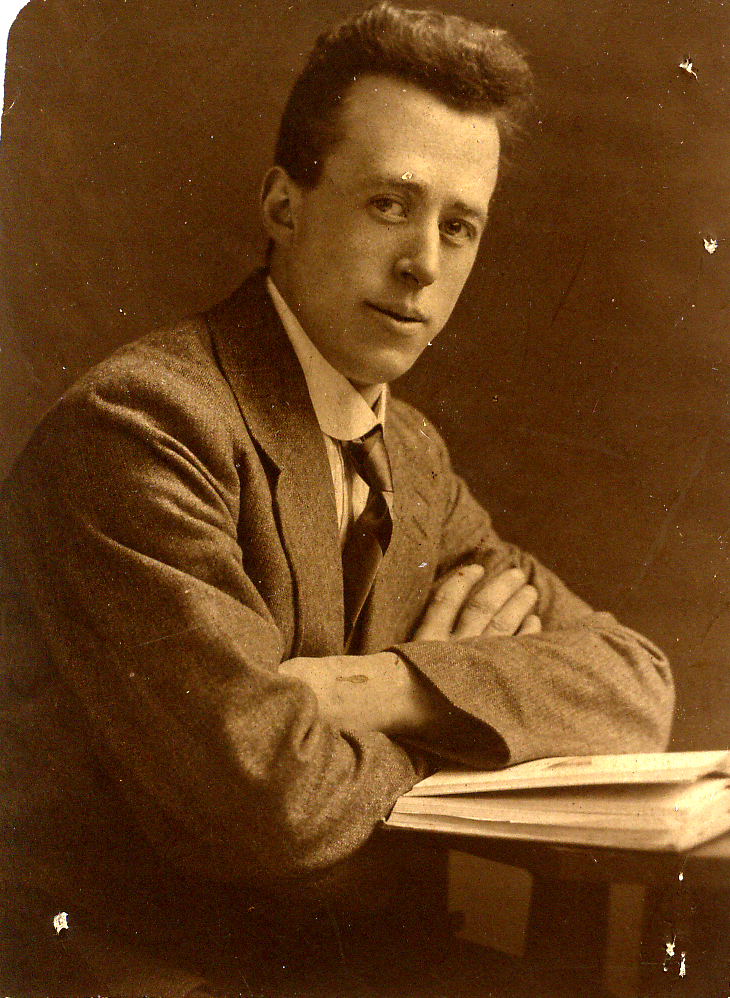
With an invitation to return after lockdown was over I took my leave and she directed me to a path running behind the house enabling me to hike back into the valley a different way, following the outline of the hill which gives the house its name. I found myself crossing a beautiful meadow awash with wild flowers, clovers, cowslip and buttercups before reaching Red Acre Wood. Much work has been done to preserve the footpaths traversing this woodland sanctuary but the path remains steep, often with stairways and I had to keep my focus on my footsteps until I reached the valley floor from where I looked back and could see, high above, Hill House, perched atop its hill, birthplace of Charlotte Greenwood. In the Spring of 1894 Charlotte married Willie Wrigley, the great grandson of James and Mally, my 4th great grandparents who had lived at Lily Hall. Willie was an architect of some renown.
Willie Wrigley
I knew that Charlotte and Willie had a turbulent life together and his desertion of his wife and children resulted in a 3 month incarceration with hard labour in Wakefield gaol in 1901. But as I chatted to the current owner of Hill House that Spring morning I wasn’t aware of a tragedy that had occurred there one hundred and sixty years ago. A search later that evening produced an account in the newspaper that chilled me to the bone.
An article in the Sheffield Daily Telegraph 4th Nov 1861 reads ‘Murder and Suicide by a Mother Mytholmroyd: On Friday last, at midday, a most awful tragedy was perpetrated at Hill House, Wadsworth, Mytholmroyd, by a married woman, named Greenwood, wife of Mr. Greenwood, farmer. It appears that during the forenoon Mr. Greenwood had gone to Mytholmroyd with a week’s butter, and while away his wife cut the throat of her little daughter, about five years old, after which she cut her own throat, and ran out bleeding profusely into the house of a neighbour, (living at Hill House Lane Top where I’d chatted to the owner) named Sutcliffe, and then ran back into her own house. She still had the razor in her hand. Sutcliffe took it from her, and the mother pointed to the child in an adjoining room, with its head almost severed from its body. It would seem she had had two razors at work; one was also lying on the table, opposite the looking glass, covered with blood, along with two empty razor cases. The house presented more the appearance of a slaughter-house than human dwelling, such was the quantity of blood on the floors. The little girl’s hands were tied with a shred of cotton lining. Mrs. Greenwood has been in a desponding state of mind for some time, but not so much so as to cause much alarm. Since the above was written, it is reported that Mrs. Greenwood is dead also.” 2
Hill House
I found over sixty accounts of this tragedy in various newspapers, the story being reported as far away as Ireland, Wales and Scotland but only the Hull Advertiser suggested a reason for the tragedy. “She had been depressed in spirits for some time in consequence of her husband’s ill luck in business as a farmer, and also in consequence of the helpless and idiotic state of the child brought on by the violent fits to which it had been subject for two or three years.” 3
Three and a half years after the devastating death of both his wife and child James Greenwood remarried. I mean, it’s not surprising. He had four remaining children under eight years old and he had a farm of 28 acres to look after. Following his marriage to Elizabeth Jackson at Mytholmroyd church the couple had three more children, the youngest being ‘my’ Charlotte born in 1871. James and Elizabeth continued to live at Hill House for the rest of their lives and as I picked my way carefully along the steep path through Red Acre Wood I wondered what ghosts penetrated their lives there.
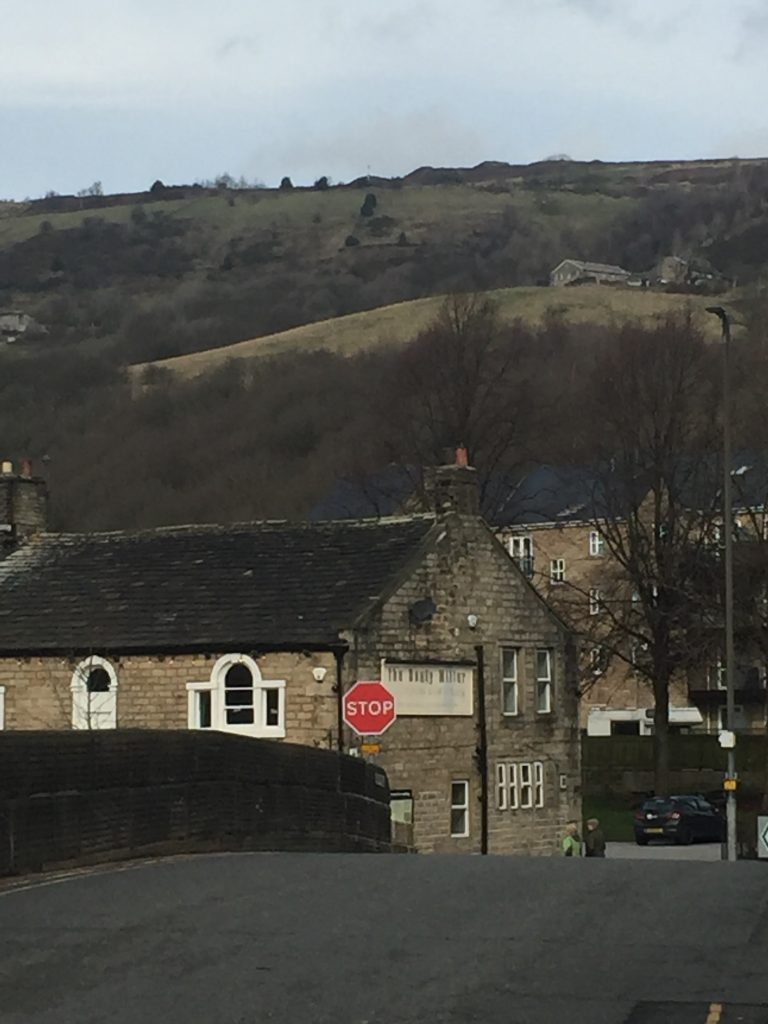
Hill House above the Dusty Miller. If only Fanny had taken notice of the sign. . . .
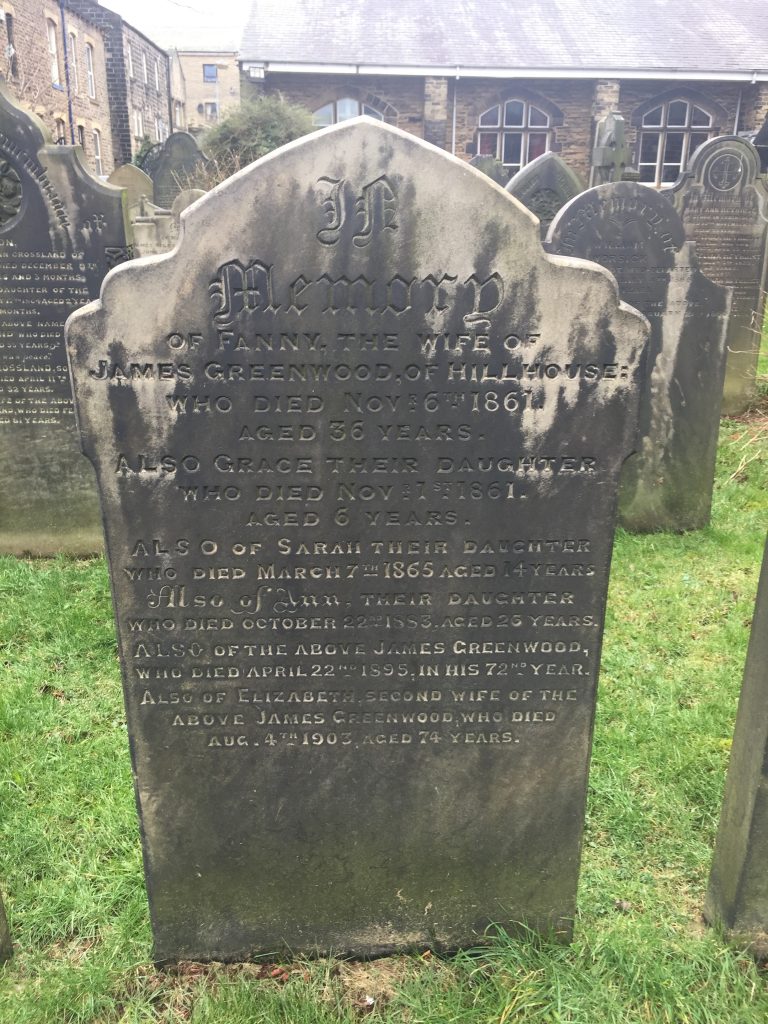
Emerging from the dark density of the woodsI found myself in the centre of a bright and sunny Mytholmroyd. This small town on the River Calder lies at the junction of Cragg Brook and the River Calder and the valley floor here is much wider than the narrow cleft in which Hebden Bridge cowers, just two miles to the East. Yet its propensity to flooding is equal to that of its neighbour and TV crews covering the floods often have a particular difficulty in pronouncing the town’s name, meaning a clearing where two streams meet. After a few minutes’ walk along the towpath towpath I crossed the canal, the road and the river and arrived at the church, in search of the resting place of Fanny. It didn’t take me long in this well kept cemetery to find her grave, in which her daughter, Grace, also rests. So too is Grace’s sister, Sarah, aged 14 and Ann, aged 25. Fanny’s husband James lived to a grand old age of 72, and his second wife rests there too.
Grave of the Greenwoods
At that moment the church bell struck the hour and as I looked up at the asymmetrical church tower the outline of Hill House perched on its hill appeared to be directly the tower. Grave That morning on my way to find Charlotte’s birthplace I’d looked down with pleasure at Hill House and its commanding position and chatted happily with the owner. I know now that the place will hold different memories for me whenever I see it perched on the hill looking out to Mytholmroyd.
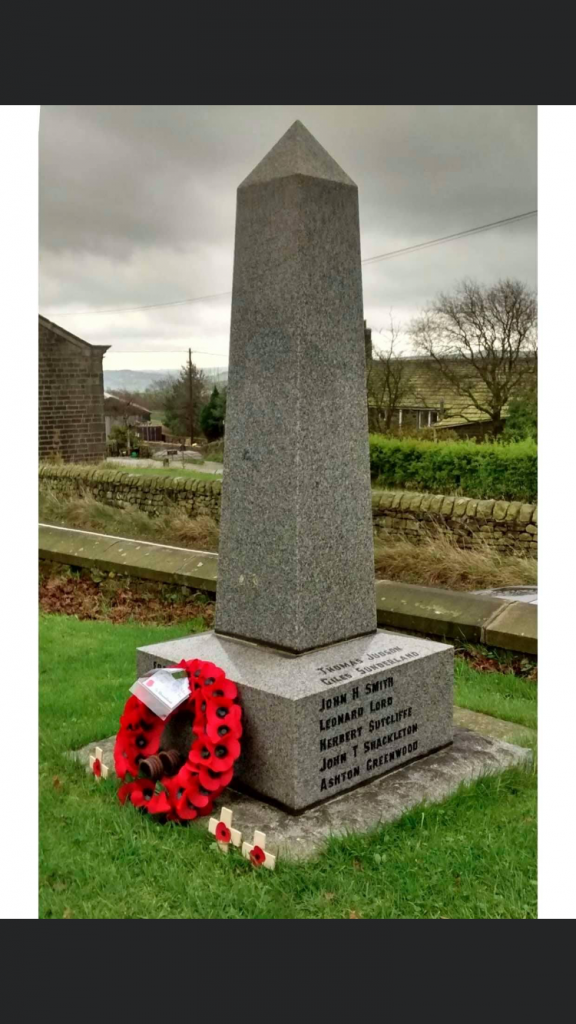
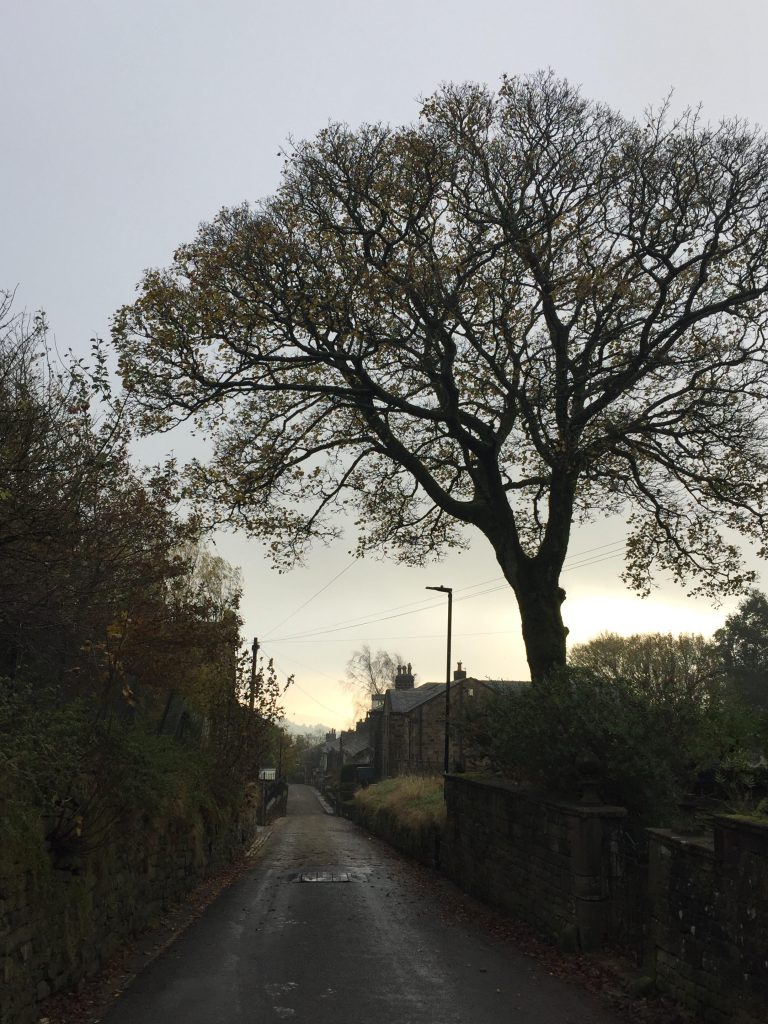
I was surprised to see sun when I opened the curtains this morning. I mist was hanging like a curtain over the valley, swishing this way and that – one minute obscuring Weasel Hall across the Calder Valley, and the next minute Weasel Hall was in full sunlight and Heptonstall was obscured by clouds. I couldn’t resist the opportunity to get out on’t’tops and I jumped onto the first bus up to Blackshaw Head, 600ft above me. There was another reason I wanted to go up there for today was Remembrance Day and one of my ancestors, Giles Sunderland, who lived on that exposed moor and was killed during WWl is remembered on the memorial stone in the chapel’s cemetery.
By the time the bus reached the scattered village, however, there was a lot more low dense cloud than swirling mist and sunshine, and I knew that it wasn’t the morning for stunning photography that I had anticipated.
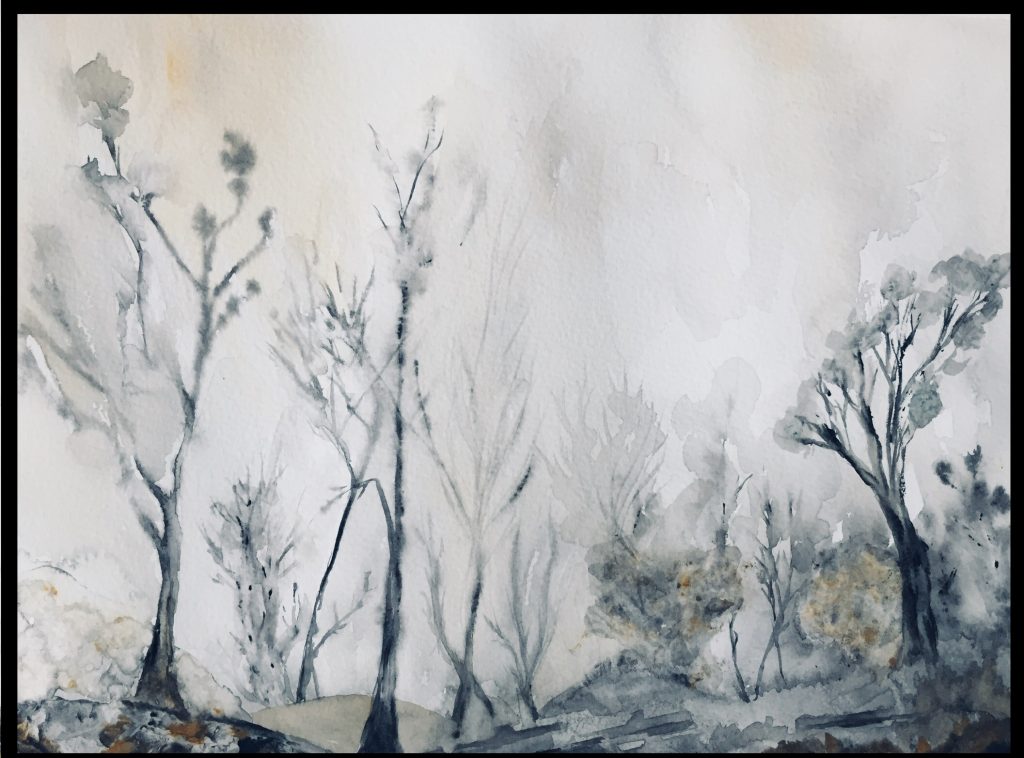
My watercolour of trees in the winter always reminds me of the WWl trench warfare
I stayed on the bus at the turnaround and alighted at the wonderfully named Slack Bottom. I peeked into the lane leading down to Lumb Bank, now a writers’ retreat that had been purchased by Ted Hughes. It wasn’t until I attended the last zoom meeting of Hebden Bridge History Society last week that I learned that Ted’s parents lived in Slack Bottom and it was there that Sylvia Plath visited them, thus leading to eventual burial in Heptonstall Cemetery, a long way from her birthplace in Massachusetts, where, as it happens, my own children were born.
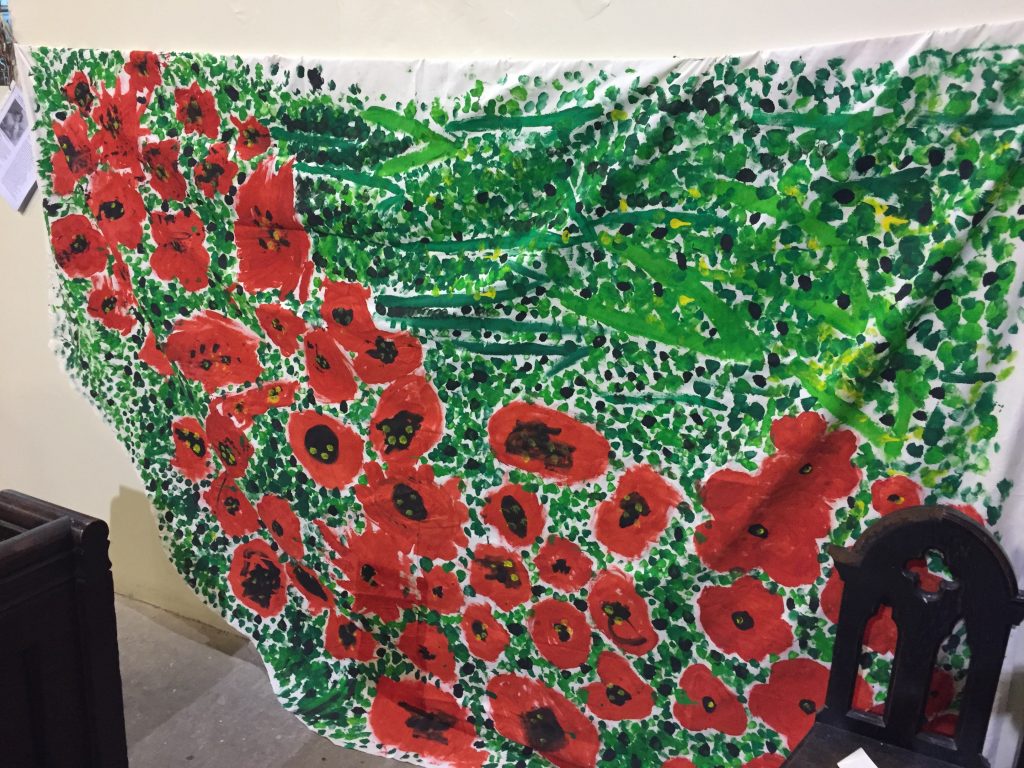
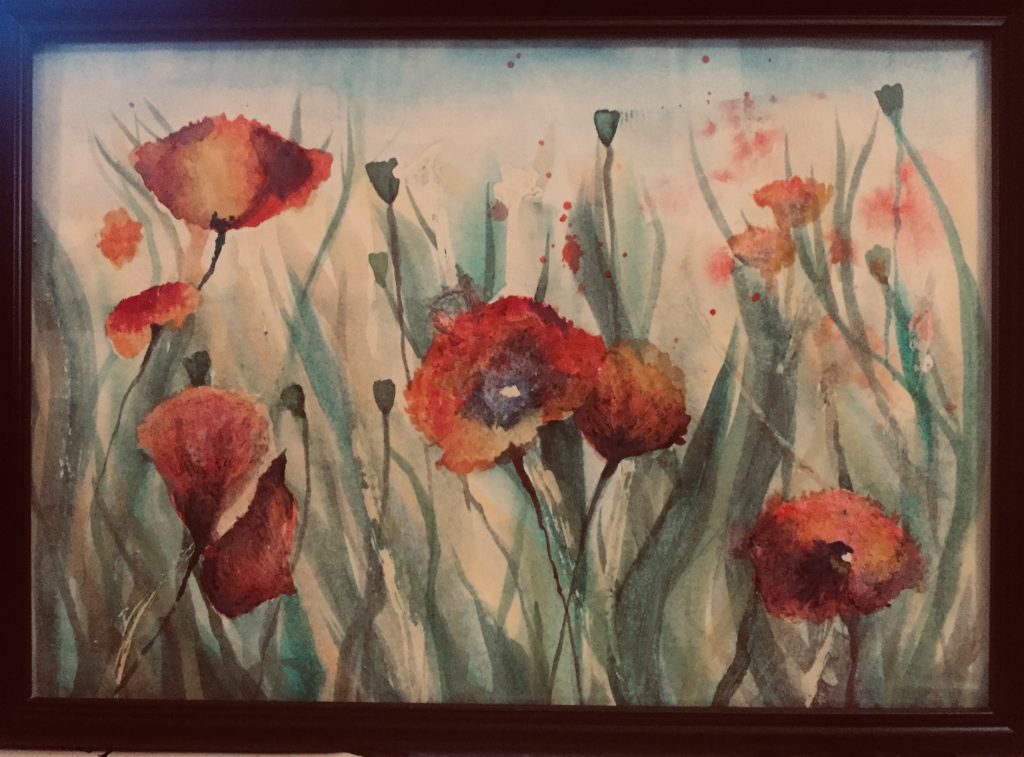
As I emerged from the lane back onto the main road a car pulled up and it wasn’t until “Heather!” came through its window that I saw that it was one of the Heptonstall residents. I’d painted a watercolour of poppies for the poppy display in Heptonstall church and the lady had been responsible for coordinating it. I’d dropped it off at The Cross a couple of evenings ago and now she was explaining to me where it could be found.
However, when I arrived at the church the door was locked, it still being quite early. However, the Tea Room was already open and I called in for a couple of their delicious cakes to take home with me.
Approaching Heptonstall from Slack Bottom
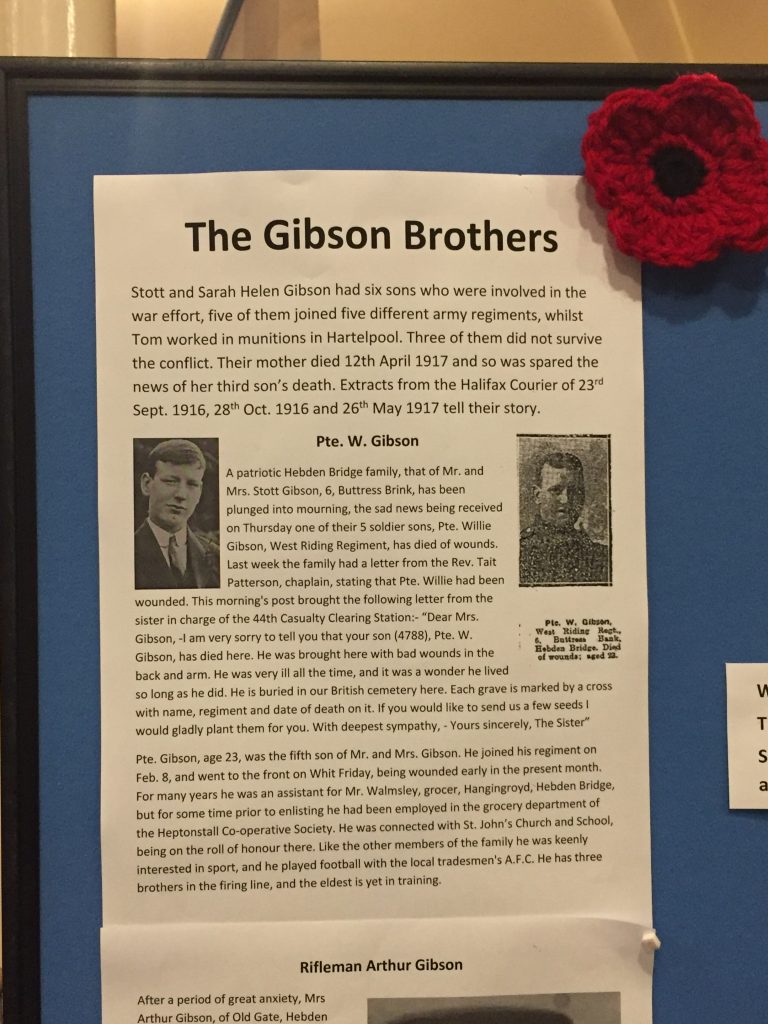
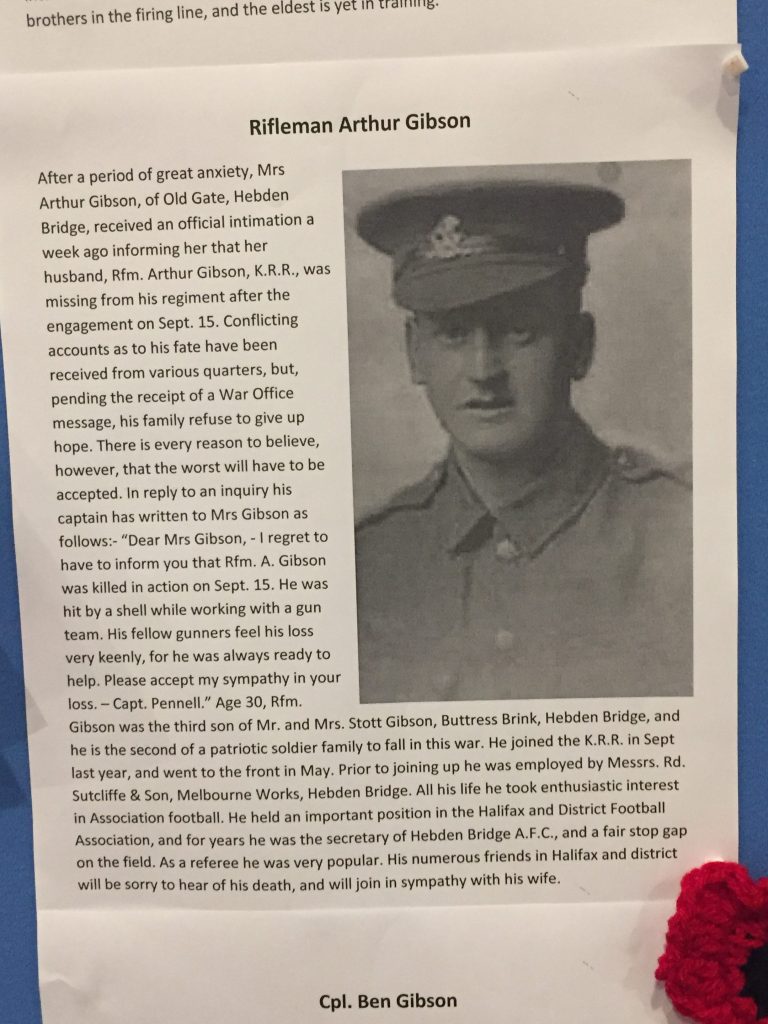
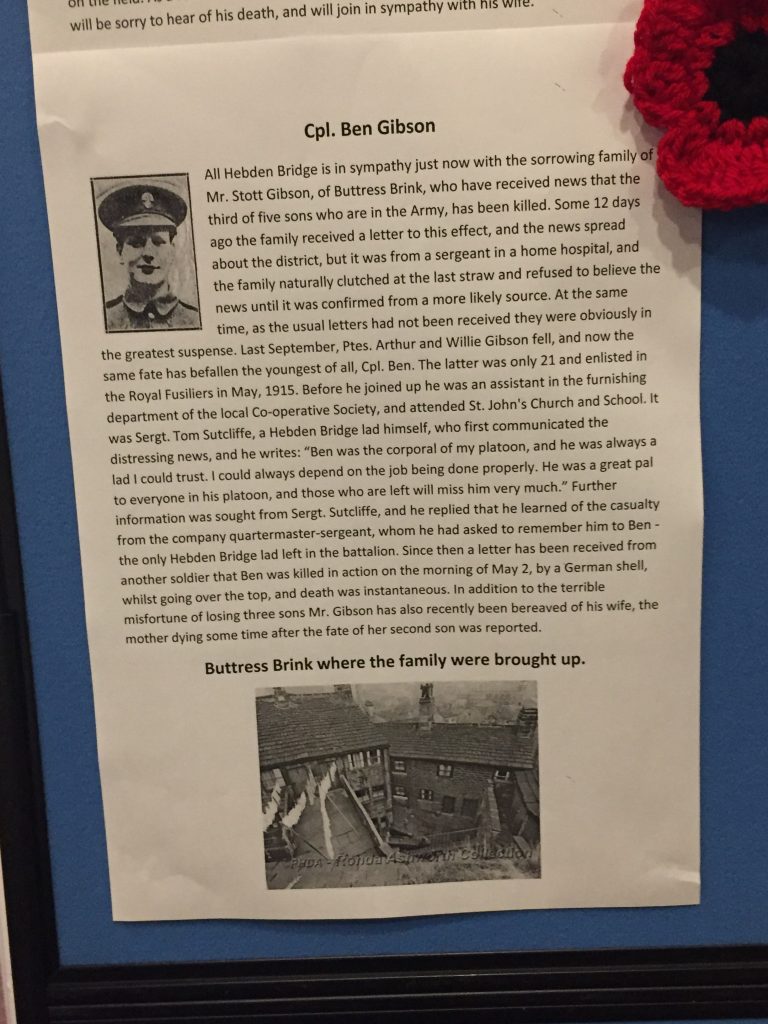
Back down in Hebden I passed St James’s church where I’ve been in to practice the organ in readiness for the Remembrance service on Sunday. I hadn’t been in the building for two years let alone played any music there. A group of people had been putting up a display there, an enormous blanket of knitted poppies , a painted sheet of poppies and displays about the lives of local residents who had lost their lives in WWl. Three brothers were commemorated, and they were related to me. I’d already researched their story and found their memorial in the cemetery but today three balloons had been placed on the headstone. They are buried in Europe where they fell.
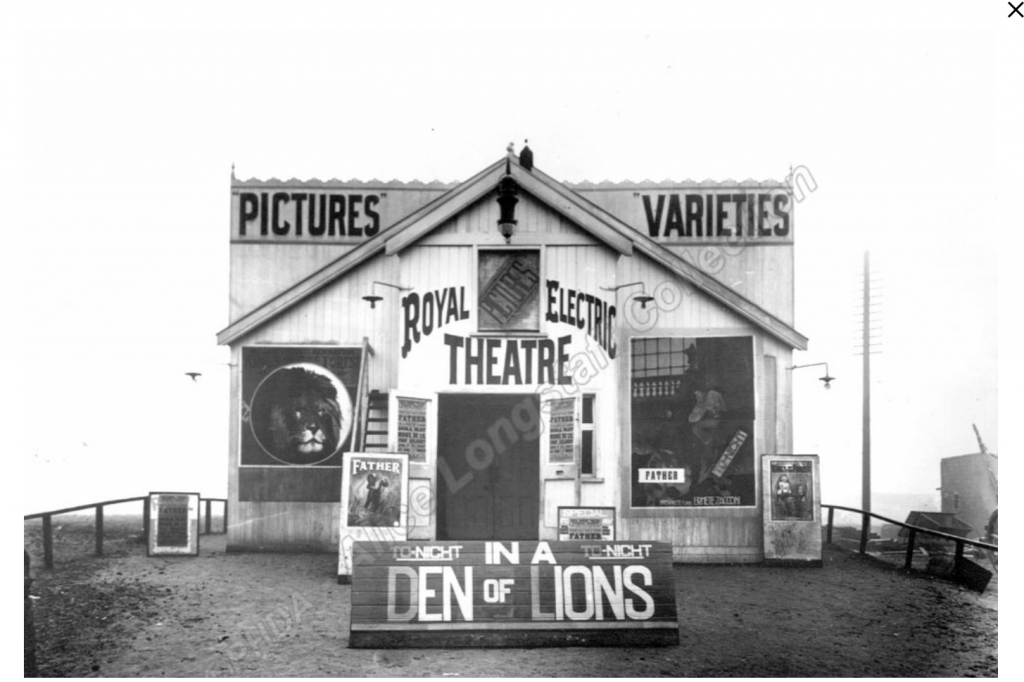
If I’d have looked out of my living room window any day between 1912 and 1921 I would have found myself looking directly onto The Royal Electric Theatre. In 1921 the ‘new’ picture house opened just a few hundred yards away and this cinema is currently celebrating its 100th year – the only cinema in England to have achieved that milestone.
‘In the late 1960s, when many of the mills had closed, the Picture House nearly suffered the fate of so many town cinemas and was very close to becoming a carpet warehouse. It was saved for the town by the actions of the then Hebden Royd Urban District Council who purchased the Picture House from its private owners for the sum of about £6,000. The cinema passed into Calderdale Councils control with local government reorganisation in 1973, and CMBC oversaw a subsequent refurbishment in 1978, removing half of the seats and leaving the current 492 seats with their often praised generous legroom.’ (From the cinema’s website).
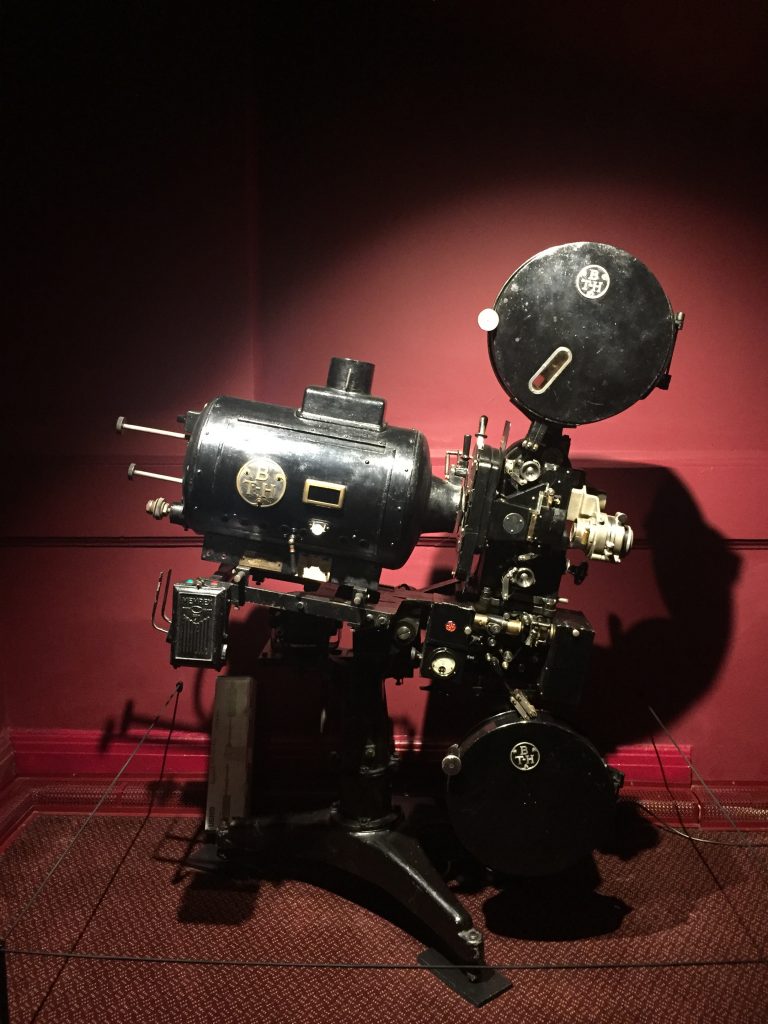
I read that there was on open day at the Picture House yesterday and so off I went. It took me exactly 2 minutes – and most of that time was spent waiting to cross the road! First order of the day was to witness a demonstration of one of the old projection devices which currently has pride of place at the back of the stalls. The current projectionist explained that there would have been 2 such contraptions originally. It actually looks like something from a sci fi movie!
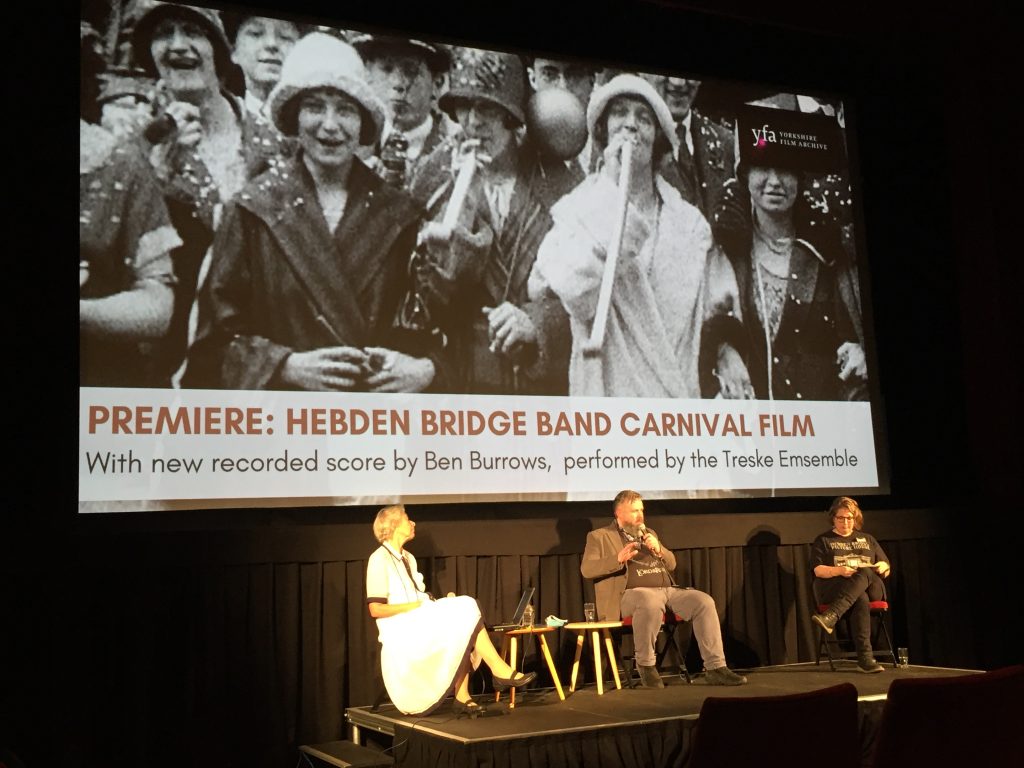
Next we were treated to a 1924 silent movie of Hebden Bridge band Carnival film. The local brass band had a stellar reputation (see my blog about my ancestor Stott Gibson who played in it: http://blog.hmcreativelady.com/?s=stott+gibson
but they were in financial difficulties. Travelling to far venues for competitions was costly so a carnival was planned. Pathe film company would film the event, hopefully including many of the crowd watching the parade. The parade itself was over a mile in length, and there was a fancy dress competition at the end of the day. Money would be raised by people attending a viewing of the movie at the cinema, hoping to see themselves on camera. The venture was so successful that it was repeated the following year. Though only 12 minutes long the movie gives a wonderful insight into people’s everyday life – their sense of fun, their eagerness to dress up in crazy outfits (the spectators as well as those entering the fancy dress competition), their ‘normal’ daily clothes, transportation, and a sense of fun that was being mirrored as I watched by the Pink Pride Picnic that was taking place in the park just outside.
After the movie there was a Q and A with Ben Burrows, the composer of the music that he been written to accompany the silent film. The Treske Ensemble had recorded the music in London. A pity about the rather large spelling error on the banner behind him. Diana Monahan from the local history society had done research into the carnival and had mapped out the route that the floats had taken.
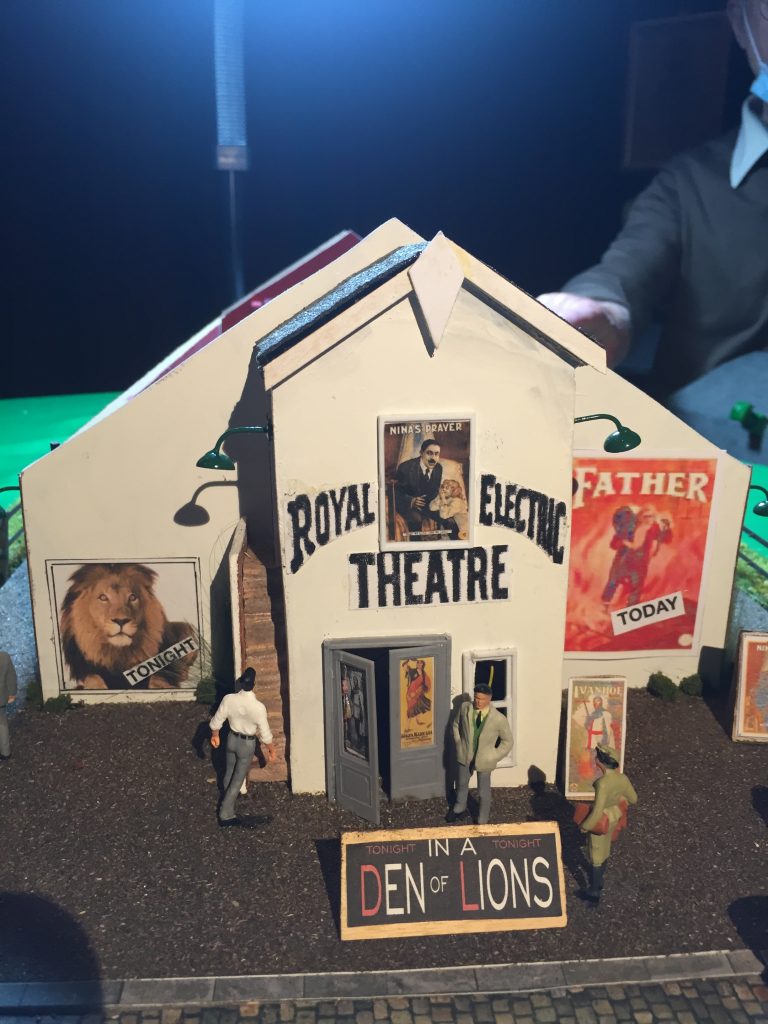
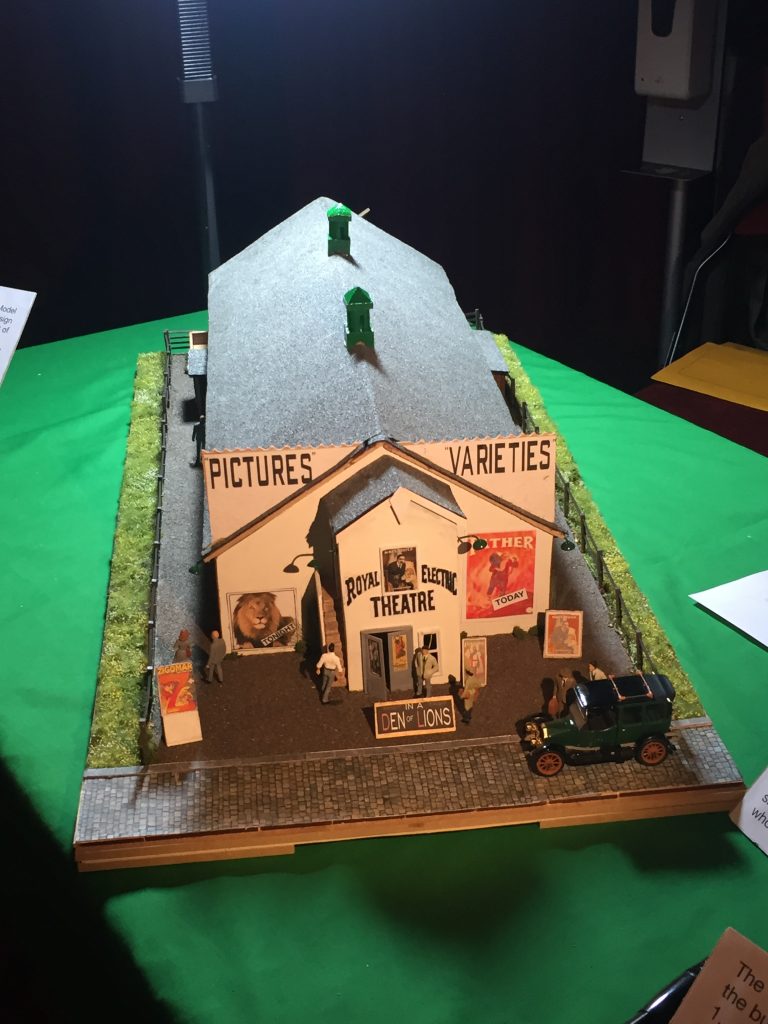
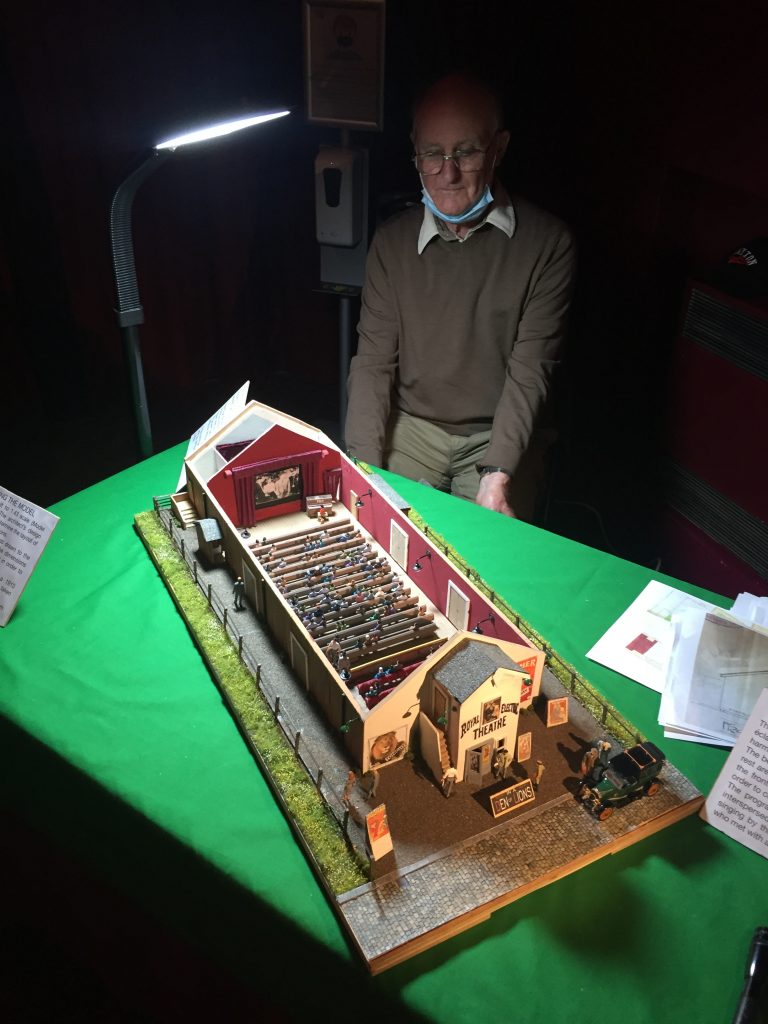
A corner of the cinema had been given over to a wonderful model of the original electric theatre and I chatted with its maker, Ray Barnes.
He had chosen that particular scale because it’s used in model railways and so he was able to purchase the figurines, but he had to repaint them with appropriate attire. The projection box was upstairs at the front of the building. People in the expensive seats – 3d – entered at the front. Those bound for the cheap seats went in through a side entrance.
It was designed by Henry Cockcroft, a Hebden Bridge architect who had been responsible for designing the trestle bridge at Blake Dean from which one of my ancestors fell (see blog about Ada Harwood: http://blog.hmcreativelady.com/2021/03/01/adas-tragic-death/
Then, to my surprise, Ray took off the roof of the model and I saw its interior, with many people enjoying a film. The men’s toilet was outside, but there was a ladies’ toilet inside the cinema and he’d even recreated this, with a woman going about her business!!! What a wonderful Lockdown project Ray had created.
You can watch the 1924 silent film for free via the Yorkshire Film Archives
‘Nestled above the hustle and bustle of Halifax Borough Market are two secret streets that are so well hidden that you may not even know about them.’ How many times have I walked around the stalls of the market and not known that above me were two streets with houses – and even a hotel!
These streets are some of Halifax’s most unique houses that run alongside the roof of the market and also look out onto the streets of the town. They used to be home to the market workers, who could then access their stalls below from their own homes. The street of terraced houses was also home to an old Victorian hotel above the high roof of the market.
The tour was part of the Halifax cultural exhibition and the guide was a man who had lived and breathed the markets of Calderdale for over 40 years. He even lives in a house perched high above the market stalls, and accessed, as he was careful to point out, by 47 steps! Talk about living on the job! He oversees Hebden Bridge, Todmorden, Brighouse, Elland and Halifax Markets. He explained how the Halifax Market is being revamped, with ideas for evening openings and even a small live performance venue being incorporated. Under his supervision Elland market has grown from just a couple of stalls to over 20. However, it looks as if Sowerby bridge market is definitely on its last legs.
Access to the streets was by a simple door adjacent to the large original historic gates into the Victorian market. A market has been in Halifax since the 1200s when it first gained a charter. There are hopes that the houses in the sky can eventually be restored and reoccupied. Two of them currently hold small offices but the rest have been empty since the 1990s but the decor was SO 60s. The colours were utterly amazing. It was wonderful and so totally unexpected. We were able to go and explore two of the houses. One was a 5 bedroomed affair.
While at Dean Clough last week I picked up information about the upcoming Halifax Heritage Festival. There were lots of interesting events and exhibitions and the first one I attended was an organ recital in Halifax minster. I arrived early to view the exhibition put on by the Piecemakers of Elland. The 21 individually designed panels reflect the mythology, folklore and distinctive features of the native trees of Great Britain as depicted in the Celtic Ogham, an ancient alphabet and calendar including trees such as the Oak, Apple, Willow and Ash.
The Piecemakers Artistic Lead, Annie Lancaster said: “Each panel depicts one tree featuring the letter and number of the tree plus details relating to mythology, history, botany, pharmacology and religion of that tree and also highlights the importance of bees in pollination.” One panel was devoted to Heather so naturally that took a lot of my attention. The details of the workmanship and the creativity of the design of the panels was inspiring. I’ve been working on many of my own fabric panels during lockdown so it fascinating to see what other people have been working on.
It’s been a while since I posted any ancestral info on this blog but here’s another branch of my family who kept pubs in Hebden Bridge and Heptonstall.
Sheep at Old Chamber
Living just a couple of houses away from William Wilkinson at Old Chamber in 1841 was a slater named John Taylor, his wife Mary and their seven children. At the time there were eighteen households in this tiny hamlet and so everyone must have known each other well.
Cottages at Old Chamber
In fact the Wilkinson and the Taylors had two of their children baptized at Heptonstall church on the same day, December 29, 1836 – Rachel Taylor and Sarah Jane Wilkinson. The towers of both the old church and the new church that was built in the early 1850s are visible from Old Chamber today though now they peak out above trees that shroud the packed gravestones, a place that was then bereft of trees. Did the two families share a ride to Heptonstall church in a cart?
View of Heptonstall church from Old Chamber
Born in the parish of Warley in 1801, John had been a plasterer by trade when he married Mary Greenwood also of Warley at St John’s Halifax in the summer of 1822. I wonder why they didn’t marry at St Mary’s church in Luddenden which served Warley parish. Mary had been born in the hilltop village of Midgley in 1804. During the following 23 years the couple would have ten children. The older children were baptized at St Mary’s church, Luddenden, so it was in Luddenden that I began my day with the Taylors. It was Easter Sunday, 2021 so armed with a couple of Cadbury’s creme eggs in case I got peckish on my travels I took the ten minute bus ride to Luddenden Foot and then followed the course of Luddenden Brook upstream. After about ten minutes I passed the ancient Kershaw House which I think always looks ill at ease , surrounded on all sides by an interwar and postwar housing development. Kershaw House, now a Grade l listed building predates these more recent homes by a staggering three hundred years and there was a house on the site for two hundred years before that. During the building boom of the 1960s the rambling mansion with its many windows and its unique Tudor rose stained glass window with unusual diamond shaped lights was converted to an inn and though I’d have welcomed a beer there today, as I’ve done before, it is of course currently closed. As I stopped to take a photo of the side of the building I noticed a sign pointing to a building at the rear of the inn’s car park – Little Foot Day nursery.
Luddenden with St Mary’s church
Seeped by the American folklore tales of the ape-like creature that inhabits the forests of North America known as Big Foot I couldn’t help but smile. I followed the river walk, the sides of the valley coming ever closer, and arrived in the heart of the village with its beautiful cottages today bedecked in their finest Spring colours despite the fact Luddenden is so deep in Calderdale that the sun does not find it after October7.[1]
With its old stone houses all huddled together on various levels of the hillsides and its waterfall and sixteenth century bridge in the centre of the village many artists and photographers have made it the subject of their work. Poet laureate Simon Armitage made it the subject of the poem ‘Full moon’ in which he makes up words to rhyme with the strangely named village. Pink blossoms of flowering cherry trees fell gently onto the stone flags on which I walked while tubs of daffodils, narcissus and aubreita radiated their colours in the multitudinous nooks and crannies between the houses bearing testament the village’s gold medal award in Yorkshire in Bloom competition in 2012. These Luddendenites are rightly proud of their beautification of the village.
Luddenden
Even the trash bin on the riverside walk is embossed with a date – 1989, alongside a Yorkshire rose. Four hundred years ago Luddenden Valley was one of the richest places in the country, as yeoman clothiers sold textiles all over England and exported to Europe. They built some of the finest houses in the Luddenden area during this time.[2] In fact, there are said to be more houses of 17th and 18th century origin in the Luddenden Valley than any other comparable area in the country.[3] I was fortunate enough to be a guest of the High Sheriff of West Yorkshire at one of these houses, Peel House, for a Christmas eve celebration in 2019. Built in 1598 it is the oldest known house still in use in Luddenden and its interior preserves many of its original features.
Peel House
I passed the Lord Nelson pub where a library was in use from 1776-1917. It is particularly of note because of its association with Branwell Bronte, who used to frequent it when working as a booking clerk at Luddendenfoot station, and living at Brearley Hall, another home of my ancestors whose story can be found in another chapter. Four years ago The Lord Nelson had provided much needed sustenance for Sarah and myself following our climb to Stoodley Pike, but of course it is now closed. Following the river, whose roar gives the village its Anglo Saxon name – a clearing in the valley of the loud river – I came to St Mary’s church where some of the Taylor children were baptised. A path around the gothic style church is made up of gravestones dating back to the 1700s and in places stairs have been made, also out of gravestones. Part of the cemetery wall has gravestones propped up against it. Little remains of the original church, built here in 1536 but it was demolished in 1814 and rebuilt, opening in 1817. The only fabric surviving from this building are some window mullions incorporated into the interior nave walls of the present building, and also three human mask corbels set into the West boundary of the churchyard. So when John, son of James Taylor, a plasterer by trade, and his wife Mary was baptised in Luddenden it would have been at the old church but by the time John’s own children were baptised the ceremony would have taken place in the newly erected church. Today I was surprised to see the church door open. Not only that but someone inside greeted me with “Hello, do come in.” Once inside I was handed a palm cross, reminding me that it was in fact Palm Sunday. At Turton church as a child I would be given a palm cross in the service – a tradition I’d completely forgotten about until this moment. I remarked that Luddenden isn’t on the tourist trail in the same way that Heptonstall is, a village of a similar size. “We like it that way,” came the immediate response. I looked for the memorial to Rev. William Grimshaw, buried here in 1763, by the side of his first wife. I keep crossing paths with him in my research. His brother John had been incumbent at Cross Stone church where many of my ancestors were married and buried, before taking up that position at Luddenden.
The magical allotment
I carried on along the track above Luddenden Brook passing the remains of former mills and long flights of well worn stairs leading from them up the near vertical hillside to the workers’ houses.
Well worn by many clogs
Interspersed between the ruined walls of Peel House mill was an allotment. But this was no ordinary allotment. I could barely believe what I was seeing. A conglomeration of wooden sheds, one of which was invitingly named the Bug Hotel, were surrounded by neatly stacked wood piles which had taken on more the guise of elaborate sculptures than mere repositories for wood. An old caravan was surrounded by soft velvet sofas and a leather arm chair. A terracotta house chimney was set out on the lawn, filled with an attractive display of dried grasses while green wheelbarrows stood proudly against a red shed, newly painted.
Amidst all this chickens pecked and geese strutted, evidently eyeing up this stranger. It reminded me that I was feeling peckish too so I took out a chocolate egg to munched on. At that very moment a man walked up the track towards me but before I could say hello he had turned off and yes, he was opening the gate into the allotment. He invited me in and told me his story. A dry stone waller by profession he’s kept the allotment for twenty years, nurturing its every need. He repaints all the sheds every year and has several fire pits strewn around the property for warmth in winter. When I took my leave of —- and his – – — – my two Cadbury’s eggs had been consumed but had been replaced with half a dozen eggs supplied by the residents of the Bug Hotel.
As I retraced my steps passing St Mary’s I
thought of Paul Taylor being baptized there in the depths of winter, on December
20, 1829, Anna’s birthday. By 1832 the family had moved to Old Chamber as seen
by the baptism record of Paul’s brother James. By the next census two more
children had been born, Greenwood (his mother’s maiden name) and Betty. It
appears that John has given up being a slater and is now a farmer of 18 acres
and the census specifically states that he has no labourers suggesting that
this would be rare. Hannah, is a servant, Paul and John are plasterers, James
is a scholar- at 19? Rachel is a factory labourer, Henry is an agricultural
labourer, Greenwood and Betty are scholars and visiting them is
Mary’s mother, Hannah Greenwood, now 64 and also born in Midgley.
On 2nd April 1854 Paul married Sarah Ann Gibson at St John’s, Halifax, and it’s through her that I am connected to the Taylor family. Her brother Thomas, a butcher, was a witness at their wedding. Sarah Ann is Joshua Gibson’s daughter and had grown up at The Bull Inn where her father was the landlord until he took his own life in 1858. During the next 16 years Paul and Sarah Ann had ten children. At some point, perhaps when they got married, they moved down into the valley and settled in Hebden Bridge for in 1861 they are running a beerhouse on Bridge Lanes just steps away from The Bull Inn. Besides running the pub Paul is also a slater, just like his father. Living with them is Sarah’s brother Richard Gibson, a machinist and millwright, who, like his father, would take his own life, as would his wife Rose causing the newspaper to headline the column ‘Is suicide hereditary? ‘ [4] In the 1871 census Paul is listed as both a beershop keeper and slater – reflecting his previous and current businesses. Their son John, 16, is a cotton weaver and daughter Sarah, now 14, is a sewing machinist. This is highly significant because she would marry Richard Redman because she played a pivotal role in the establishment of Redman empire, a highly successful international sewing company whose story is told in another chapter. Richard, 12, mule piecer as is his brother Willie, aged 9!
Fox and Goose
But which pub were Paul and Sarah Ann keeping? The tightly packed community known as Bridge Lanes was a conglomeration of streets connected by stone steps on the West end of the town centre, demolished in the 1960s and there is little left of details of the area. However, the earliest reference to a named pub that the Taylors ran was in 1875 when they were keeping The Fox and Goose. Oh my. When the floods of February 2020 in Hebden prevented me from accessing my home after playing the organ for the service at Heptonstall church I sought refuge in The Fox and Goose, primarily because its location is slightly elevated from the centre of town and was therefore above water! Along with other refuge seekers, some visiting the town on holiday, I was provided with warm food and as much tea as I could cope with. I was so grateful. What a surprise to find that my ancestors had been the landlord here 145 years before. I hope they were as kind and inviting to their customers as today’s landlord is. I later found a reference in a local paper that the Taylors had been running the Fox and Goose for 42 years when the article was written in 1899, placing the Taylor family as residents there from 1857. [5]
I retraced my steps along Luddenden Brook
and jumped on a bus heading back into Hebden Bridge, alighting at the turning
circle at the bottom of Heptonstall Road. Now that I knew of my family
connection to the Fox and Goose I was eager to pay that hostelry another visit.
West Yorkshire’s first community owned
pub and Calderdale’s pub of the year in 2019 has a couple of benches outside
the front door and a man who I took to be connected with the business was
sitting, enjoying the afternoon sunshine. I explained my mission and asked if
he knew anything about the history of the building or its former landlords.
“Well, it was built as an inn in the early 1300s according to the documents
held in Wakefield but I don’t know much else until the 60’s” “The 1360s?’ I
inquired. “No, the 1960s.” He invited me to forward anything I found out about
the pub’s history to him.
As I took my leave he looked forward to
welcoming me into the pub when it reopens. As
I thanked him I recalled an incident when landlord Paul may have ben a
little too welcoming.
In
1875 Paul was charged with permitting drunkenness on his premises between 10
and 11 pm. When two bobbies entered the premises they found Paul Taylor in the
taproom, along with James Clayton, the blacksmith, with a mug of beer in front
of him and ‘another man in who was fresh.’ Paul was fined 20s. In the same year
it appears that the same two bobbies were again on Paul’s trail. This time Paul
and another man were spotted by the two plain clothed bobbies playing cards ‘on the Lord’s day’ at
Rawtenstall wood, the very steep hill that rises directly above the pub, – and gambling. Greenwood was captured on the
spot but Taylor ran off but took his cap off and looked back. One bobby said
“That’s Paul Taylor, the landlord.” Greenwood was taken to the lock up. Taylor
denied being there and called others as witnesses who supported his claim and
his case was adjourned. I’ll never be able to wander around that wood just
above Bridge Lanes again without looking out for those plain clothed bobbies!
While this incident had a comedic element to it in today’s world five years later tragedy befell Paul and his wife when their six year old son, Frank, drowned on his way home from school, St James’s, Mytholm. It was the depths of winter, February 1880. Frank was dismissed from school at 4:10. It would have been totally dark by that time but there was a lit gaslight close by. Frank clambered over the wall opposite the school and climbed down to the river where the school children were known to like to slide on the frozen dam. Below the dam, was the ‘panhole’ – a hole four feet deep, with no fencing around it, just below a small waterfall. Frank balanced on some ice on the frozen Colden Beck and reached into the panhole to gather some ice. Someone on the bridge saw him fall into the panhole and Richard Mellor, the schoolmaster was summoned and was quickly on the scene. Mellor could just see the top of Frank’s head peeking above the hole. He managed to retrieve Frank but his attempts to resuscitate him failed.
Was this the bridge from where someone saw Frank fall into the Colden Beck?
Colden Beck from the bridge
frank’s school and St James’s church
Frank’s body was taken to his home at the Fox and Goose, just five minutes walk from the school. His dad was out feeding the pigs at the time but within minutes a doctor was called for, but his efforts too were in vain. The shock for his parents and five siblings is unfathomable. They had already lost one son, Gibson, who had died a few months short of his second birthday. At the inquest into Frank’s death held at the Bull Inn, Frank’s mother’s former home, in giving evidence the schoolmaster commented that “If P.C. Eastwood would visit the school and give a warning to the scholars it would no doubt frighten them for a time.” The school lies just a few hundred yards up Church Lane and I crossed over the Colden River on Bankfoot bridge where, in the Taylor family’s day stood Bankfoot Mill, spinning and weaving. St James’s church where I sometimes play the organ for services was to my right and directly behind it is the school that Frank attended. The school was established in 1870 and funded by public subscription- …”a school shall be established for the education of children and adults or children only of the labouring, manufacturing, and other poorer crafts of the ecclesiastical district of Hebden Bridge…”[6] Originally it was a single storey building and all the children were taught together. However, in 1880, the year of the tragedy, it was decided to separate the ‘Mixed’ from the ‘Infants’ with Richard Mellor head of the mixed and Mrs Mellor head of the infants. In 1888 a second storey was added for the needs of the growing population and I’m proud to say that my Wrigley ancestors were employed to carry out the painting. So from the Fox and Goose I headed to St James’s school and the scene of Frank’s death. Passing the former site of Bankfoot Mill, a spinning and weaving mill that would have been a hive of activity at the time but which was demolished in 1971. Mytholm school lies directly behind St James’s church, The site for both had been donated by James Armitage Rhodes of Mytholm Hall. He had reserved a piece of triangular land behind the church. “I reserved it for a School: but I subsequently thought that it was too dark – as light is essential to the well conducting a School.”[7] A low stone wall, barely two feet surrounds the perimeter of the school and directly below the ground drops vertically to the river. I could make out a weir, which is probably ‘the waterfall’ referred to in the inquest into Frank’s death as I stood on the bridge, probably standing in the very spot from where the schoolmaster could see Frank’s head peeking above the hole.
By the time of the 1881 census Paul’s
children Richard, John and Sarah had all married and set up homes close by. The
most interesting of these marriage from my family history’s perspective is that
of Sarah who had married Richard Redman in the summer previous to Frank’s
death. This means that Sarah is connected to me twice over! Sarah was a sewing
machinist, as were her sisters Annie and Mary, and her pivotal role in the development
of her husband’s clothing manufacturing
business, which developed into an international concern is the subject of
another chapter. But I was to come
across the name of the school master who had tried to save Frank’s life again
in my research, finding that I am, in fact, a distant relative. Paul’s
daughter, Mary married the school master’s son, Thomas Cooper Mellor in 1892
at, where else, but St James’s church. Their marriage certificate bears their
two signatures but it also includes the signature of Richard Mellors, a witness
to their marriage and school teacher to Paul’s children.
Meanwhile back at the ranch Paul was having
problems with the privy. Back in 1878 Paul had been required to undertake the
drainage and completion of closets to his houses at newgate end as per plans submitted
to the board. But four years later it was reported in the Todmorden Advertiser
that ‘ there is a continual nuisance in and about the privy belonging to Paul
Taylor, Newgate end which is caused by
the defective drains of the 2 cottages belonging to Thomas Sutcliffe.’ Eight years later Paul and his sanitary
conditions was still making the newspaper columns when
1890 building and nuisance committee abate a nuisance arising from a defective urinal. But ten years later Paul’s connection with another story in the paper is no laughing matter. By this time their daughter Ellen is 35 and living at home, as are her sister Mary, a fustian tailoress and brother James, a clerk for a courier. Ellen had no occupation listed on the census of 1891 which is very unusual. She ‘helped around the house’ we are told by her father. Following a serious bout of influenza she had been afflicted with much pain in her head and back and had been attended to by the local doctor. Shortly after her brother Richard and his wife went away on holiday to Blackpool for a few days and had given their house key to Ellen so that she could look after the cat, the dog and the bird while they were away. During this period Ellen had left the Fox and Goose but didn’t return that night. Her parents were not anxious. They thought that she’d gone up to Heptonstall to help her sister look after a boy who was ill for Annie was now keeping the White Lion in Heptonstall with her husband, John Butterworth. When Richard returned from his holiday he called in at the Fox and Goose to get his key back from Ellen but found that she hadn’t been home the previous night. When the family checked with her sister and found that she hadn’t been to the White Lion they went to Richard’s house, broke down the door, it being barred on the inside. Laid out on the bed, fully clothed was Ellen, a handkerchief tied around her head is if to reduce the pain there. The door crevices had been filled with brown paper and her petticoat had been stuffed at the bottom of the door. The gas tap was open at full. “I should say she had been driven crazy with pain,” stated Mr Clay at the inquest and a verdict was returned – that she had suffocated herself with coal gas while in an unsound state of mind.” Perhaps the first thing that came to mind when I read this was the suicide of Sylvia Plath, wife of the poet laureate Ted Hughes whose demise has been recounted in detail in several films and biographies. A much less detailed account was the attempted suicide of my grandmother’s second husband, Harry Hall, just days after their marriage. He survived and lived for four more years dying of natural causes – in the county mental hospital.
Ellen’s sister Anniewand her husband John Butterworth ran the White Lion in Heptonstall
Nine months after Ellen’s death a temporary
transfer of the beer license took place between John Butterworth, Annie’s
husband, at the White Lion and Paul Taylor of the Fox and Goose. So Paul and
Sarah Ann move up to run the White Lion and two months later Paul’s next
appearance in the newspaper is something very close to my own heart. At
Todmorden petty sessions Paul applies for an extension of the inn’s opening
hours for a very special occasion: the Heptonstall Brass band contest. He is
granted ‘an occasional license’ which
allowed him to open the pub from 2-8p.m. on that one Saturday for the event. 14
brass bands entered from as far away as Derbyshire but two didn’t show up. The
contest, lasting 4 hours, at which it was noted that ‘at least one female
watched the contest for the whole 4 hours.’ [8]
took place on a grassy field close to the school and ‘the weather was beautiful
and the green pasture land for miles around afforded an admirable spectacle for
visitors. ‘ [9]’At
the end of the performances the crowd gathered around the enclosure to await
the decision of the judge. When the first prize was awarded to Rochdale public
band the decision was ‘received with uproarious shouting.’ After the contest a
gala was held when, according to the rules, the winning band played until dusk.
Unfortunately Rochdale public band had failed to bring any other music apart
from the contest music with them. I wondered if they thought they had no chance
of winning, or whether it was merely an oversight. However, Heptonstall band, who had not
participated in the contest, came to the rescue and provided music and the
dancers were kept alive til 8 o’clock. The District News then reprints the
judge’s remarks for all the bands in their entirety. As I read phrases such as ‘in the Cantabile
section the trombone should try to kill that nervousness’ and ‘euphonium did
not play bar 4 correct’ ‘crescendo in bar 9 too abrupt,’ ‘accompaniment not in sympathy with the
melody,’ and ‘accompaniments not dead in
tune: a little wolfy,’ I laughed out loud. Nothing has changed in 120 years! My
experience as both a classical music critic for newspaper and magazines, an
evaluator for piano exams and my time playing and composing works for concert
band makes me relish these descriptions.
With my headphones I listened again to a CD
of band music recorded in 2018 by
Halifax Concert band on which I was a participant I girded my loins for the
steep climb to Heptonstall. Passing the overgrown wasteland that once was home
to the thriving community of Bridge Lanes and then passing Lily Hall, the genesis
of my story, I arrived at the cobbled street in the centre of Heptonstall. To
my left the tower of the church where .
. . . and passing The Cross pub on my
right I arrived at The White Lion, the inn operated by Paul’s son-in-law John Butterworth,
and then for a brief time by Paul himself during the band contect. As I sat on the picnic table outside the pub, the
penultimate piece on the CD, settled themselves in my ears: ‘Once Upon a Time
in America,’ by Ennio Morricone.
I retraced my steps down Heptonstall Road
where the last building on the right is the Fox and Goose where three years
after the excitement of the brass band contest Paul was fined 5s for being
drunk in charge of a horse and cart. Once the Butterworths had taken over its
running Paul and Sarah Ann lived out the rest of their lives at 3 Heptonstall
Road. I have an inkling that it may have been on the site that is now the pub’s
beer garden, elevated high above the road, from where an overgrown track leads
through Rawtenstall Woods.
Paul died in 1904 and Sarah Ann, seven years later, living at 3 Heptonstall Road. Finding 3 Heptonstall Road was more tricky than I anticipated, but there were clues. The pub is now numbered #7 Heptonstall Road yet it’s the first building on the street. I returned to the pub several months later when the pandemic restrictions had been lifted. It’s a lovely old world pub exuding a feeling of community with its area divided into small rooms with quaint signs indicating their names. The small room next to the toilets is ‘The Waiting Room.’ Historical photographs line the uneven stone walls , interspersed with historic beer mats and framed certificates for Best pub of the Year. A photo of the inn dated 1960s showed rubble adjoining the left side of the pub on the almost vertical hillside and to its left the end of what appeared to be a terrace of houses, taller than the pub. To the left of the pub today is the elevated beer garden, access being gained from a flight of very step stairs within the pub. Below the beer garden a fenced area hides a small yard where the rubbish bins are stored. In another room an older photo shows just the glimpse of a four storey building that was once attached to the pub. Outside in the front street hangs a line of washing. The photo is titled ‘Fox and Goose 1905 when Whittakers “cock o’ the north” brewery from Halifax took over the pub.
Paul Taylor had died the previous year while living at 3 Heptonstall Road, the running of the pub having been transferred to his son-in-law John Butterworth. Sarah Ann remained at #3 until her death in September, 1911, so the washing outside the house was hers! I headed up the steep stairs carefully balancing my glass of cider and found a seat in the beer garden, now sporting a rainproof roof, a sign of the changing times. I was sitting in the very spot that housed Sarah Ann and Paul in their retirement, imbibing a cool drink from the pub that they’d operated for over forty years.
I completed my day with the Taylors in the cemetery where Paul and Sarah Ann are buried along with Paul’s parents John and Mary who remained living at Old Chamber until their deaths in 1879 and 1883. Also buried in the same plot are Mary’s parents, Paul and Hannah Greenwood of Old Chamber.
In January 1876 the following notice was issued in the Todmorden Advertiser regarding Paul’s brother, John: “John Taylor of Stubbin Wharf beerhouse, King-street, Hebden Bridge, for being drunk in his own house on the 1st instant, fined 10s, costs 9s.– P.S. Eastwood said a valuation was being taken of the stock ; defendant meant to give up the house.” Paul’s brother, Henry, was landlord of Stubbing Wharf from 1877 and he died there on May 20th, 1892. Like his brother he was buried at St James’s Church in Hebden Bridge. Just two weeks later the license was transferred to his widow, Betty, nee Normanton. How strange to realise that soon after moving to Hebden Bridge Stubbing Wharf pub became the place I would take visitors to with its gentle walk along the canal from the town centre. I even attended a birthday party there in honour of Ted Hughes who wrote a poem about the pub.
Ted Hughes’s birthday celebration
Last time my daughters visited me we enjoyed an evening in the pub looking at old family photos little knowing of our family’s connection with the place!
2018
[1] Lilian Robinson (ed.), The Court Rolls of the Manor of Wakefield
from October 1651
to September 1652 (1990) quoted:
http://midgleywebpages.com/midgleywest.html#settlements
I’d not spent a night away from home for 18 months, so it felt like a big deal to spend 4 nights in Skipton, even though its only 21 miles from where I live. I booked a cottage in the middle of a l -o -n-g terrace of houses that retained a lot of their charm, not to mention their coal bunkers, outside loos and wheelie bins by the score.
My back street
Skipton castle. I did the self guided tour for the first time. Part of it is still lived in.
Old church window next to the castle
Skipton roof tops from my bedroom window
Pansies and a parish church
delicious anchovie salad in a little courtyard
Bus ride to Settle for the plant pot festival
Settle
Journal writing courtesy of Anna. My last trip was to Paris with Anna.
One of the most amazing and unexpected buildings in Settle
Hedgehogs and dahlias – what more could I ask for?
Where?
New top from Skipton outdoor market
Watching Euro 2020 in 2021
A sign of the times in Grassington
Canal life in Skipton
Afternoon tea in Skipton
Skipton Market
Roof tops
Breakfast on the patio – quite a treat
The castle
In the inner courtyard
A school tour group
Golly – when did I last have Coco pops for breakfast?




Recent Comments